
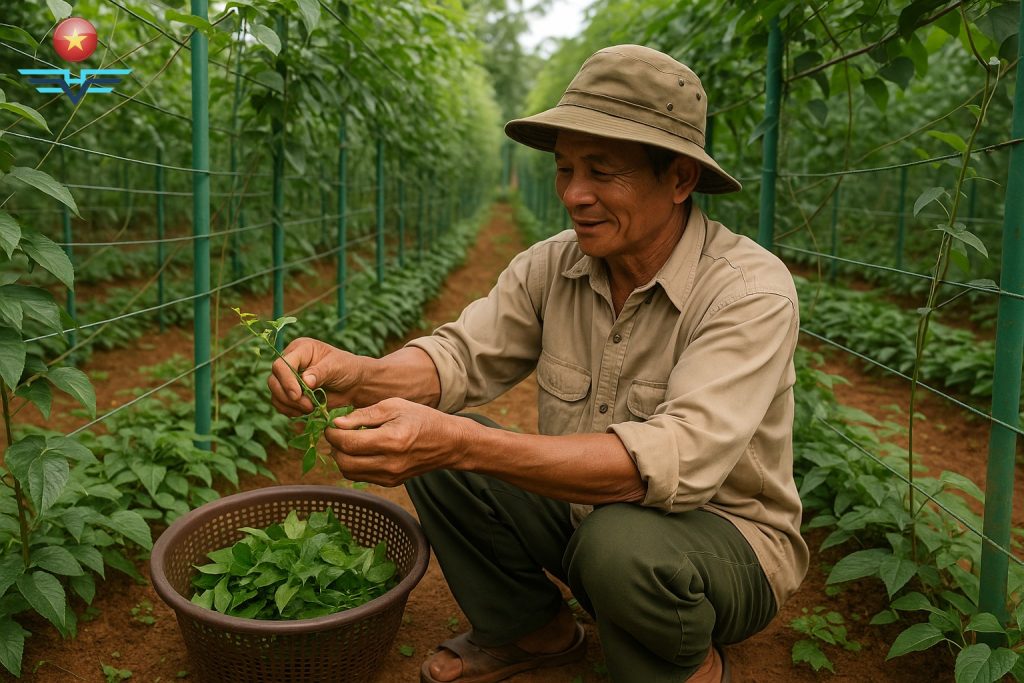
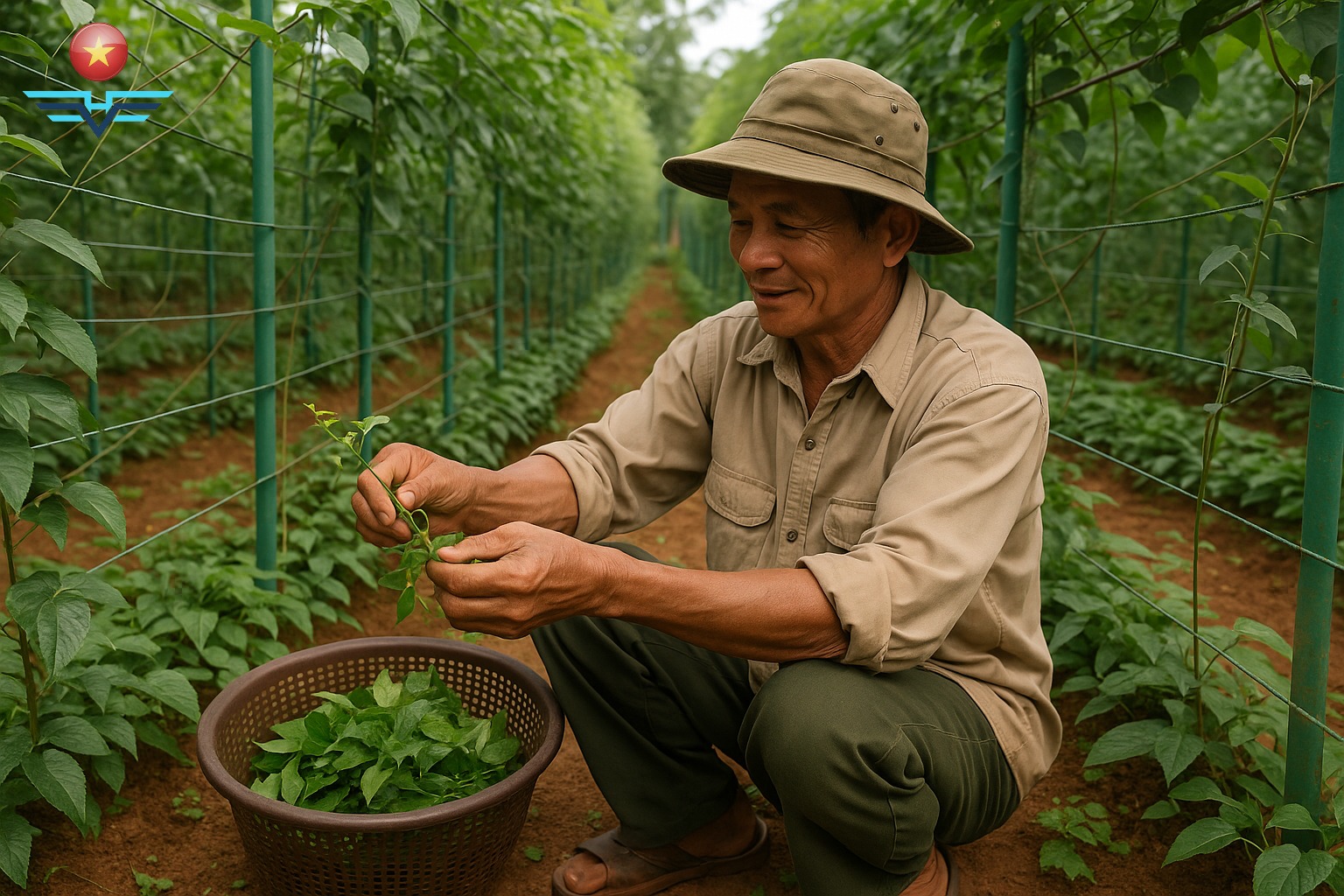
Nguyễn Văn Sơn, 58, of Hamlet 2, Phú Tân Commune, Định Quán District (Đồng Nai Province), once cultivated 1.5 hectares of coffee but suffered repeated losses as coffee prices collapsed.
Last year, seeing that ginseng was fetching a good price, he cut down his coffee trees and set up trellises to grow ginseng. Finding that it required little pesticide and was profitable, he has now switched to semi-intensive cultivation: using concrete posts and wire trellises.
Based on his experience, Sơn says wire trellises may not yield as much as wooden ones, but they allow multiple growing cycles without the extra labor of rebuilding the trellis each time. He notes that while ginseng does not require heavy capital investment, it does demand significant labor.
Currently, Sơn grows nearly 5,000 ginseng vines on more than 1,200 square meters. Each month he harvests twice, collecting about 100 kilograms. At today’s price in Định Quán—22,000 VND per kilogram—after expenses he nets nearly 2 million VND in profit. During the dry season he must irrigate constantly, but unless the ginseng is struck by pests, he would only face losses if the price dropped below 5,000 VND per kilogram.
In recent times, even at its lowest, ginseng prices have stayed between 10,000 and 12,000 VND per kilogram (and at times over 25,000 VND), so Sơn has avoided the financial hardship caused by the severe drop in coffee prices.
Meanwhile, the local coffee price has fallen below 5,000 VND per kilogram—roughly a loss of about 3,000 VND per kilogram. For this reason, in Phú Tân Commune and many other parts of Định Quán, farmers are returning to ginseng cultivation, viewing it as one of the most effective ways to earn a living.