
I. Origin of the Coffee Plant
Table of Contents
Coffee originated in the forests of Africa, on Ethiopia’s Kaffa highlands (1,370 – 1,830 m). From there it spread to other continents.
In Vietnam, French missionaries first brought coffee in 1857 as an ornamental plant. By the 1930s, it was planted on estates for bean production. Since then, the area, yield, and output of coffee in Vietnam have steadily increased.
II. Botanical Characteristics
1. Roots
Taproot: 0.3–0.5 m long, anchoring the tree.
Lateral roots: branch from the taproot, can reach 1.2–1.5 m deep, improving drought tolerance.
Feeder roots: concentrated in the top 0–30 cm of soil; absorb nutrients and water.
2. Trunk and Branches
Woody tree; if left unpruned can grow several meters tall. Primary (first-order) branches grow from the main stem; secondary (second-order) branches grow from primaries.
3. Leaves
Robusta leaves live 7–10 months. Good foliage is vital: leaves store starch that feeds flowering and fruiting.
4. Flowers
Emerge at leaf axils on primary and secondary branches, usually bloom at night and finish by early morning. Robusta is mostly cross-pollinated by wind and insects, so keeping honeybees helps fruit set.
5. Fruit
Usually 1–2 beans per cherry; development takes about 9–11 months depending on care.
III. Environmental Requirements
-
Temperature: ideal 22 – 26 °C
-
Light: prefers light shade; plant shade trees during the establishment stage.
-
Humidity: high, near saturation.
-
Rainfall: 1,800 – 2,000 mm annually with a short dry season to induce flowering.
-
Wind: hot, cold, or strong winds harm growth; windbreaks are recommended.
IV. Soil
Grows well on many soils (red basaltic, yellow, or gray), but thrives best in deep (>70 cm) red-basalt soils of medium to heavy texture.
V. Varieties
Main coffee species: Arabica, Robusta, and Excelsa.
High-yield Robusta lines from the Western Highlands Agro-Science Institute include:
TR5: 3.5 t/ha, 100-bean weight 20.6 g.
TR6: 5.6 t/ha, rust-resistant, 100-bean weight 17.5 g.
TR4: 7.3 t/ha, rust-resistant, 100-bean weight 17.1 g.
TR8: 4.2 t/ha, rust-resistant, 100-bean weight 17.6 g.
VI. Propagation
Select mother trees 6–8 years old with stable high yield and healthy, well-shaped cherries.
Sprout seeds in treated nursery beds or polyethylene bags (17 × 25 cm, with drainage holes).
Nursery soil: good topsoil mixed with well-rotted manure and superphosphate.
Maintain moisture and shade, gradually hardening seedlings to sunlight.
Seedlings ready for field planting: 6–8 months old, 25–35 cm tall, 5–7 pairs of true leaves, 3–4 mm stem diameter.
Grafting high-yield scions onto poor-quality rootstocks is also practiced to upgrade old plantations.
VII. Field Planting and Care
-
Planting time: early rainy season (May–June).
-
Spacing: 3 × 3 m on fertile flat land (≈1,100 trees/ha); 3 × 2.5 m on medium or sloping land (≈1,300 trees/ha).
-
Planting holes: 60 × 60 × 60 cm; mix topsoil with 10–20 kg compost, 0.5 kg superphosphate, and 0.5 kg lime.
-
Fertilization: each tree needs 10–15 kg organic manure yearly plus split applications of NPK through the rainy season.
-
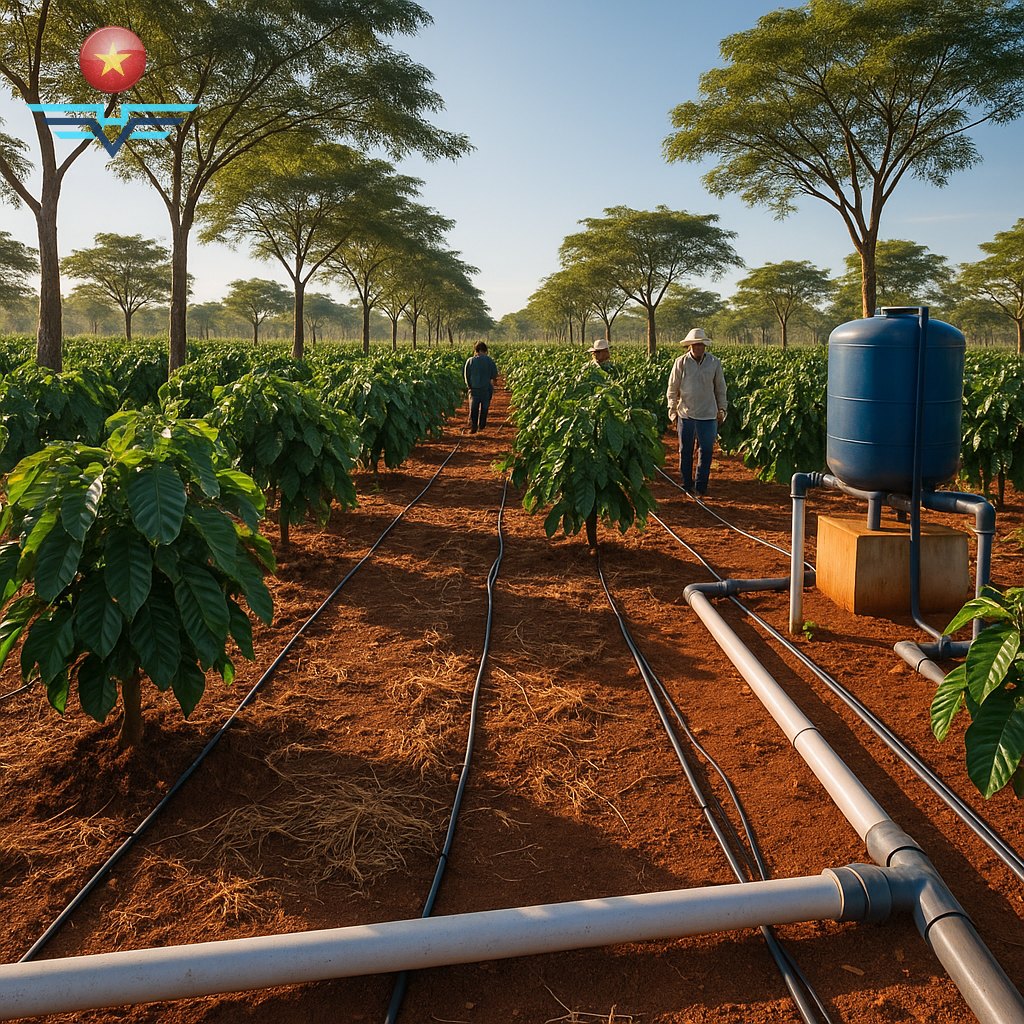
Irrigation: first watering when flower buds show “sparrow-beak” stage; then every 7–12 days depending on soil type, 150–200 L per tree. Mulch with straw or grass in dry season.
-
Pruning: maintain three main stems per plant; remove suckers and old, diseased, or overly dense branches. Old, unproductive trees can be rejuvenated by cutting back to 20–30 cm above ground and selecting 3 vigorous shoots.
VIII. Pest and Disease Management
Common problems:
Root collar rot (Rhizoctonia solani) – treat with fungicides like Validacin.
Branch and fruit anthracnose – control with fungicides such as Antracol or copper-based sprays.
Root-knot nematodes – improve organic matter, apply nematicides as needed.
Coffee leaf rust – spray copper or systemic fungicides (e.g., Anvil, Tilt).
Pink disease – prune and treat with Bordeaux mixture.
Insect pests: mealybugs, stem borers, fruit borers—monitor and spray recommended insecticides only when necessary.
IX. Safe Use of Pesticides
Follow the “four rights”: correct product, correct timing, correct dosage, correct method.
Wear protective clothing, avoid contamination of food or water, and observe safety intervals before harvest.
X. Harvesting, Processing, and Storage
Harvest: pick only fully ripe cherries to preserve flavor and prevent mold. Process the same day.
Processing:
– Wet method: pulp fresh cherries, ferment to remove mucilage, wash, and dry.
– Dry method: sun-dry whole cherries in thin layers (3–4 cm), turning frequently.
Storage: only store beans at ≤12.5 % moisture in clean jute bags in a well-ventilated warehouse away from walls and moisture.
This comprehensive guide outlines high-tech Robusta cultivation—from plant biology and variety selection through propagation, field management, pest control, and safe harvesting—to achieve high yields and quality beans.