
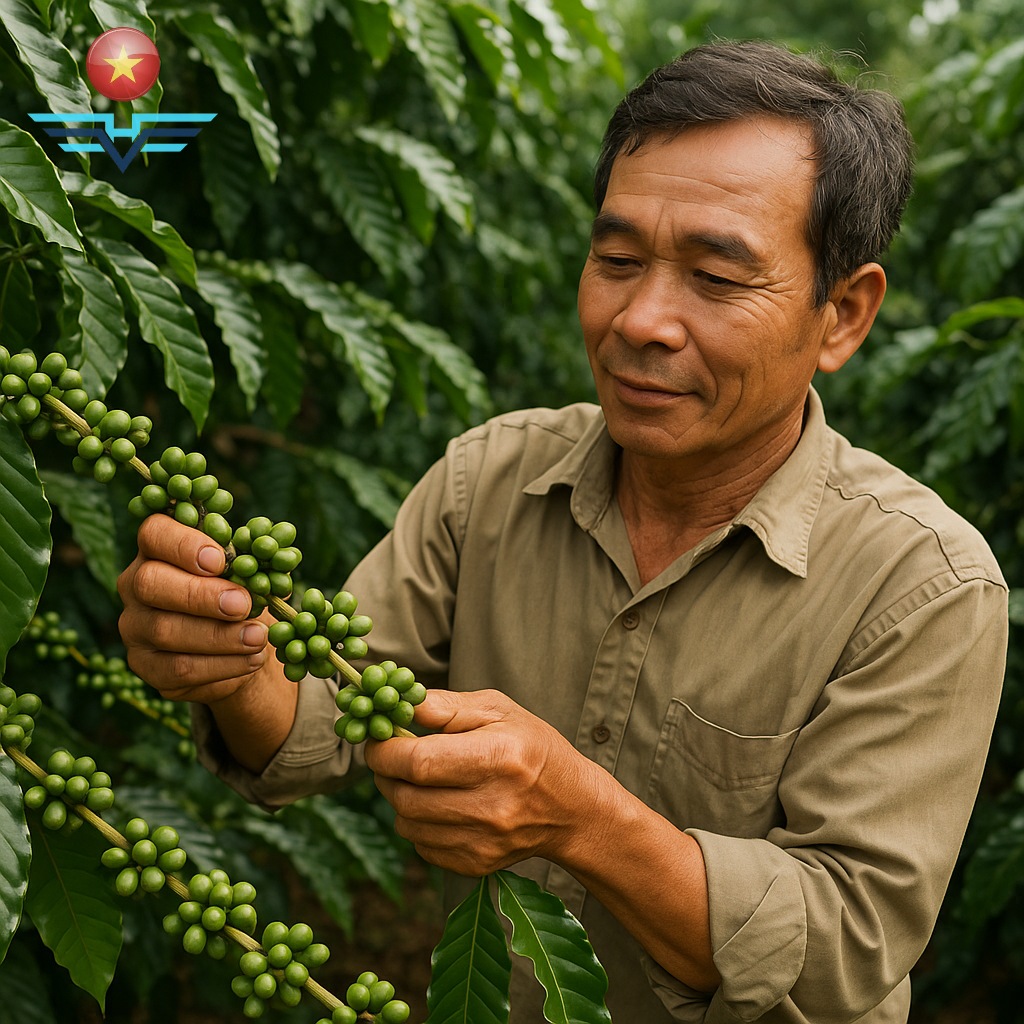
Nguyen Van Du, an agricultural officer at the Gia Lai Department of Agriculture and Rural Development, has developed a highly cost-efficient method of growing “clean” coffee that delivers excellent yields. His plantation produces about 25 tons of fresh cherries per hectare, while total annual costs are only about 25 million VND/ha. At current prices, this brings him a profit of over 70 million VND/ha each year.
Based on his practical experience, Du recommends the following key cultivation practices:
1. Careful Variety Selection and Skilled Pruning
Table of Contents
From the outset, choose high-quality planting stock. Throughout cultivation, apply modern pruning and canopy-shaping techniques promptly and correctly. This keeps the canopy healthy, balanced, and well-ventilated. Each year, select and graft buds from the “best” trees within the orchard to replace plants with small cherries, trees infected with coffee leaf rust, or those that set stubborn, hard-to-harvest fruit clusters. Grafting and shaping should be carried out as skillfully as a bonsai master.
2. Biological Disease Management
Du relies entirely on biological control, avoiding chemical pesticides. For trees infected with leaf rust, graft healthy, disease-free buds. To prevent branch dieback and fruit drop, provide balanced macro- and micro-nutrients and maintain a well-lit, airy canopy.
For sap-sucking pests such as scale insects and mealybugs, Du notes that ants are the main carriers. The insects excrete sugary honeydew that attracts ants, which then spread the pests and encourage sooty mold, reducing photosynthesis.
His effective method: mix 0.5–1 kg of raw pork fat (or rendered lard left to solidify) with one packet of Regent 1.6 g insecticide. Smear the mixture around coffee tree bases. Ants eat the fat and die, breaking the pest cycle and making harvest and maintenance easier.
3. Fertilization for High Yields at Low Cost
Du begins with a baseline target of 2 tons of green beans per hectare, which requires:
-
180 kg pure nitrogen (≈ 400 kg urea),
-
180 kg potassium as K₂O,
-
120 kg phosphorus as P₂O₅.
For every additional ton of green beans expected, add 70 kg nitrogen, 90 kg potassium, and 20 kg phosphorus.
-
For phosphorus, he prefers Văn Điển fused phosphate, which supplies lime and trace elements such as manganese, copper, zinc, and boron.
-
For nitrogen, apply 200–400 kg ammonium sulfate (SA) early in the year to provide sulfur; supply the remainder of nitrogen with urea.
4. Organic Matter and Soil Improvement
Use cattle or pig manure, green manure, or coffee husks. A fully husk-based method works well:
-
Apply about 60 m³ of coffee husks per hectare.
-
Pile the husks, soak thoroughly, and let them ferment for about two weeks to decompose and kill pathogens before spreading them under the trees.
Alternatively, wait for natural rainfall to start fermentation.
When pruning, cut discarded coffee branches into 20 cm pieces and scatter them in the tree basins. The decomposing branches and leaves add nutrients, improve soil aeration, and help suppress weeds.
5. Periodic Liming
Every 2–3 years, apply about 500 kg of lime per hectare to maintain soil pH and structure.
By combining high-quality plant material, precise canopy management, biological pest control, and cost-effective fertilization, Du’s approach keeps the plantation “clean,” lowers production costs, and consistently delivers high yields and strong profits