
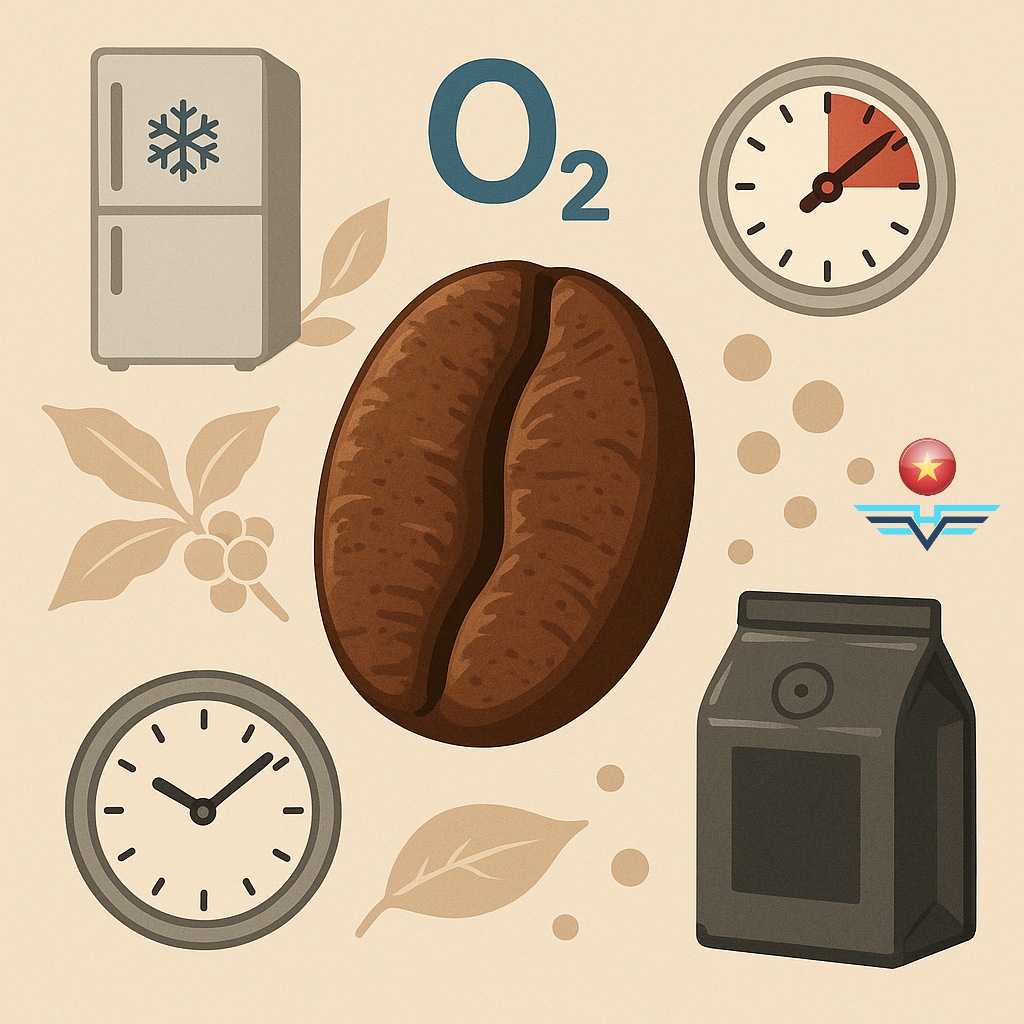
Freshness has been at the center of specialty coffee since the very beginning. It is one of the key parameters to control when introducing specialty coffee products. Recent trends in coffee are all about pursuing the best cup, and not only for specialty coffee—freshness has become a critical concern for mainstream coffee as well.
1. What is the Freshness of Roasted Coffee?
Table of Contents
Freshness in coffee is defined as retaining its original qualities without degradation. Specifically, we talk about the freshness of roasted coffee. Roasting creates the aromatic compounds that make coffee extractable, but it also destabilizes the bean. Once roasted, coffee becomes vulnerable to oxygen and begins releasing volatile aromas. Thus, roasted coffee is inherently unstable, constantly changing internally.
To understand freshness, we must first understand how and why freshness is lost. Four external factors play the most critical roles:
-
Storage Environment
Freshly roasted beans are saturated with volatile aromatic molecules that escape into any available open space. -
Oxygen
Exposure to oxygen degrades sensitive aromatic compounds and can oxidize coffee oils (lipids), producing rancid odors. Oil oxidation is slow inside the bean, but once oils migrate to the surface, rancidity occurs rapidly. -
Temperature
Both aroma diffusion and oxidation are accelerated by heat. The higher the temperature, the faster volatile loss and oxidation occur. In theory, at absolute zero, coffee would remain fresh indefinitely. -
Time
All degradation processes require time. The longer the coffee sits, the more freshness is lost.
Other factors like moisture and strong light also damage coffee quality. For example, higher moisture accelerates aroma loss in ground coffee.
Freshness can be categorized into two types:
-
Chemical Freshness – related to changes in aroma compounds.
-
Physical Freshness – related to degassing processes in roasted beans.
2. Chemical Freshness of Coffee
Aroma compounds in coffee are studied using gas chromatography/mass spectrometry (GC-MS), which separates molecules and measures their mass. Freshness indicators are ratios of certain aroma compounds. These help evaluate packaging, capsule materials, storage temperatures, and shelf life after opening.
For instance, four key aroma compounds develop differently during storage:
-
Methanethiol: garlic, cheesy, cabbage, rotten egg notes
-
Propanal: winey, earthy, cocoa, whiskey notes
-
2,3-Butanedione: buttery, creamy, sweet, vanilla
-
Methylpyrazine: nutty, chocolate, green, peanut
After two weeks, methanethiol may drop to 20% of its initial level, while others remain higher (e.g., 60% butanedione/propanal, 80% methylpyrazine).
With ~40–50 main aroma compounds, each behaving differently, coffee’s aroma profile evolves in complex ways. Some compounds (like beta-damascenone) may be pleasant at low concentrations (floral) but unpleasant at high concentrations (smoky).
Every coffee, roast style, and brewing method (espresso, pour-over, phin) has an optimal freshness peak.
3. Physical Freshness of Coffee
Degassing is the physical process where roasted beans release gases (mainly CO₂). Roughly 1% of roasted coffee mass is gas, released over 1–2 months. Degassing causes coffee bags to inflate, hence the use of one-way valves.
Roast style affects degassing: darker, faster roasts generate more gas that escapes faster. Origin and processing also play smaller roles.
Degassing directly impacts espresso crema and bloom in pour-over or phin brewing. Espresso crema is particularly dependent on gas content, and testing espresso shots at different degassing stages clearly shows how crema volume reflects freshness.
4. Tips for Preserving Roasted Coffee
Roasting: Fast or dark roasts produce more internal pressure, which can push oils to the surface, leading to rancidity. Avoid surface oils for optimal freshness.
Packaging: Best packaging prevents aroma loss and oxygen ingress while allowing CO₂ release through a one-way valve. For long-term storage, vacuum or nitrogen-flushed bags are ideal. For short-term (within a week), simple paper bags may suffice.
Storage: Keep coffee below room temperature. Aroma loss doubles with every +10°C rise. Exposure above 50°C can rapidly destroy aromas.
Brewing Adjustments: Degassing changes extraction behavior. Adjust brewing parameters based on bean age.
Freezing: Freezing coffee can extend freshness up to 10 times. Since roasted beans are low in moisture, no ice forms; freezing only slows chemical changes.
Always store in airtight bags to prevent odor absorption.
Let beans warm fully to room temperature before opening to avoid condensation.
Time” Ultimately, nothing can stop time. Enjoy coffee while it’s fresh. Optimal freshness depends on roast, brew method, coffee type, and personal taste. For example, cupping is best within 24 hours of roasting, but some coffees (like those used by the 2019 Indonesian Barista Champion) peak after 2 months/