
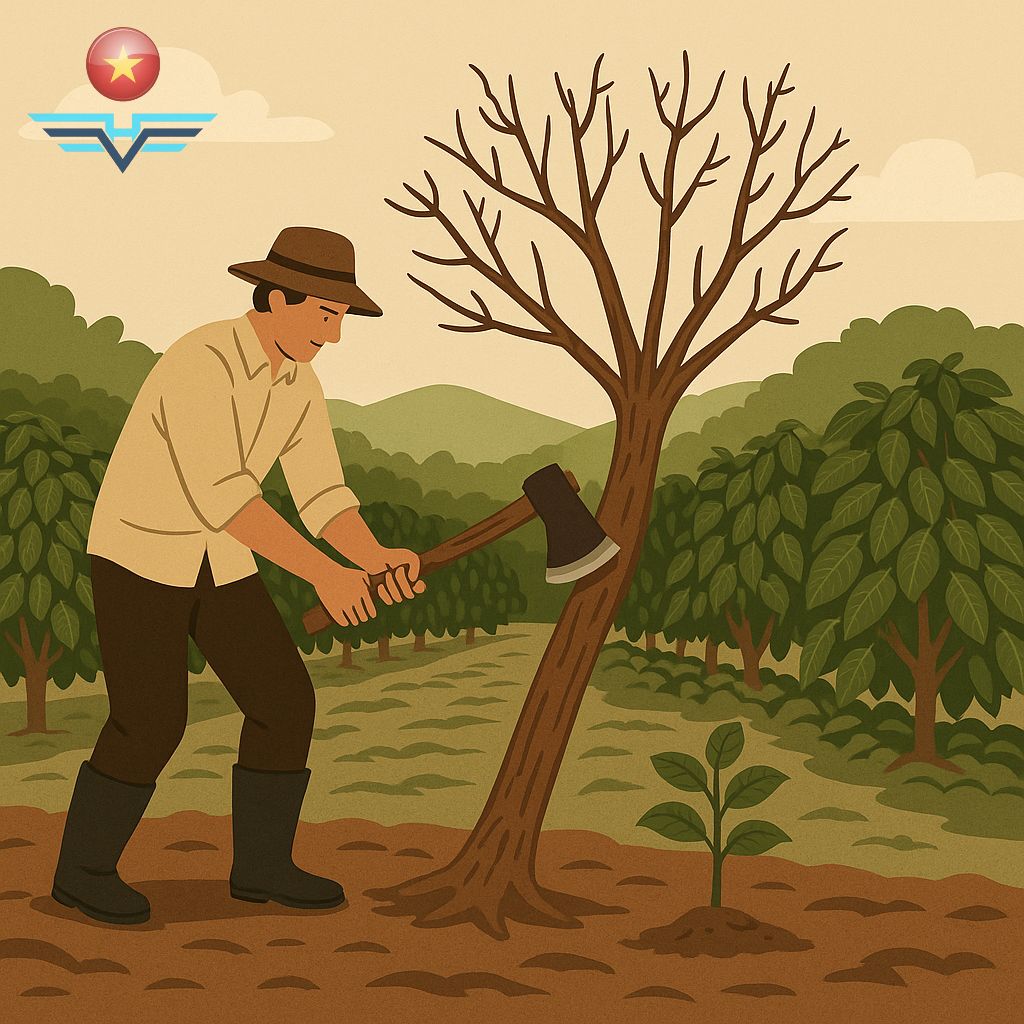
Ideally, replanting (coffee rejuvenation) should be carried out gradually each year in a rolling plan. But now the situation has become urgent. Without careful organization, coffee-growing households will face serious difficulties.
At a conference in Đắk Lắk on “Assessing 2010 Coffee Production and Solutions for Sustainable Coffee Development,” organized by the Department of Crop Production, many issues were discussed. One of the most pressing was coffee replanting.
For a long time we have focused only on planting and harvesting coffee, forgetting that coffee trees are aging. Preliminary surveys show that over the next 10 years, about 140,000–160,000 hectares of old coffee must be removed and replanted—a huge figure.
Planting new coffee requires at least three years (one year to plant and two years of care) before harvest begins. So how will farmers earn a living during those three years?
Replanting should ideally have been done gradually, but now the need is immediate. Without good planning, coffee farmers will struggle.
The Department of Crop Production (Ministry of Agriculture and Rural Development) has already issued an official replanting protocol for Robusta coffee, with clear technical guidelines that farmers should follow closely.
To ease the hardship during the replanting phase, a few measures can help farmers maintain income:
-
Intercropping with quick-yielding trees.
If the existing coffee can be kept for a few more years, introduce high-value intercrops such as macadamia or avocado. These grafted varieties bear fruit in about three years—just as the old coffee is ready to be removed—providing income while the new coffee is established.In the Central Highlands, trials of macadamia and avocado intercropped with coffee have shown very promising results. For example, at the farm of Trịnh Xuân Mười in Hòa Thắng commune (Buôn Ma Thuột), and at Nguyễn Ngọc Đức’s orchard in Ea Tiêu (Cư Kuin district), a single “four-season” avocado tree can yield over 20 million VND per year. Such crops can greatly ease the transition when old coffee is removed and replanted.
-
When coffee must be completely removed.
On plots where trees are too old or heavily damaged by nematodes, total removal is necessary. Farmers should uproot all trunks, branches, and roots immediately after harvest, collect and remove them from the field, then plough and expose the soil to sun. Plant a different crop on that land for at least two years before replanting coffee.A particularly good interim crop is new-variety cotton. Cotton takes only about four months from planting to harvest and offers excellent yields and strong income compared with many other crops.
By combining careful replanting with short-term, high-value intercrops, farmers can maintain income and make the transition to new coffee plantings more sustainable and less risky.