
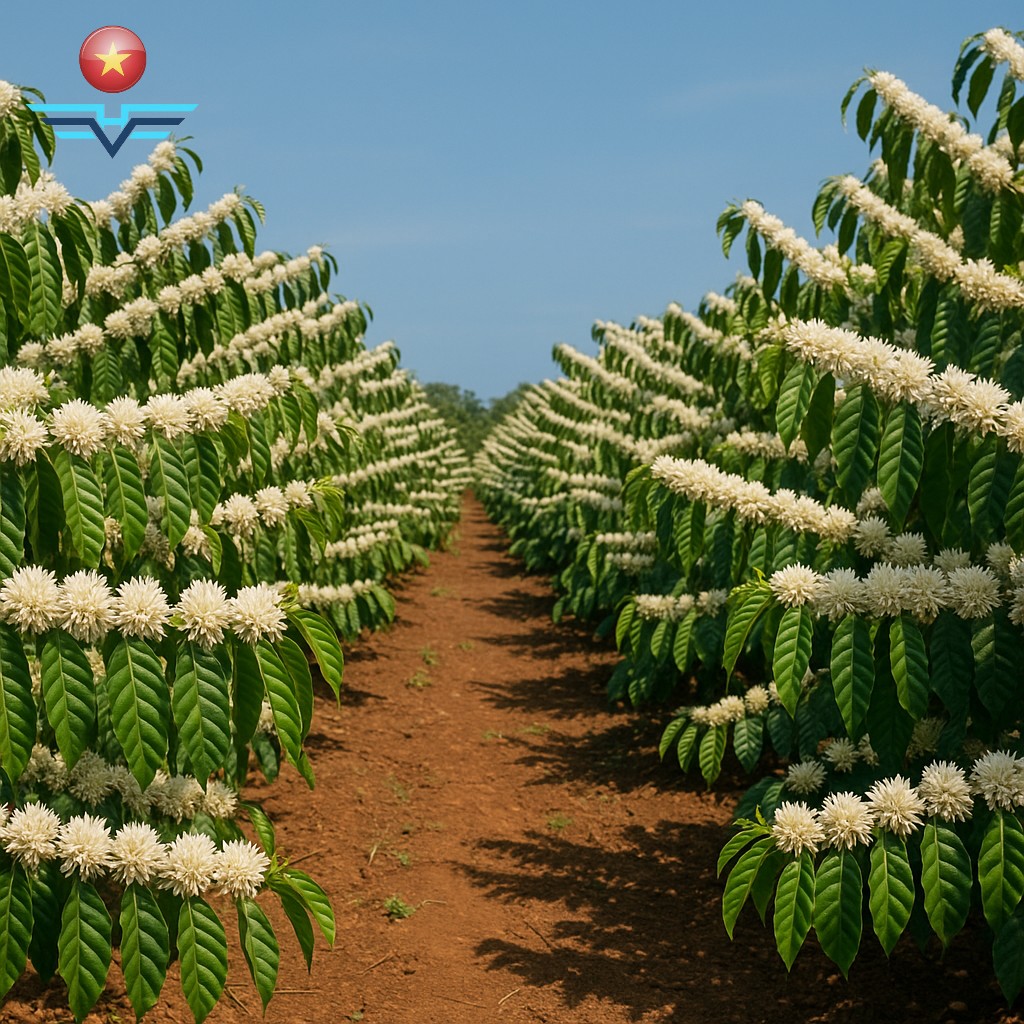
At a national conference held in late April 2011 in Buon Ma Thuot (Dak Lak) to review 2010 coffee production and discuss sustainable development strategies, Lam Dong was identified as one of the Central Highlands’ four key coffee-growing provinces (alongside Dak Lak, Dak Nong and Gia Lai).
Yet the same conference urgently called for a fundamental “transformation” in how Lam Dong develops its coffee sector to ensure long-term sustainability.
A Challenging National Target
The Ministry of Agriculture and Rural Development (MARD) set a national target: by 2030, Vietnam’s coffee area should be reduced from the current 555,065 ha to about 480,000 ha, while maintaining the present output of roughly 1.1 million tons of green coffee beans. For Lam Dong—together with Dak Lak, which alone accounts for 190,765 ha—this directive requires careful strategic adjustments.
According to Lam Dong’s Department of Agriculture and Rural Development, about 40,000 ha of coffee plantations are already old and producing low yields. Another roughly 15,000 ha—though younger than 20 years—are showing signs of decline because they were planted in unsuitable soils. These areas must either be converted to more suitable crops or replanted with new, higher-yielding coffee varieties. Across the entire Central Highlands, an estimated 30 percent of the region’s nearly 500,000 ha of coffee will need to be replaced.
The province’s master plan calls for stabilizing coffee acreage at about 135,000 ha by 2015 and through 2020—down nearly 8,000 ha from the present 142,900 ha—while focusing on high-tech agriculture and new coffee cultivars. But with coffee prices surging in recent years, persuading farmers to uproot or replant around 50,000 ha of aging trees will be far from easy.
Vietnam’s Global Role, Limited Pricing Power
Since 1986, Vietnam’s coffee industry has expanded rapidly—averaging 10.6 percent annual growth in area and 3.4 percent in yield. Today, Vietnam is the world’s second-largest coffee producer and exporter, accounting for roughly 18 percent of global coffee trade. Yet experts note that despite this scale, Vietnam has little influence over world prices because most of its beans are sold through foreign intermediaries before reaching roasters.
High Stakes for Lam Dong
Lam Dong currently has about 142,900 ha of coffee, with roughly 135,500 ha in production, placing it among the country’s top producers. But to help Vietnam cut total coffee area to 480,000 ha by 2030 while keeping output above 1.1 million tons, Lam Dong—like the other key Central Highlands provinces—must embark on a true “overhaul.”
That transformation hinges on improving quality from start to finish: from planting material and cultivation techniques to harvesting and processing. Only by raising quality at every stage can Lam Dong’s coffee industry remain competitive and contribute to a sustainable, globally respected Vietnamese coffee sector.