
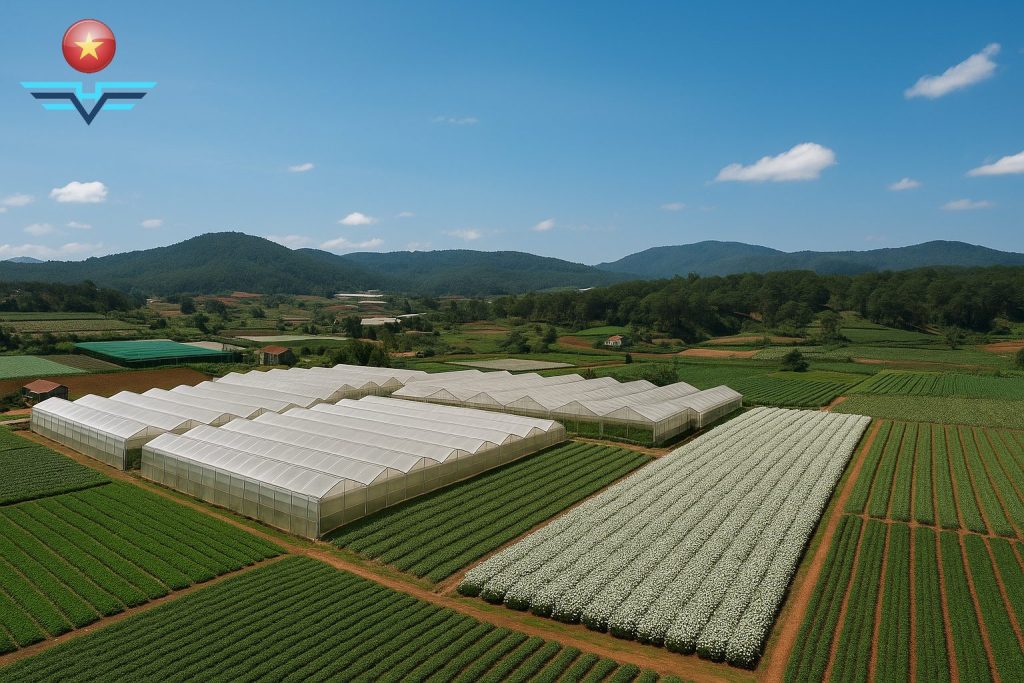
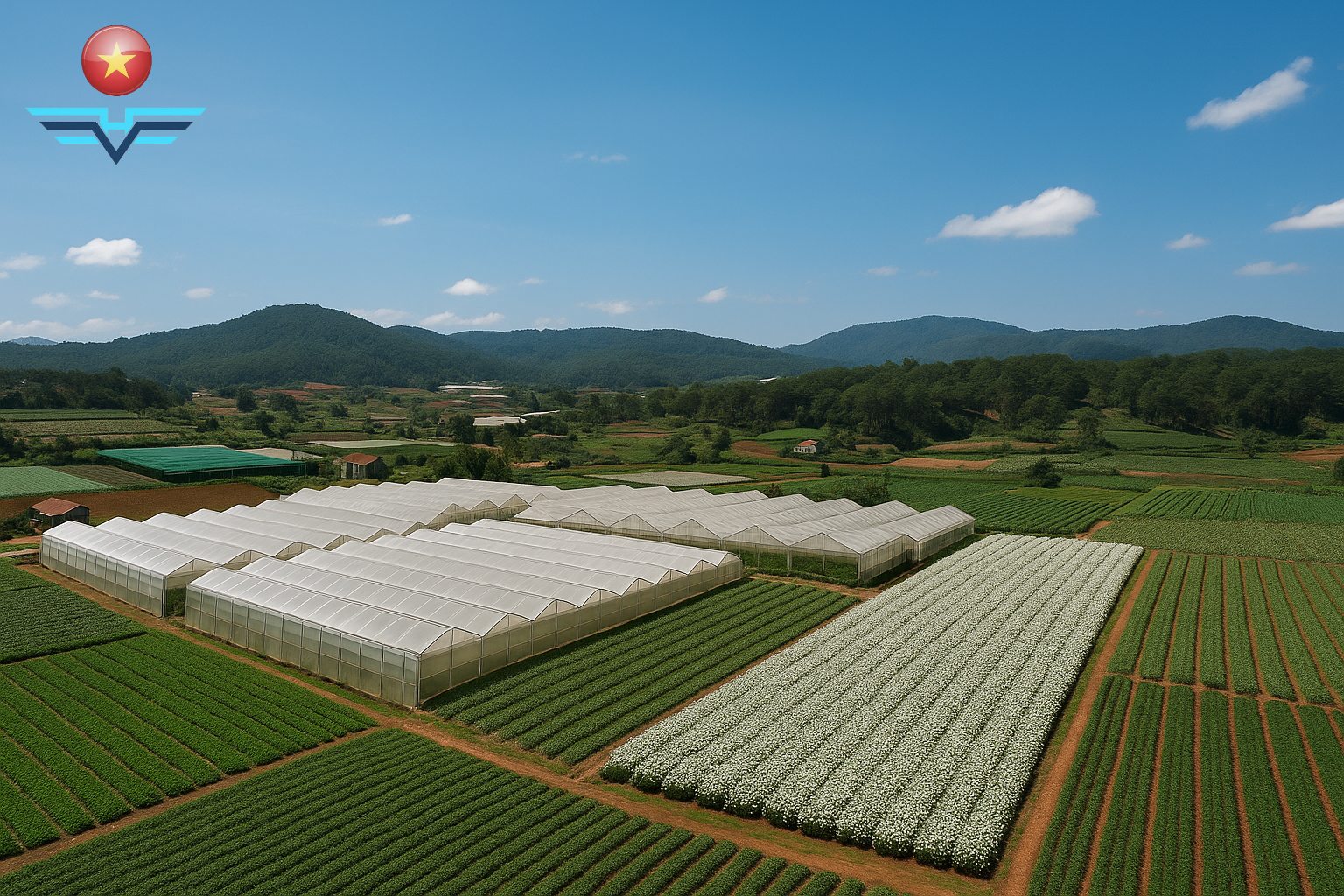
Located in the southern Central Highlands, Lam Dong province enjoys ideal conditions for agriculture thanks to its climate and fertile soils, supporting high-value crops such as vegetables, flowers, tea, and coffee. Since 2004, the province’s High-Tech Agriculture (HTA) program has significantly boosted local socio-economic development.
Revenue Calculated by the Square Meter
From 2004 to 2010, Lam Dong invested nearly 3 trillion VND in high-tech agriculture, with less than 38 billion VND from the state budget and the rest mobilized from farmers and private investors. Early on, only a few foreign-invested enterprises (FDI) grew several dozen hectares of vegetables and flowers in Da Lat. Today, thousands of hectares across the province are cultivated using modern methods. Local brands such as Da Lat vegetables and flowers, B’lao tea, Di Linh coffee, Cat Tien rice, and Laba bananas are now well-recognized.
The province hosts 58 tissue-culture facilities applying biotechnology in seedling production, employing nearly 500 skilled technicians and engineers—more than 150 with university or higher degrees—along with thousands of experienced farmers.
Thanks to natural advantages, Da Lat has made breakthroughs in productivity and product quality. Its vegetables and flowers are not only popular domestically but are exported worldwide. Dalat Hasfarm began with 2.5 hectares of greenhouses growing high-tech flowers for export and has now expanded to a 300-hectare farm, including 70 hectares of state-of-the-art greenhouses with automated systems for light, temperature, humidity, fertilizing, and irrigation.
After nearly 20 years, Dalat Hasfarm has become the leading flower producer in Southeast Asia in both area and output. By 2011, the company cultivated over 300 flower varieties, producing 90 million stems annually, with 65% exported to markets such as Japan, Thailand, Australia, Taiwan, and Cambodia.
Langbian Farm is another pioneer, employing biotechnology specialists, importing foreign flower varieties, and even marketing online for decades. The farm now spans 30 hectares of flowers—7 hectares in greenhouses—and runs a tissue-culture lab with 70 workers, including 15 agricultural and biological engineers.
Since 1995, cooperatives in Da Lat have adopted Integrated Pest Management (IPM) and later GAP standards to produce clean, high-value vegetables. Xuan Huong Cooperative grows dozens of imported vegetable varieties, earning 1–1.5 billion VND per hectare annually, with lettuce reaching 2.5 billion VND per hectare. Dalat GAP produces about 350 tons of vegetables per year, including 200 tons of sweet peppers exported mainly to Japan. Other clean vegetable producers sell through major distributors like Co.opMart and Metro.
In Da Lat, large-scale farming using high-tech methods for flowers and vegetables is now common. Flower cultivation in particular yields extraordinary revenue—measured not per hectare or per acre, but sometimes by the square meter.
High-Tech Agriculture Across the Province
In Duc Trong district, many enterprises use high-tech irrigation and polymer-covered fields, generating 100–200 million VND per hectare, while net-house farming reaches 200–300 million VND and greenhouse production up to 300–500 million VND per hectare per year. Eight enterprises in Duc Trong have been certified for safe vegetable production, including Bo Cong Anh Co., Quoc Te JSC, and several cooperatives and family farms.
According to the provincial Department of Agriculture and Rural Development, Lam Dong has nearly 11,000 hectares of high-tech cultivation: 7,205 hectares of vegetables and 2,586 hectares of flowers, including 1,696 hectares of greenhouses, 604 hectares of net houses, and 5,289 hectares of automatic outdoor irrigation. The province has also replanted or grafted thousands of hectares of aging coffee trees, planted high-yield tea, cocoa, and fruit trees, and developed dairy farming and cold-water fish.
High-tech cultivation delivers far greater value than traditional methods: premium vegetables yield about 400 million VND per hectare annually—double the provincial average—while premium flowers yield 800 million to 1 billion VND per hectare—about 1.6 times the average.
Alongside vegetables and flowers, tea remains a key crop. Lam Dong has 23,876 hectares of tea, with an average yield of 8.5 tons of fresh buds per hectare and total production of around 200,000 tons annually. High-quality tea cultivation has expanded steadily since 2004, with 4,837 hectares of high-yield, high-quality tea now in production.
The province hosts 22 foreign and 11 domestic enterprises investing in premium tea, cultivating 1,361 hectares, of which 113 hectares are certified VietGAP. Revenue from high-quality tea reaches 200–250 million VND per hectare annually, with profits of 70–90 million VND—ten times higher than traditional tea varieties.
Transforming the Rural Economy
After eight years of the HTA program, Lam Dong’s agricultural productivity and quality have improved markedly. Average agricultural output value rose from 27 million VND per hectare in 2003 to 80 million VND in 2011. Though high-tech cultivation covers only 3% of farmland, it contributes 18–20% of total agricultural value, driving economic restructuring and helping thousands of households escape poverty and even become millionaires.
Lam Dong continues to expand high-tech agriculture in vegetables, flowers, tea, coffee, dairy, and cold-water fish, aiming for high-tech farming to cover more than 10% of cultivated land by 2015 and raise agricultural output to over 100 million VND per hectare—paving the way for sustainable rural development and prosperity.