
At first glance, the civet seems unrelated to coffee production, but thanks to this animal, Vietnamese coffee processors can find a model for sustainable development in the coffee industry.
For nearly a year, world and domestic coffee prices have dropped far below production costs. This prolonged price slump is the final push compelling Vietnam’s coffee industry to shift toward sustainable production after more than a decade of rapid expansion in acreage, output, and exports.
Civet Coffee and Wet Processing
According to popular legend, civets pick and eat only the ripest coffee cherries. The beans inside the cherries pass through the civet’s digestive tract without being digested. After collection, these beans are roasted and ground, producing the famous and exceptionally aromatic “civet coffee,” known to many by reputation but tasted by few. In reality, what many cafés sell as “civet coffee” is usually just regular roasted coffee infused with artificial civet-like flavors.
Civet coffee’s unique taste comes from natural fermentation inside the civet’s stomach, where digestive enzymes act on the cherry pulp. The civet digests only the fruit’s flesh and skin, leaving the beans intact. Another key factor is that civets eat only fully ripe cherries, so these beans are inherently of very high quality.
Early in the 20th century, the French introduced to Vietnam the wet-processing method of removing the pulp and skin of coffee cherries to extract the beans—essentially imitating the civet’s digestive process.
Wet processing requires harvesting only fully ripe cherries and using water to separate pulp and skin, unlike the traditional dry method used for decades, in which farmers strip both ripe and unripe cherries from branches, sun-dry them, and then mechanically remove the husk.
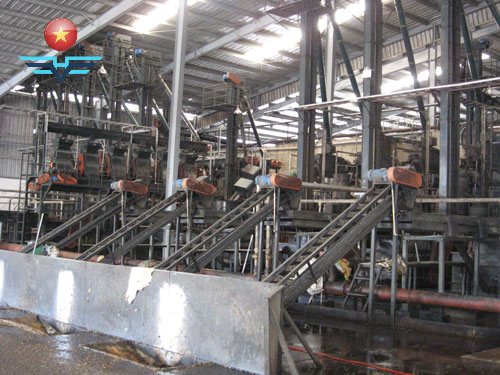
Although Vietnam has become a major coffee exporter in the past decade and many companies have invested in wet-processing machinery to improve quality, these machines often remain idle. The reason: farmers traditionally pick both ripe and unripe cherries at once—a faster method that is hard to change.
Processors are also hesitant. If dry-processed coffee can still be exported, few want to risk investing in wet processing without guaranteed buyers.
Changing Habits to Increase Value
After more than a decade of rapid growth in acreage and output, Vietnam’s coffee industry has focused on quantity rather than quality and brand building. When coffee prices collapsed, both farmers and companies suffered.
Nguyen Van An, General Director of Thai Hoa Group, one of Vietnam’s major coffee exporters, notes that within just ten years, the industry endured two major price crises: a coffee surplus from 2000–2004 and the global financial downturn, which has depressed coffee prices since last year.
To grow sustainably, Vietnam’s coffee sector must shift from expanding acreage to increasing export value by improving quality, harvesting practices, and processing, while building strong brands. “Wet processing is the simplest way to enhance coffee quality and value,” An says. His company achieves prices 15–20% higher for wet-processed coffee compared with dry-processed coffee.
But veteran coffee expert Doan Trieu Nhan, a founder of the Vietnam Coffee and Cocoa Association, emphasizes that shifting from dry to wet processing requires changing not only farming practices but the entire coffee supply chain.
An adds that farmers must first change harvesting habits: selectively picking only ripe cherries, even though it requires more labor, because higher prices will offset the effort. “If farmers harvest only ripe cherries, Vietnam’s coffee output could increase by 10%—over 100,000 tons per year—without expanding acreage. This would add about 150 million USD in revenue to the industry,” he explains.
Companies must also invest in wet-processing plants and change their buying practices. Currently, most factories buy de-husked beans and simply clean them for export. To wet process, they must buy fresh ripe cherries and install specialized equipment.
Nhan estimates that if all of Vietnam’s annual 1 million tons of export coffee were wet processed, its selling price would rise 15–20%, adding roughly 250 million USD in value. Combined with the extra 150 million USD from increased yields through selective harvesting, total industry income could increase by about 400 million USD—without expanding the planted area.
Moving Toward Sustainable Coffee
Recognizing the need for sustainable production, the Ministry of Agriculture and Rural Development plans to present a national coffee development plan (2010–2015, vision to 2020) focusing on sustainability: no increase in acreage, limiting Robusta replanting, and expanding higher-value Arabica.
The Institute of Policy and Strategy for Agriculture and Rural Development (IPSARD) and the Vietnam Coffee and Cocoa Association (Vicofa) are proposing the creation of a Coffee Sector Coordination Board, modeled after successful coffee supply chains in Brazil and Colombia. This board would advise on policy, provide market information, and coordinate production, processing, and trade across the entire coffee value chain—linking farmers, farmer associations, companies, scientists, and government agencies to implement sustainable development strategies.
In 2009, Vietnam’s coffee area reached 537,000 hectares—up 48,000 hectares from 2008—growing by about 2.5% annually in recent years. Although a relatively young agricultural industry compared with rice, rubber, or tea, Vietnam’s coffee sector has developed rapidly. From negligible output and export value before 1990, the country has become the world’s second-largest coffee exporter (14% of global production) and the largest exporter of Robusta coffee. Coffee is now one of Vietnam’s five key agricultural exports, with over 1 million tons exported annually and nearly 2 billion USD in export value—second only to rice among agricultural commodities.