
1. Concept of the Derivatives Market
Table of Contents
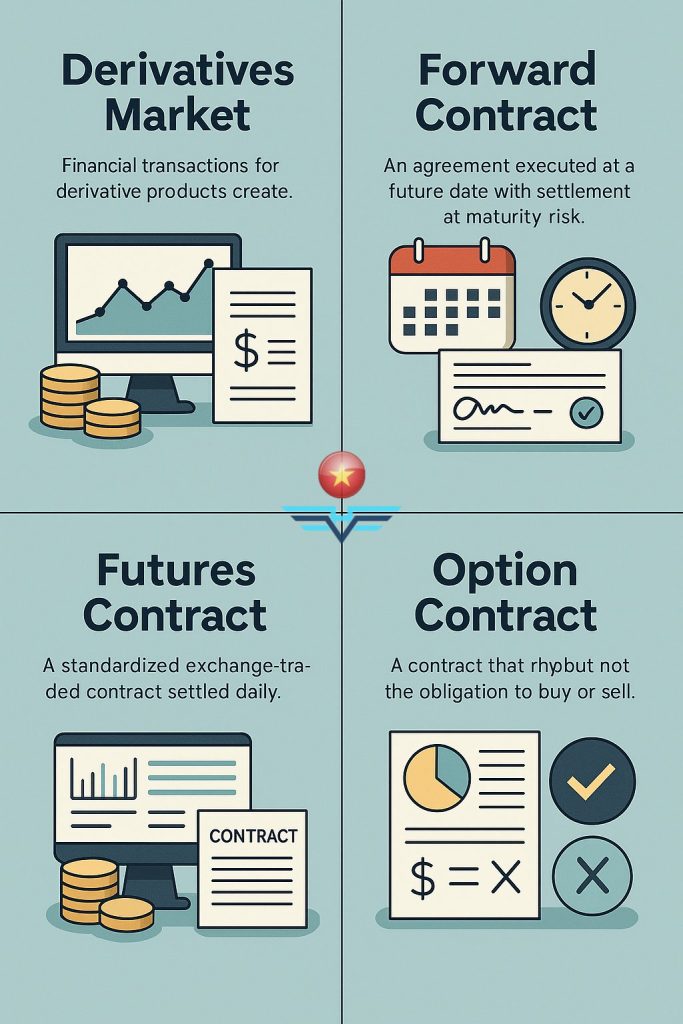
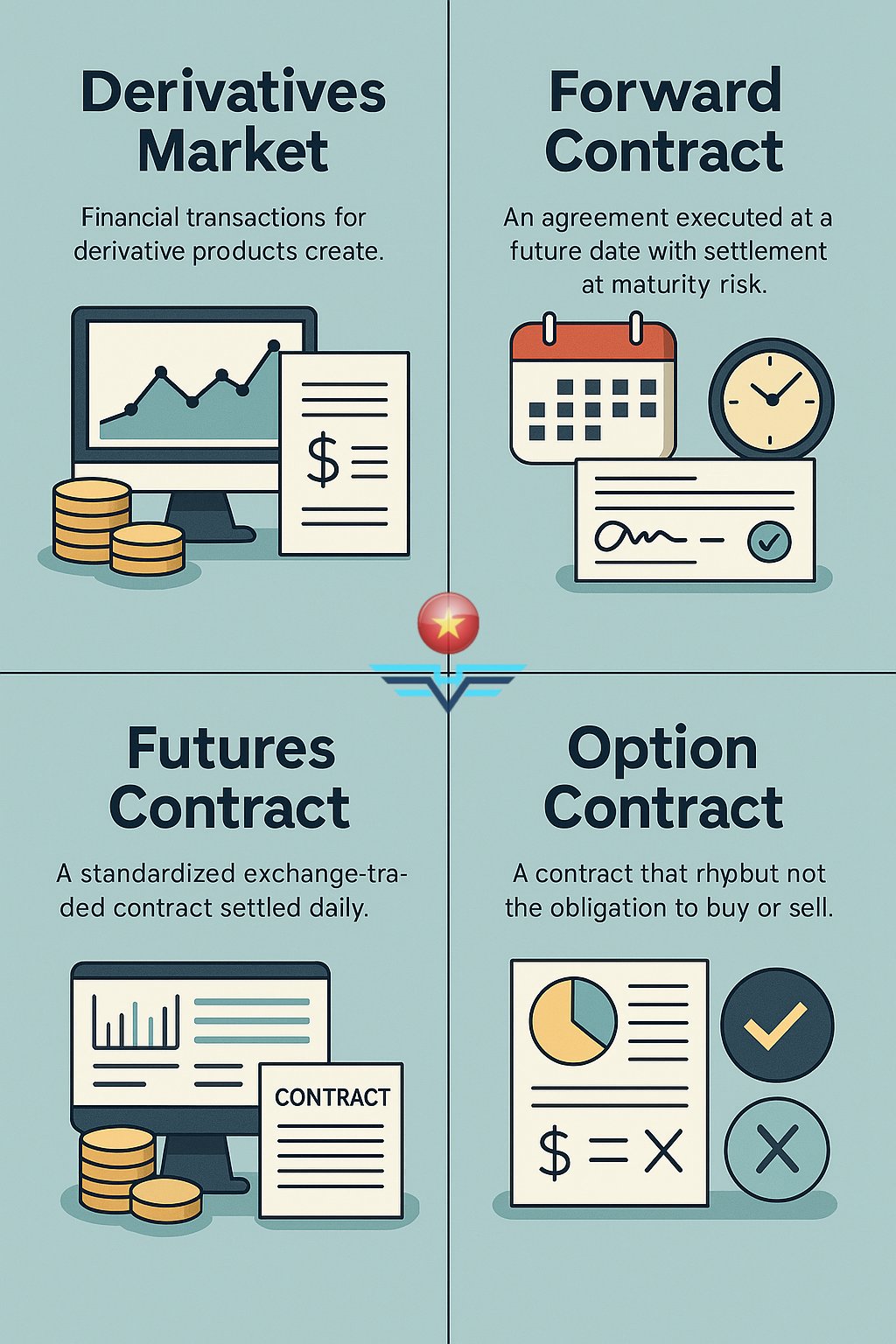
The derivatives market is a marketplace where derivative contracts are created, signed, and traded.
A derivative product is a financial instrument whose value is derived from another underlying asset (such as bonds, stocks, currencies, or commodities). The value of a derivative depends on the fluctuations in the value of its underlying asset.
Derivative financial instruments are used to transfer unwanted risks to counterparties who are either able to offset those risks or willing to assume them.
2. Basic Types of Coffee Derivatives
The coffee derivatives market includes four main types of contracts: forwards, futures, options, and swaps.
Forward Contract
Definition
A forward contract is an agreement between a buyer and a seller made in the present, but executed at a specific future date. The value of the contract is settled only on the maturity date, with no payments made at signing or during the contract period.
Characteristics
-
Traded over-the-counter (OTC), not on an exchange.
-
Terms are flexible and privately negotiated.
-
High liquidity risk, as participants may find it difficult to resell the contract.
-
High settlement risk because both parties must transact at the pre-agreed price at maturity, regardless of market price changes.
-
Usually based on trust and relationship between the parties.
Futures Contract
Definition
A futures contract is a standardized contract traded on an exchange. Its value is marked-to-market daily, meaning losses from one party are transferred to the other as the market moves.
Characteristics
-
Traded on organized exchanges through brokers.
-
Contract terms are standardized.
-
Both buyers and sellers must post margin deposits.
-
Most futures contracts are closed out before the delivery date.
Option Contract
Definition
An option is a contract between a buyer and a seller that gives the buyer the right, but not the obligation, to buy or sell an asset in the future at a predetermined price. The buyer pays the seller a premium, which is the cost of the option.
Characteristics
-
Types:
-
Call option: the right to buy.
-
Put option: the right to sell.
-
-
Styles:
-
American option: exercisable anytime before expiration.
-
European option: exercisable only at expiration.
-
-
Traded on both organized and OTC markets.
Swap Contract
Definition
A swap contract involves a series of regular payments exchanged between two parties at future dates, based on an agreed price or rate. Most swaps do not require an upfront payment, making their initial value effectively zero.
Characteristics
-
Settled through netting, reducing credit risk by offsetting payment obligations.
3. Coffee Futures Contracts
Among all derivatives, coffee futures contracts are the most common. They are traded on two major global exchanges:
-
ICE (Intercontinental Exchange) in New York.
-
LIFFE NYSE in London.
A coffee futures contract is a standardized binding agreement to deliver or receive a specific quantity and type of coffee at a fixed future date and price.
-
The buyer is obligated to take delivery of coffee at the agreed terms.
-
The seller is obligated to deliver the coffee.
In practice, most coffee futures contracts are not physically settled. Instead, traders close their positions by making opposite transactions in the market before delivery.
-
Buyers sell back their contracts.
-
Sellers buy back their contracts.
This process eliminates delivery obligations.
4. Margin Requirements for Coffee Futures
To ensure contract performance, exchanges require participants to deposit initial and variation margins.
-
The initial margin acts as a security deposit to guarantee financial responsibility.
5. Leverage
A major attraction of trading coffee futures is leverage.
Because futures trading requires only a small margin deposit, investors can control large contract values with relatively little capital.
Example:
A trader buys one Arabica coffee futures contract (37,500 lbs ≈ 17 tons) with a margin deposit of $3,000.
-
If the entry price is 150 cents/lb (contract value = $56,250)
-
And the trader sells when the price rises to 165 cents/lb,
→ The profit = (15 cents × 37,500 lbs) = $5,625,
which equals 187.5% of the initial margin.
This demonstrates the power of leverage — it can generate significant gains.
However, the downside is equally strong: if prices move against the trader, they can lose their entire margin or even more if proper trading discipline is not maintained.