
Our ancestors used to say, “A steady drip can wear away stone,” meaning that small, unnoticed losses can add up to great damage. This is exactly true in a common situation faced by coffee processors that often goes unnoticed.
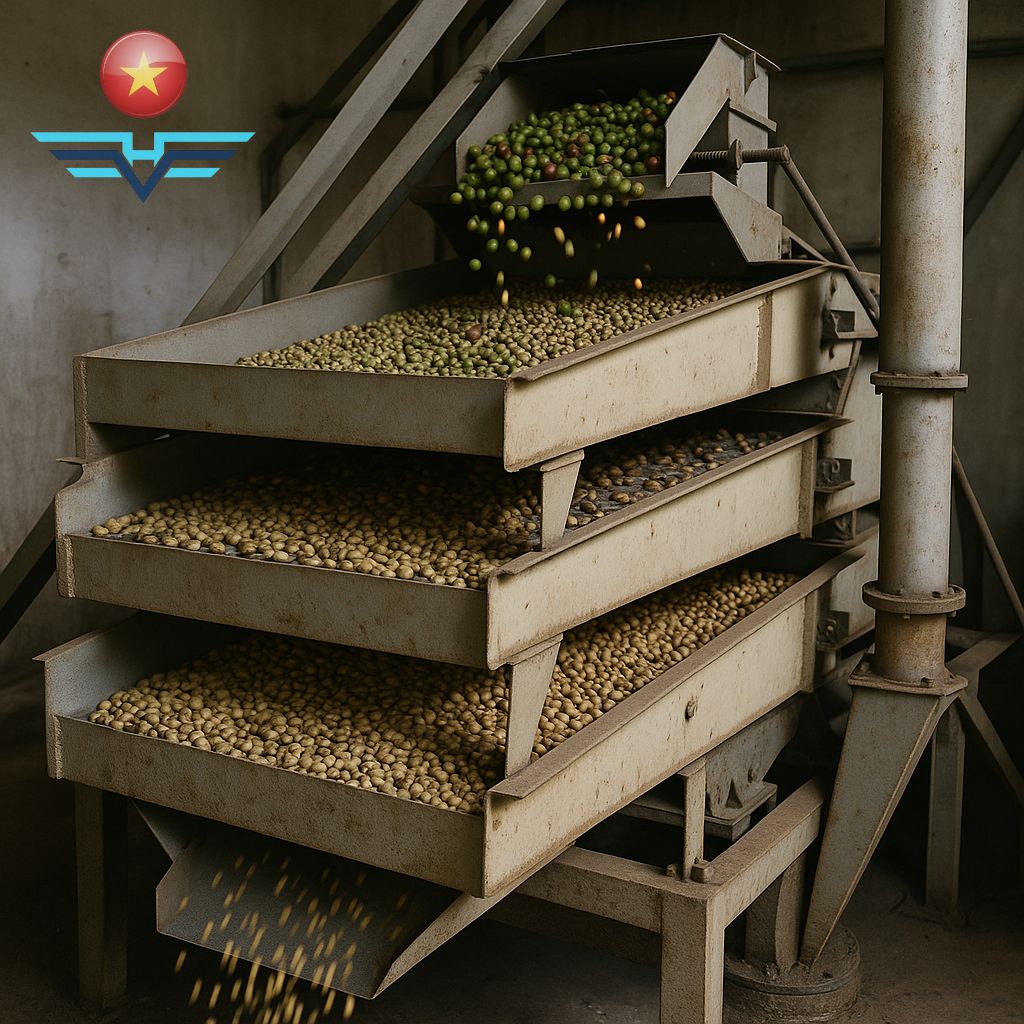
We would like to highlight a real problem currently occurring in the grading stage (Coffee Grader) for everyone to examine. Here, we focus on two commonly used R1 grading screens: the 18-screen with 7.1 mm holes and the 16-screen with 6.3 mm holes in processing plants.
Inaccuracy Caused by Outdated Equipment
Table of Contents
In practice, some factories still operate old grading machines whose vibration strength is imprecise—either too strong or too weak. To obtain beans of 6.3 mm size, operators often install mesh screens with hole diameters of 6.7 mm. Why? Because with these machines, if they use the correct 6.35 mm mesh, the 16-screen R1 batch will contain over 10% beans that should be classified below size 13. Customers will not accept this.
To prevent more than 10% of undersized beans from mixing into the 16-screen, they resort to using mesh with 6.7 mm holes.
The consequence of using 6.7 mm or larger holes is that many beans sized between 6.3 mm and 6.7 mm fall through to the 13-screen (5 mm). You can verify this yourself: check the 13-screen output and see how many 16-screen beans it contains. Our tests at multiple plants still using 6.7 mm mesh found that about 20% of 16-screen beans end up in the 13-screen batch—when it should be only about 3%.
This means you are losing 17% of R1 beans without getting paid for them.
Imagine that in one day you produce 100 tons of R2 (13-screen). You are losing about 17 tons of R1 (16-screen) beans, which should be sold at a higher price.
Just one month of production at this loss is enough money to buy a precision grader that can maintain only about 3% of this mix, because such a machine uses the correct 6.35 mm mesh to capture 6.3 mm beans.
Machines with Incorrect Vibration Speed or Amplitude
On the market today, there are also newer coffee graders—not just old models—but some are poorly made. Their vibration speed or amplitude is not calibrated accurately. The manufacturers may be skilled in mechanics but lack expertise in coffee processing.
As a result, when they install mesh with the correct 6.35 mm hole size, the 16-screen output still fails to meet customer requirements, as it contains too many beans from the 13-screen.
To achieve high throughput and avoid undersized beans mixing into the larger screen, operators again install mesh with larger holes. The result is the same financial loss described above.
Similar Problems with R1 18-Screen (7.1 mm)
The same issue occurs with R1 18-screen (7.1 mm). You should use a standard 18-screen to check the 16-screen batch and see how many 18-screen beans are mixed in. A highly accurate machine must be fitted with mesh holes exactly 7.1 mm—the precise size of the standard screen—with no tolerance. Only then can you avoid losing 18-screen beans into the 16-screen batch.
A Simple Check
To know whether this problem exists in your facility, use a 16-screen sample to check the 13-screen coffee output. If you find that more than 3% of 16-screen beans are mixed into the 13-screen batch, congratulations. But if the figure is greater than 10%, review your grading machine immediately to avoid losing R1 beans that are being sold at the lower 13-screen price.
We wish your plant safe and efficient operation.