
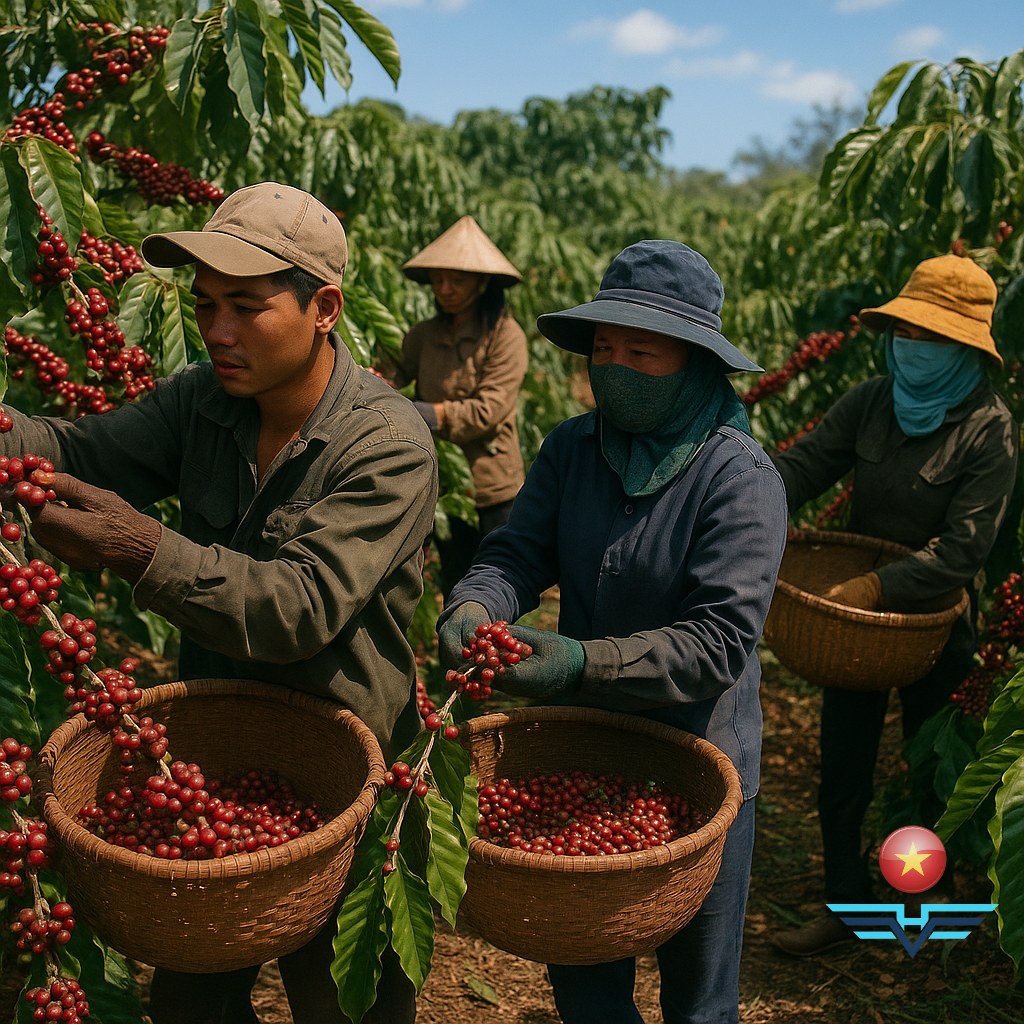
With about a month to go before the peak of the coffee harvest, thousands of seasonal workers from both northern and southern provinces are already streaming into Vietnam’s Central Highlands to pick coffee cherries.
A Seasonal Influx of Workers
Table of Contents
The Central Highlands, home to more than 500,000 hectares of coffee—locally called simply “cà”—is about to enter harvest season. Local labor alone cannot meet the demand, so, as in previous years, the rural poor from across the country are arriving in large numbers.
They come from distant northern provinces like Cao Bằng, Bắc Kạn, and Lạng Sơn; from the storm-battered central provinces of Thanh Hóa, Nghệ An, Hà Tĩnh, Quảng Nam, and Quảng Ngãi; and even from the floodplains of the Mekong Delta—Bến Tre, Tiền Giang, Đồng Tháp, An Giang—where the waters are now high and work is scarce. For these migrants, coffee harvesting offers a lifeline.
At the Buôn Ma Thuột and Buôn Hồ bus stations, crowds of new arrivals can be seen all day—sitting, standing, waiting for someone to hire them.
Stories of Hardship and Hope
Nguyễn Văn Bình from Đại Lộc, Quảng Nam, looked exhausted after his long bus ride. Typhoon No. 9 recently flattened his house, swept away his small grocery shop, and left his family destitute. His two young children are with their grandparents; his wife has gone to work in a factory in Bình Dương. “It’s my first time picking coffee,” he said. “I just hope to earn a bit to send home for the kids.”
From Nghệ An, Hùng left his one-year-old daughter with grandparents. He and his wife came to hire out as coffee pickers but were separated: she went to Đắk Nông while he found work with a family in Cư M’gar District. “Seeing the host family’s child, about the same age as mine, makes me miss her terribly,” he admitted. “I didn’t want to leave home, but we had no choice.”
Among the migrant workers are many teenagers. Seventeen-year-old Lâm from Yên Thành, Nghệ An, looks far older than his age. The eldest of four children in a family with only half a hectare of rice, he quit school after grade eight to help support the family. After a year washing dishes in Saigon, he discovered that two months of coffee picking could earn the same three million đồng he saved from a full year in the city. “Now I know the job and even get treated like a regular hand,” he said proudly.
Eighteen-year-old Nguyễn Thị Hương from Hà Tĩnh, who failed her university entrance exam, came at her aunt’s invitation. After a morning of weeding, sweat streaking her face and her work clothes stained red with basalt soil, she said with a smile, “I’ll send the money to my mother so I can return to Vinh next year to prepare for the exam again. I need a proper career—this work is so hard.”
Praying for Dry Skies
For coffee farmers, these seasonal laborers are essential. “I have 20 hectares of coffee,” said Nguyễn Văn Kỷ of Ia Tiêm, Chư Sê District, Gia Lai Province. “At the peak of harvest I need 25–30 workers. Without them, my wife and I couldn’t possibly keep up. Fortunately, they come every year so we can harvest on time.”
But even with workers in place, growers still worry—most of all about rain. “If it rains, workers can’t pick, but we still have to pay them,” explained Lê Văn Hải of Đắk Song District, Đắk Nông, who employs 18 workers on his 13-hectare plantation at 1.5 million đồng per month each. “Every morning we look to the sky and pray it doesn’t rain.”
Farmers who house their workers provide food, lodging, work clothes and even medicine, paying 1.5–1.8 million đồng per person per month. No wonder the rural poor flock here.
A Booming Side Economy
The coffee harvest also fuels a bustling support economy. Inter-provincial buses run at full capacity; drivers like Vinh, who operates the Đắk Lắk–Hà Tĩnh route, say this is their most profitable time of year. At Đắk Lắk’s bus station, motorcycle taxi drivers not only ferry passengers but also act as labor brokers, earning a 100,000-đồng commission per worker delivered to a coffee farm.
Even the small market outside the Đrao plantation has transformed. “My meat sales have tripled or quadrupled these days,” said vendor Nguyễn Thị Huệ. Smiling shoppers tease one another: “Coffee harvest season is here!”
For the Central Highlands, the arrival of thousands of migrant laborers each year has become as much a part of the coffee harvest as the ripening red cherries themselves.