
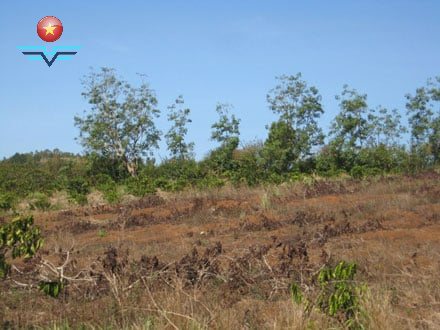
During the peak of the dry season, thousands of hectares of coffee across the Central Highlands—and especially in Đắk Nông Province—suffer from severe drought. Over-use of surface water and unregulated groundwater pumping for coffee irrigation has only worsened seasonal water shortages. Recently, however, a water-saving coffee cultivation model adopted by farmers in Đắk Min District has proven highly effective.
Rising water scarcity
Despite the district’s network of headwater streams—tributaries of the Đồng Nai and Sêrêpôk rivers such as Đắk N’reng, Đắk Sor, Đắk Mâm and Đắk Gằn—most are small and typically run dry in the dry season. Đắk Min also has 11 reservoirs storing about 15 million m³ of water, plus ten smaller ponds managed by farm and forestry stations with nearly 1 million m³ in total. These facilities were designed to irrigate roughly 1,814 ha of crops, but at present they can supply only about 1,000 ha: some 325 ha of rice and vegetables and about 700 ha of perennial crops, mainly coffee.
With surface water limited, many farmers in communes such as Đắk Sắc, Đắk Gằn, Đức Minh, Đức Mạnh, Thuận An and Đắk Lao have drilled or hired wells dozens of metres deep to water their coffee. Uncontrolled extraction has lowered groundwater tables by 3–5 m compared with previous years, as confirmed by Geological Survey Team 704. Less annual rainfall, longer dry seasons, shrinking forests and a rapid expansion of irrigated crops—especially coffee—are all driving this decline.
Efficient irrigation practices
Among the district’s strategies—reforestation, reservoir construction, upgrading canals—the approach drawing most attention from local authorities and coffee growers is careful groundwater use through water-saving farming methods. Thousands of Đắk Min households are now following this model.
Pioneering households
In Thuận An commune, Mr. Trần Văn Hải planted windbreaks and shade trees such as Cassia siamea, legumes and other forest species around his coffee fields. His success has inspired both ethnic minority and Kinh farmers to adopt similar shelterbelt systems that reduce evaporation and conserve soil moisture.
In Đắk Gằn commune—known for its stony, drought-prone soils—Mr. Trần Thành Tâm intercrops shade trees with fruit and other long-term crops. He reports that before intercropping he needed four to five irrigations each dry season and yields were modest. Now, with the windbreak and shade system, he saves at least one irrigation, reduces costs and earns extra income from durian, mango, rubber and cashew while coffee yields have risen.
Another popular practice is mulching around coffee bases with plant residues such as grasses, maize stalks, banana leaves and coffee husks. For five years Mr. K’Lơm of Jun Jú hamlet (Đức Minh) has relied on mulching to keep soil moist longer, cut the number of irrigations and lower care costs—without any drop in yield.
Results and outlook
Đắk Min now has nearly 20,000 ha of coffee. For many years thousands of local households have applied water-saving techniques, reducing input costs while maintaining high productivity—averaging 2.5–3 tons of green coffee per hectare and, under good management, 5–6 tons.
According to the district Farmers’ Association, these methods not only raise economic efficiency but also improve soil fertility and limit dry-season water extraction. In an era of increasingly scarce water and more severe droughts, the Đắk Min water-saving coffee model deserves rapid and wide replication.