
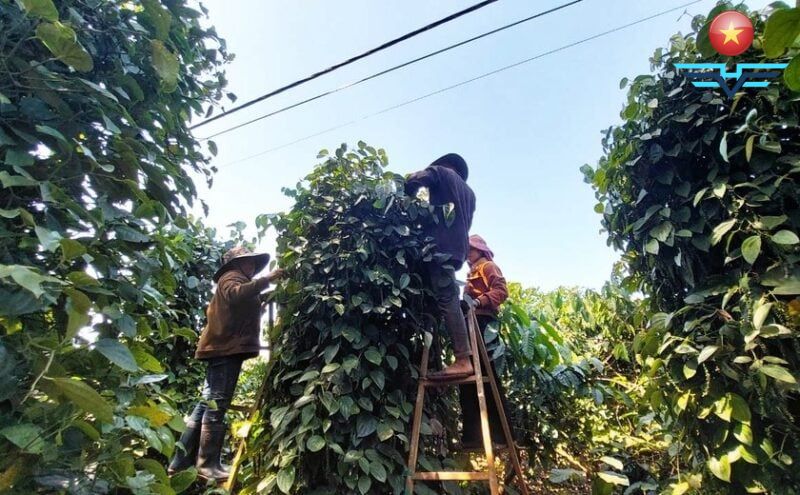
Gia Lai Province, Vietnam – After several years of falling prices, black pepper has entered a new growth cycle, reaffirming its position as a key cash crop across the province. The recent price rally has encouraged farmers to reinvest, but with a more cautious and sustainable approach.
Pepper Prices Rebound Strongly
Table of Contents
In Chu Se District, farmer Nguyễn Đình Trung recently sold 2 tonnes of dried pepper at 124,000 VND/kg, only to see prices jump to 136,000 VND/kg the next day.
“Traders are coming directly to households to buy, but most growers prefer to wait for even higher prices,” Trung explained.
Similarly, Vu Duc Dan from Chu Puh District said prices have risen from 70–80,000 VND/kg at the end of 2023 to 135–140,000 VND/kg today, giving farmers the confidence to reinvest.
“I sold several tonnes of stored pepper at 100,000 VND/kg earlier to cover costs. Now I still have 8 tonnes of dried pepper in stock and expect profits to exceed 500 million VND if prices continue rising,” Dân calculated.
Stable Planting Area with Organic Shift
According to the Gia Lai Department of Agriculture and Rural Development, the province currently has about 8,798 hectares of pepper, including nearly 8,000 hectares in full production and around 130 hectares of new or replanted pepper. The main growing areas are Chu Se, Chu Puh, Đak Đoa and Chu Prong districts.
Since late 2023, many farmers have stored harvested pepper instead of selling immediately, anticipating further price gains. However, despite higher prices, farmers are not rushing to expand plantations.
Many now intercrop pepper with newly replanted coffee and practice diversified, organic farming to reduce risk and improve long-term soil health.
Sustainable Farming Practices
Under the province’s Agricultural and Rural Development Strategy 2021–2030 (Vision 2050), Gia Lai aims to stabilize pepper cultivation at around 10,000 hectares and promote high-tech, organic farming.
Farmer Nguyen Anh Viet explained that after years of low prices and disease outbreaks, few growers are willing to expand aggressively.
“Even with prices rising, most farmers now focus on maintaining and replanting within their existing coffee farms to limit risks,” he said.
Nursery owner Tong Van Truong noted he produced 80,000 Vinh Linh pepper seedlings this rainy season, but has sold only about half. Buyers are mainly purchasing seedlings for gap-filling and intercropping rather than large-scale new plantations.
Industry Support for Sustainable Growth
According to Hoang Phuoc Binh, Standing Vice Chairman of the Chu Se Pepper Association, the current price recovery is a chance to revive this high-value crop. To ensure sustainable growth, the association advises:
-
Choosing pepper varieties suited to local soils,
-
Intercropping with replanted coffee,
-
Maintaining ground cover to retain moisture and reduce erosion,
-
Planting shade trees,
-
Reducing chemical fertilizers and pesticides,
-
Increasing organic fertilizers, and
-
Using advanced, water-saving irrigation technology.
The association is also linking farmers with pepper buyers and fertilizer suppliers, and building organic demonstration models to meet rising export demand for clean, sustainable pepper.