
Living on the red–soil Central Highlands—often called a paradise for long–term industrial crops—the Mạ and M’Nông ethnic minorities in Đắk Ha Commune, Đắk Glong District, Đắk Nông Province still rely mainly on slash-and-burn rice farming, hunting, and gathering forest bamboo shoots.
Broken “Fishing Rods”
K’Nganh spreads a worn plastic mat, full of holes, across the floor to invite visitors to sit. His 40 m² house, roofed with corrugated iron and with a simple cement floor, is one of 12 built this year under the government’s housing program for poor households in Kon Hao village. Apart from two rickety beds there is hardly any furniture; the kitchen is bare except for a few pots, bamboo fish traps, and cooking utensils. Yet K’Nganh is content—his dream of a rainproof home has finally come true.
In 2004, the local Farmers’ Association gave him 150 cashew seedlings to plant on a one-hectare plot. Though the trees grew quickly, they never bore fruit. Recently agricultural officers told him: “The climate here doesn’t suit cashews—you need to cut them down and plant something else.” He has not cleared them yet—he has no idea what to plant instead.
Early in 2009, K’Nganh received a cow as part of a poverty-reduction program. But during the long dry season the grass around Kon Hao burns away and the cow became emaciated. His fields lie more than ten kilometers from home, making it impossible to graze the animal. He eventually traded the cow for two quintals of rice, some clothes and a little dried fish. Despite working hard year-round, he and his wife still cannot escape poverty.
Kon Hao and neighboring Kon Đăng villages together have about 140 households with nearly 800 people. The most educated resident has only finished ninth grade; both village chiefs never made it past fourth grade. After decades of settlement, villagers still plant only upland rice, one crop a year, entirely dependent on the weather. For the six-month dry season they abandon their fields to hunt game, fish, or collect honey and rattan. With this subsistence lifestyle, about 80 % of households remain poor.
Having a Rod Is Not Enough
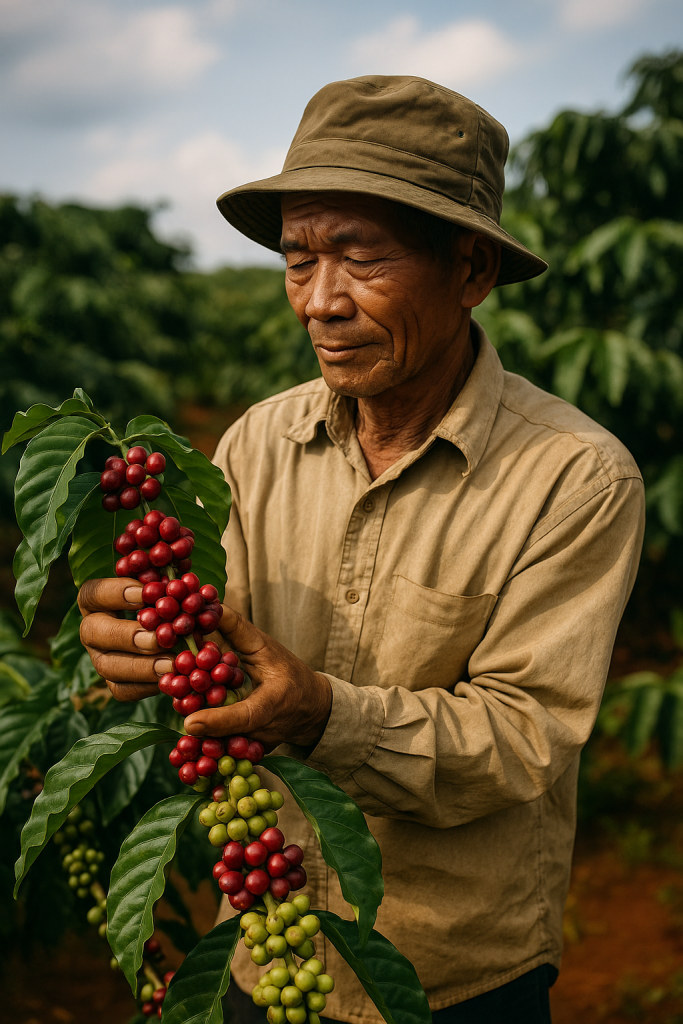
K’Xiên is a rare exception. Proud of being the first in the village to complete ninth grade, he is also the first to plant coffee in a systematic way—choosing good seedlings, digging proper holes, fertilizing and irrigating after learning techniques from growers in Gia Nghĩa and Đắk R’lấp.
His coffee trees are the healthiest in the village, yet their yield is barely one-third of specialized coffee areas elsewhere in the Central Highlands. Last season he harvested 1.2 tons of green coffee beans, earning about 25 million VND—just enough to recover the money he had invested over several years.
Đắk Ha Commune has over 3,000 ha of land suitable for industrial crops such as rubber, pepper, and coffee. In the past five years locals have planted about 950 ha of coffee, 350 ha of rubber, and nearly 100 ha of pepper, but most of these plantations have not yet delivered real economic returns. Properly managed, these crops could give 1,500 households a stable livelihood.
According to K’Luých, Secretary of the Đắk Ha Commune Party Committee, the commune has passed a special resolution to secure long-term economic stability: each household should cultivate at least five sào (about half a hectare) of coffee and farm it intensively. Each Party member is assigned to mentor families, encouraging them to learn new techniques and make effective use of government loans. Only by steadily applying these measures, he says, can the community gradually escape poverty and build a sustainable future.