
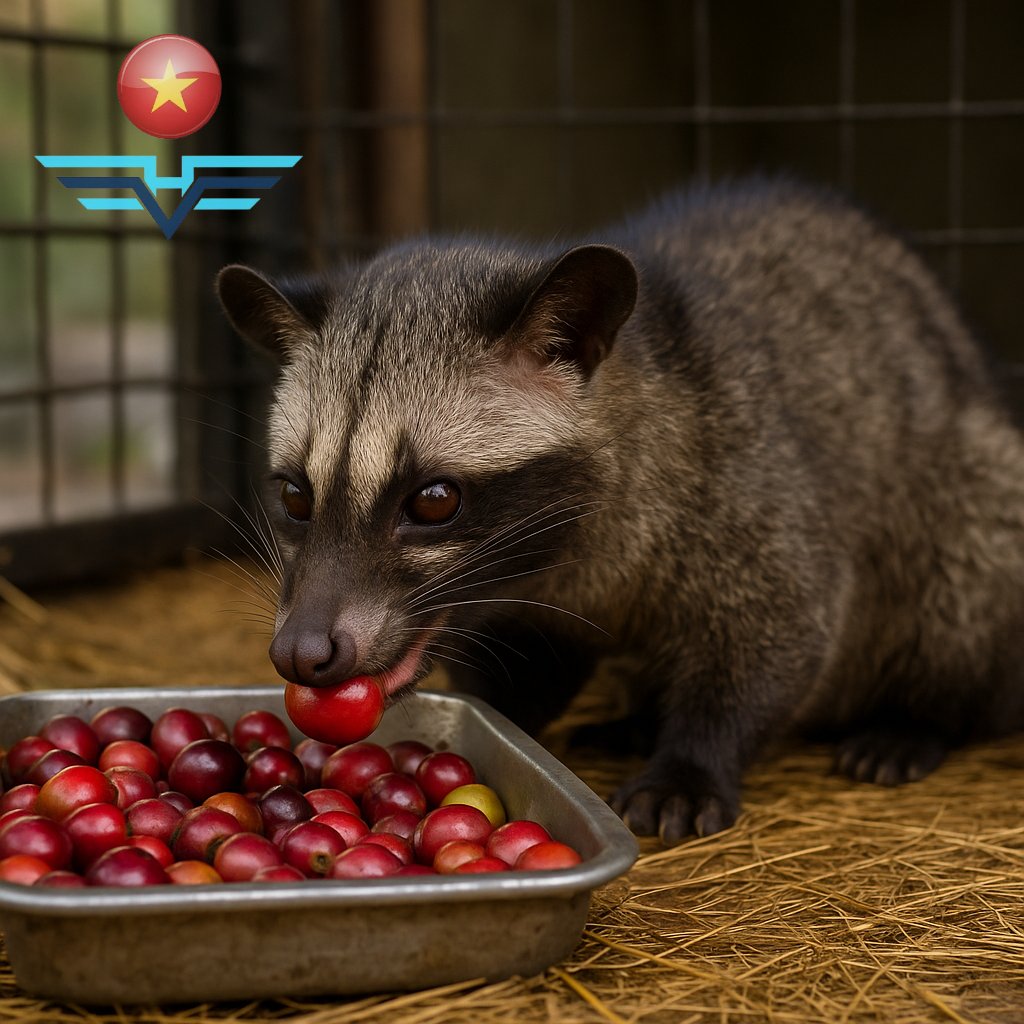
In Vietnam’s Central Highlands coffee capital, raising civets to produce weasel coffee has become increasingly popular. Yet on the market, genuine and fake weasel coffee are often mixed together, misleading consumers.
Weasel coffee is produced naturally by civets, which during the coffee harvest choose to eat only the ripest, pest-free cherries. Enzymes in the civet’s stomach interact with the coffee pulp, changing the composition and flavor of the beans that are later excreted. This process gives the coffee a uniquely enticing and captivating taste for connoisseurs.
80 Civets Yield 500 kg of Coffee per Year
Hoang Manh Cuong, a resident of Tan Tien Ward, Buon Ma Thuot City, Dak Lak Province, has been producing and selling weasel coffee since 2004. As a child, he used to collect the fragrant coffee cherries dropped by civets and roast them at home, sparking his early interest in weasel coffee.
Mr. Cuong invested in a well-built system of cages and registered the origin of his civets with the local forestry authorities. These palm civets are carefully cared for and kept in an environment that mimics the forest. Their diet includes fish, meat, and ripe fruit. During the coffee harvest, he buys only the ripest cherries—at prices two to three times higher than the market rate—to feed the civets. Each morning he collects the beans excreted by the animals, washes, dries, and packages them. Each civet can produce 5–6 kg of coffee per season.
To produce high-quality weasel coffee, Cuong insists the civets must be raised in conditions close to their natural habitat and fed cherries that are free of pests or chemical residues. In 2009, his 80 civets produced 500 kg of weasel coffee. The product is sold mainly to tourists and high-income customers at prices from 1 to 1.5 million VND per kilogram. He has also signed contracts to supply Saigon Ban Me Coffee Company for export to Japan and Europe. “Many people think weasel coffee is just a myth,” Cuong says. “But when they see how civets are raised to produce it, they are amazed.” According to him, producing weasel coffee is not difficult, brings considerable income, and is environmentally friendly.
This type of coffee is completely handmade, naturally sourced, and free from chemicals, giving it very high value. Increasingly, farmers and coffee companies in Dak Lak, Dak Nong, and Gia Lai are engaging in weasel coffee production.
Proliferation of Artificial “Weasel-Flavored” Coffee
Today, truly wild weasel coffee is extremely rare in Vietnam; most comes from farmed civets and can fetch 50–60 million VND per kilogram. Such high prices make it difficult to sell domestically, so most is exported. Farmers face challenges in production and in meeting international market requirements, as exporters usually demand clear legal proof of origin, since the civet is a protected wild species.
Trung Nguyen Coffee Company has chosen a different path: buying wild weasel coffee cherries collected in deep forest coffee gardens. These are processed entirely by hand to preserve the natural flavor. Raw weasel coffee cherries are purchased for 1–10 million VND per kilogram, and after special roasting the coffee sells for about USD 3,000 per kilogram. The company produces only for special contracted customers. A company representative notes that coffee from farmed civets does not have the same value as that from truly wild civets, so authentic weasel coffee is very limited.
Industrial Imitations Flood the Market
Most products sold as “weasel coffee” today are actually industrially flavored. Coffee companies add artificial civet aroma during processing to mimic the taste of natural weasel coffee. These imitation products are sold widely, making it hard even for coffee enthusiasts to distinguish the real thing. In upscale cafés, a cup of this so-called “VIP” coffee may cost only 30,000–50,000 VND. Globally, only Indonesia and Vietnam produce genuine weasel coffee, and in very limited quantities—intended mainly as gifts, not as mass-market products as often seen today.