
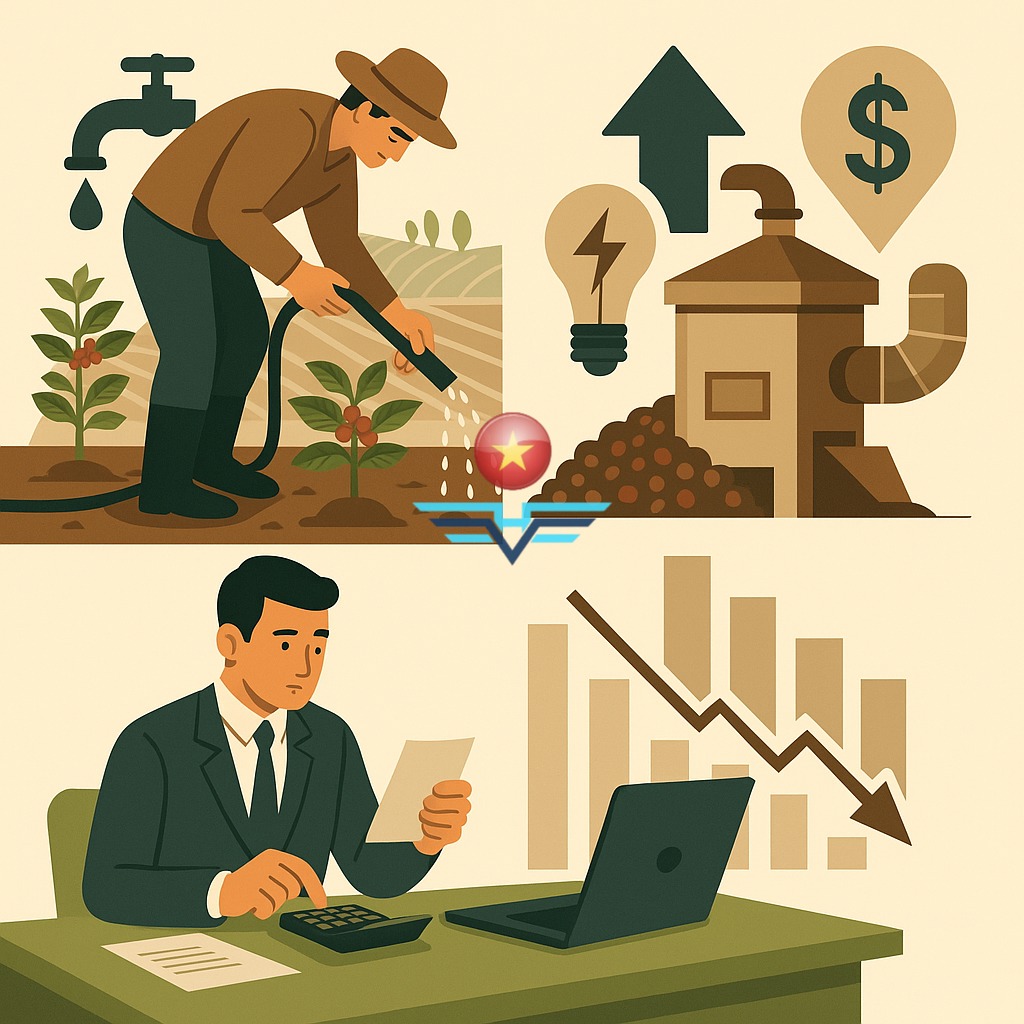
Recently, both businesses and farmers have paid growing attention to saving production costs. From this focus, many practical solutions have emerged, significantly reducing costs and improving the competitiveness of agricultural products.
Saving Irrigation Water in Agriculture: A Double Benefit
In recent years, unpredictable weather has left Dak Lak’s agriculture facing frequent droughts—even during the rainy season. Yet most coffee farmers still water their crops based on experience, typically 4–5 times per season, using sprinkler or root irrigation. This often exceeds the necessary amount by 300–400 liters per tree per watering. The result is wasted water and loss of soil fertility as nutrients are leached away.
To address this, the Western Highlands Agriculture and Forestry Science Institute successfully implemented a project led by Dr. Lê Ngọc Báu: “Research on Water-Saving Irrigation Combined with Fertilizer Application via Water for Coffee in Dak Lak.” This system delivers water directly to each tree at 60–90 liters per hour and can be adjusted to crop needs, helping coffee bloom uniformly. At the same time, a fertilizer dosing unit feeds nutrients directly through the irrigation pipes, boosting fertilizer efficiency.
Calculations show that this water-saving method reduces fertilizer and application costs by 1.77–2.58 million VND per hectare compared to traditional broadcasting. It also limits evaporation, nutrient runoff, and environmental pollution. Water usage drops by about 20%, which means Dak Lak alone could save about 70.2 million m³ of water per year.
Labor is reduced as well: traditional irrigation needs about 24 labor days per hectare annually, while the new method cuts that to about 9 labor days—saving roughly 292,500 labor days each year if just 10% of Dak Lak’s 195,000 hectares adopt the system.
This technology is now also used for vegetables and flowers through drip and sprinkler irrigation. Pilot programs in Buon Ma Thuot City and Cu M’gar District show that automated drip systems supply water and pre-diluted fertilizer evenly, increasing fertilizer efficiency and significantly reducing plant disease. Participating households report a 90% cut in labor (watering and fertilizing combined) and 50–70% fewer pests. For example, Ms. Nguyễn Thị Vân of Ea Tam Ward says her family no longer hires extra labor and has reduced costs while increasing profits.
Thang Loi Coffee Company: Practical Gains from Saving Electricity and Replacing Fuel
Thang Loi Coffee Co., Ltd. has also implemented cost-saving measures with impressive results. According to Chairman and CEO Nguyễn Xuân Thái, the company continually reviews costs and finds ways to eliminate waste. For example, it now uses coffee husks instead of coal or firewood for drying beans. Previously, drying one kilogram of coffee required about 400 VND in fuel; now it costs only 120 VND. With about 1,500 tons dried each year, this saves roughly 420 million VND—enough to pay one month’s wages for the company’s administrative staff.
Similarly, switching from 40-watt fluorescent tubes to 12-watt compact bulbs has cut lighting costs from 5–6 million VND per month to about 1.8 million. For production electricity, replacing large 36 kW motors with smaller 16 kW ones on the wet-processing line has halved power costs.
These efforts in energy and resource conservation have clearly lowered production costs and product prices, increasing profitability for the company and raising workers’ incomes—demonstrating how cost-saving measures can strengthen both business performance and long-term sustainability.