
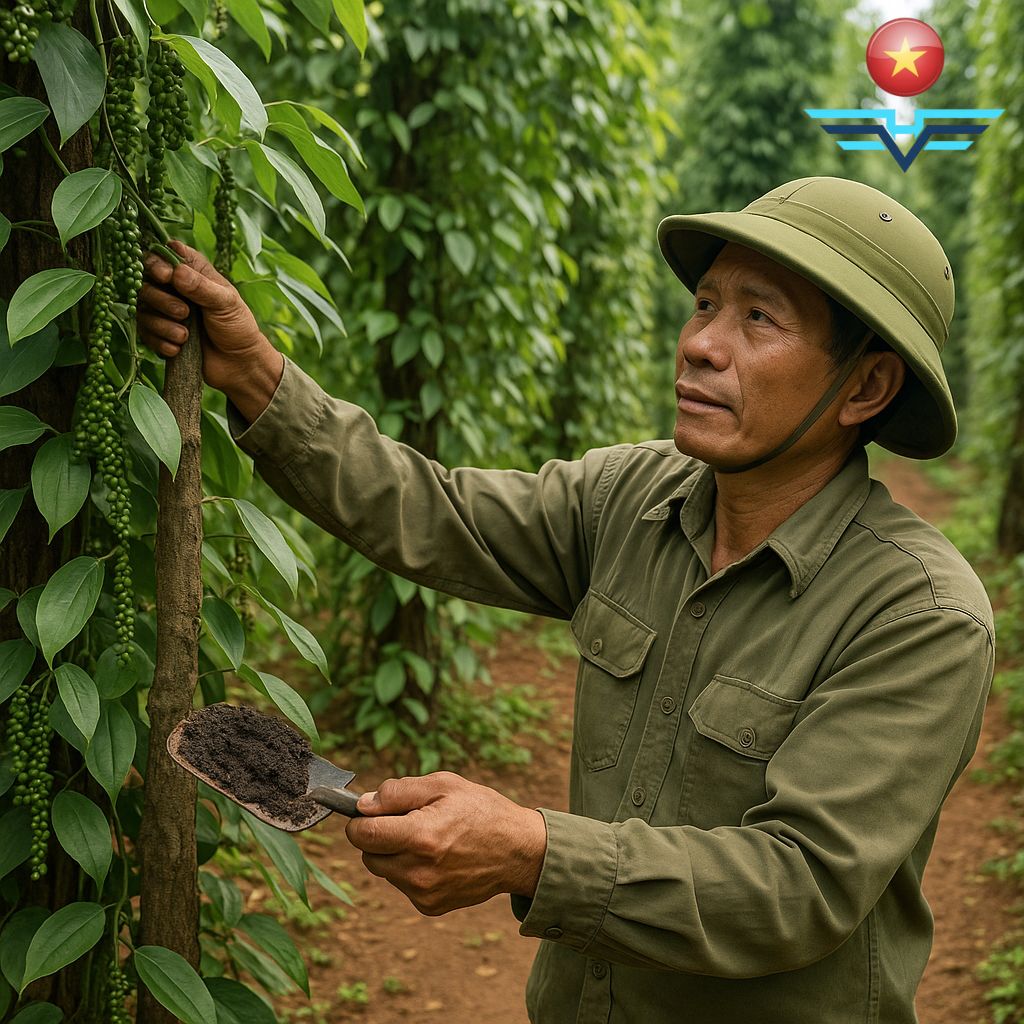

Farmers in Cư Kuin District, Đắk Lắk Province are increasingly adopting organic methods for pepper cultivation. By using biological products and organic fertilizers, they reduce costs, maintain stable yields, and help protect the environment.
Turning Challenges Into Opportunity
Table of Contents
After years of volatile prices, Mr. Vũ Đình Khôi from Village 6, Ea Bhốk Commune, has remained resilient thanks to sustainable organic pepper farming.
He recalls that when pepper prices once soared to record highs, many households—including his own—rushed to expand acreage and relied heavily on chemical fertilizers, pesticides, and growth stimulants to boost yields. This overuse created ideal conditions for pests and fungal diseases, notably quick-wilt and slow-wilt, leading to serious economic losses.
Switching to Organic Practices
To overcome these problems, Mr. Khôi researched and decided to transition to organic cultivation. At the start of each season, he “cleanses” the garden to prevent disease, and uses microbial preparations throughout the production cycle. On his 1.2-hectare pepper farm, yields have improved and pest pressure has decreased. In addition, applying well-decomposed cow manure and other organic fertilizers has further strengthened the plants’ natural resistance.
Similarly, Mr. Vũ Kim Thịnh in Kim Châu Village, Dray Bhăng Commune, now prioritizes microbial fertilizers instead of chemical plant-protection products. Because pepper needs moisture but is vulnerable to waterlogging, his family only clears weeds around the base during the rainy season to prevent nematode disease, while leaving ground cover in the dry season to preserve soil moisture.
Higher Quality, Healthier Farms
Organic cultivation not only enhances plants’ immunity but also ensures stable, year-round yields. The harvested peppercorns are denser and of higher quality than those grown conventionally. “With 7 hectares, our family harvests about 40 tons of pepper each year. This is the result of applying organic growing and care practices,” Mr. Thịnh said. Importantly, this method protects farmers’ health and guarantees that consumers receive safe products.
Learning and Innovating
Mr. Nguyễn Văn Lượng from Village 23, Ea Ning Commune, keeps his pepper garden productive by using microbial fertilizers and biological products. In 2019 he joined the Sustainable Pepper Landscape Program launched in Cư Kuin. Through the program, local growers learned how to plant shade trees, improve organic cultivation skills, and create a better ecological balance.
Key techniques—such as adapting farming methods to climate change, saving water, and reducing greenhouse-gas emissions—have helped both the environment and farmers’ incomes.
Beyond training sessions, Mr. Lượng actively experiments. He produces his own fish-based microbial fertilizer, lowering costs while providing plants with natural nutrients. Rich in protein and combined with beneficial microbes, fish fertilizer improves nutrient uptake, loosens soil, and increases moisture retention—ideal conditions for healthy, vigorous pepper vines.
Community Benefits
According to Mr. Ngô Minh Dũng, Chairman of the Ea Ning Farmers’ Association, the program has made a clear difference. Households participating in the landscape pepper model report higher yields and better quality while reducing pests and protecting the environment. Production costs have dropped, and chemical inputs have been significantly curtailed.
The success of the program has encouraged widespread adoption: today 328 households across the commune cultivate nearly 361 hectares of sustainable pepper.