
Recently in Vietnam’s Central Highlands (Tây Nguyên), the weather has been highly erratic—sporadic nighttime showers, intermittent daytime sunshine, and occasional heavy rain. These conditions have created a favorable environment for crop pests, causing significant losses for local farmers.
According to the Đắk Lắk Department of Agriculture and Rural Development, since the beginning of the year pest infestations across the province have been relatively high and complex, particularly affecting key crops such as rice, coffee, pepper, and rubber.
-
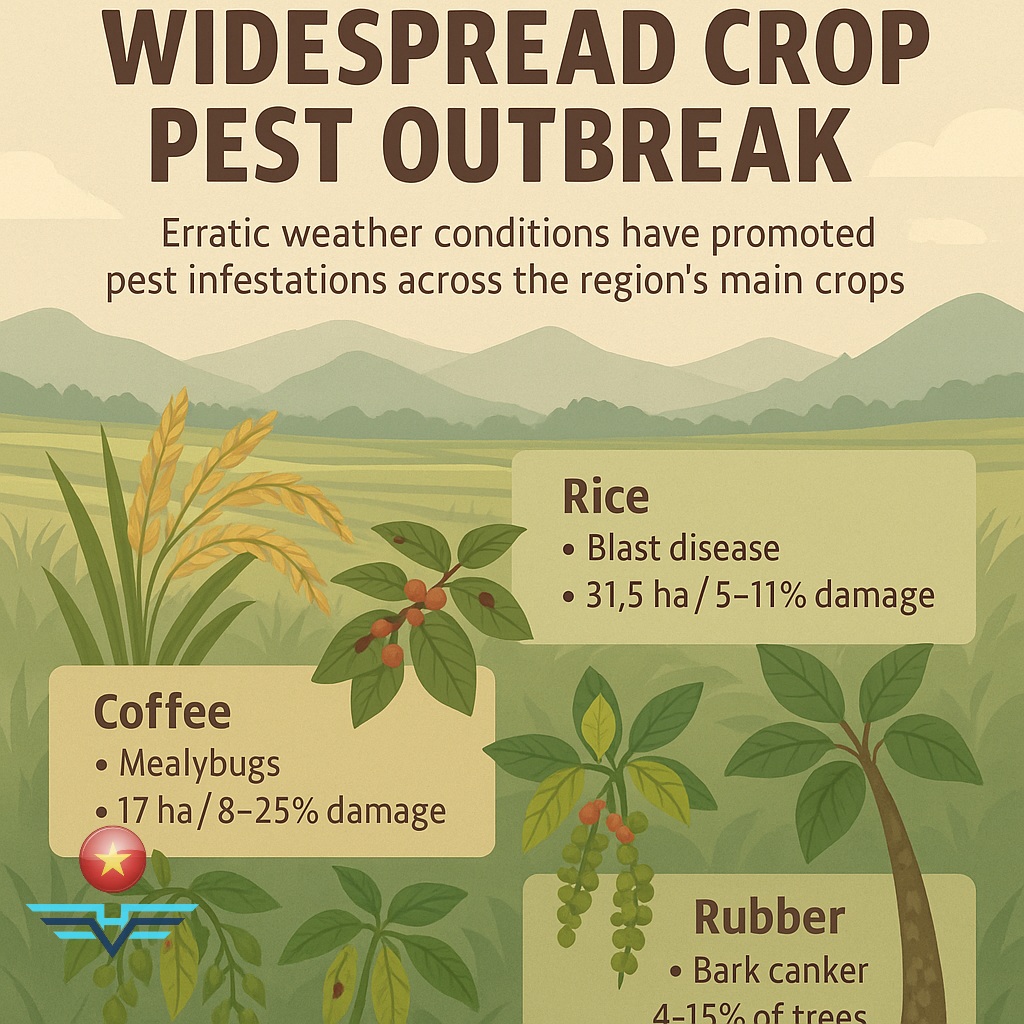
Rice: Blast disease has infected 31.5 ha with a damage rate of 5–11%. Thrips density ranges from 100–800 insects/m² on 9 ha, brown planthoppers from 30–1,000 insects/m², and nematodes are damaging 10 ha in Krông Bông district at rates of 10–25%.
-
Coffee: Mealybugs attacking flower clusters and young cherries have caused 8–25% damage on 17 ha in Ea Kar and Krông Bông. Green mealybugs, branch borers, coffee leaf rust, and dieback are also present at light, scattered levels province-wide.
-
Pepper: Slow wilt disease is appearing on 25.1 ha at rates of 4–11% in Ea H’leo, Krông Năng, and Krông Bông.
-
Rubber: Bark canker along tapping lines occurs on 4–15% of trees, while pink disease is found on 5–15%, mainly in Ea H’leo, Krông Năng, and Krông Buk.
In Lâm Đồng province, weather patterns have encouraged pests such as brown planthoppers, golden apple snails, rice blast, and sheath blight in rice; clubroot in cabbage; and coffee diseases including brown eye spot and pink disease. For example, brown planthopper density averages about 208 insects/m² (peaking at 800) across 436.5 ha in Đạ Tẻh, Đạ Huoai, and Cát Tiên—down 568.7 ha from the previous survey. Golden apple snails have infested 3,527.7 ha (1,197.3 ha heavily) in Đạ Huoai, Đức Trọng, Đạ Tẻh, Đơn Dương, and Di Linh, with densities of 2–120 snails/m², an increase of 477.5 ha compared with the previous reporting period.
In Đắk Nông province, abnormal weather patterns have also fueled pest outbreaks, particularly mealybugs on coffee. Around 500 ha of coffee have been damaged by mealybug infestations, with Krông Nô district hardest hit—over 200 ha affected.
Provincial Plant Protection Sub-Departments urge farmers to implement effective preventive measures from the start of each planting season: adopt high-yield, high-quality crop varieties, improve soil treatment practices, and increase crop rotation and land-use intensity to reduce pest pressure and protect yields.