
Coffee has brought a decent living to millions across Vietnam’s Central Highlands. Yet it has also brought heartbreak to tens of thousands of coffee workers—people who have toiled a lifetime only to remain burdened with debt inside inefficient state-run enterprises that still practice a feudal “rent-farming” model built on workers’ sweat and tears.
Frustrated that, after years of hard labor and loyalty, the means of production remain tightly controlled by weak and self-serving management, thousands of coffee workers in the Central Highlands have spent decades petitioning and fighting for justice.
The Rise and Decline of Cu Pul Coffee Company
Just 12 km from the coffee capital Buon Ma Thuot lies Cu Pul Coffee Company, originally formed after 1975 from the estate of Mr. Tu Yen—the first Vietnamese to establish a large private coffee plantation in the Central Highlands.
When Mr. Tu Yen was later invited back by the government to direct the Cu Pul farm (1986–1990), General Secretary Do Muoi visited and told accompanying officials with delight: “Comrades, you don’t need to learn from anywhere else—come to Cu Pul and learn here.”
But from 2001 onward, more than 30 Cu Pul workers waged a relentless struggle against management’s violations, many of which state inspectors later confirmed. For example, even though the coffee tree’s life cycle is about 25 years, contract quotas forced workers to deliver production for 34 years; the company illegally collected excessive social-insurance fees and orchard depreciation, suppressed workers who resisted, and ignored orders to refund these overcharges. In 2004, Director Nguyen Ngoc Chuyen admitted to these mistakes.
Yet twelve years later, after Chuyen retired, his successor Le Ngoc Ha repeated the same errors, squandering company resources on failed pilot projects while obstructing workers’ efforts to protect themselves.
Most recently, after Dak Lak’s People’s Committee Chairman Hoang Trong Hai issued Official Letter 6284 (Sept 1, 2013) ordering the company to correct its abuses, Ha responded by destroying hundreds of pepper vines belonging to nine workers who had planted them along the edges of aging coffee plots—even though those workers consistently met the contracted quota of 0.5 tons of coffee cherries per hectare per harvest.
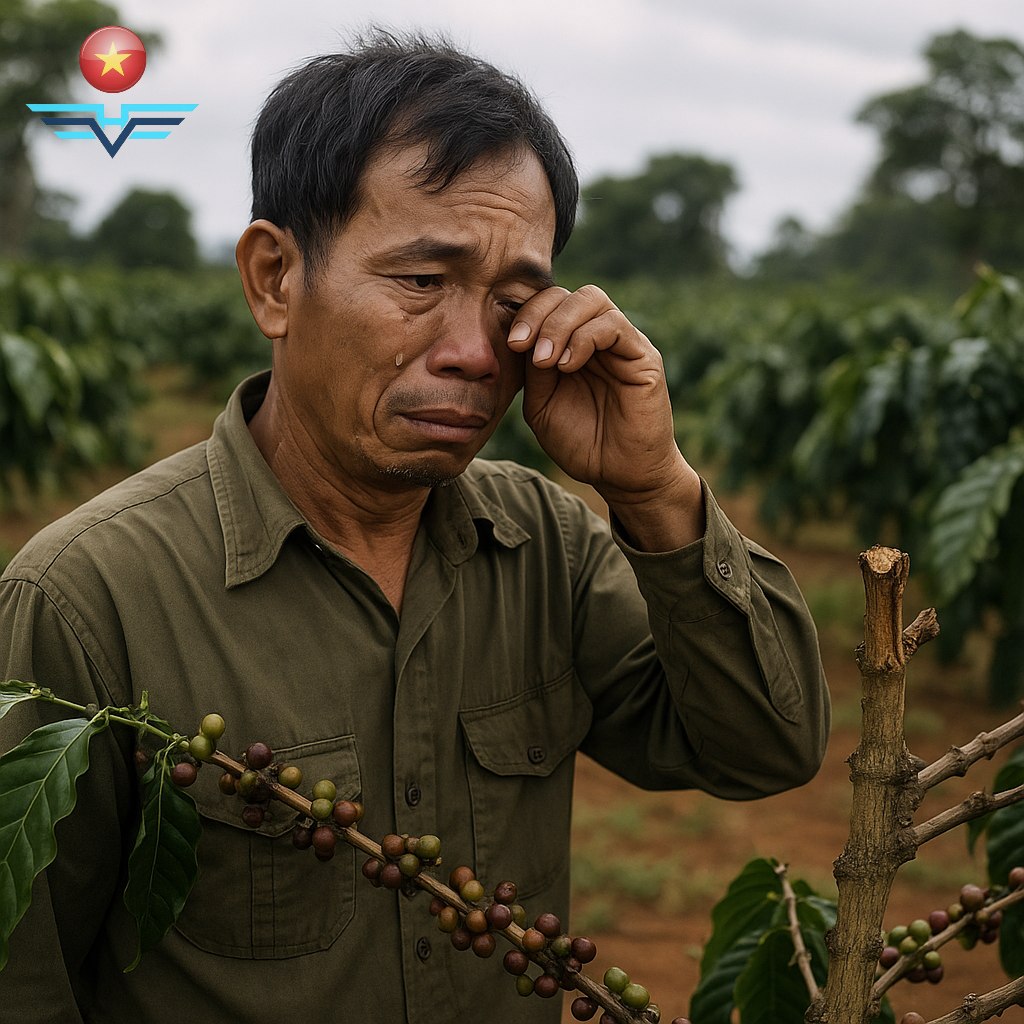
Showing us where company agents had cut fruiting pepper vines and poured herbicide on the roots, Phan Van Trung, a worker from Team 2, wept: “They are so cruel.”
Repeated attempts by Tien Phong newspaper to contact Ha were met with excuses of “being busy.” When we confronted the company directly, Deputy Director and Trade-Union Chairman Y Seng claimed, citing internal documents, that the pepper vines were cut because workers had “planted at densities exceeding regulations.”
Worse Conditions Elsewhere
At Krong Ana Coffee-Cocoa Company (Krong Ana District, Dak Lak), conditions were even harsher. For more than a decade, hundreds of workers saw their income dry up after management forced them to uproot hundreds of hectares of productive coffee to plant cocoa—a crop that fruited sparsely and lost money. The remaining thousands of hectares of coffee were then subject to excessive levies by a bloated management apparatus of more than a hundred staff, which even demanded double depreciation charges.
Workers were squeezed from all sides. In Ia Pia and Ia Ver (Chu Prong District, Gia Lai), Vinacafe’s local branch once rationed each worker just 12 kg of rice, 1 kg of dried fish, and 1 liter of fish sauce per month to survive while tending coffee—this even as the parent company kept reporting ever larger losses to the state, after earlier trumpeting the project as a success.
At Dak Doa Coffee Company (Gia Lai), quota contracts that demanded full production regardless of good or bad harvests pushed many workers deep into debt. Worker Le Thi Huong of Team 2 wept while reading her contract: her coffee plot was infested with pests, her wages were almost entirely withheld to pay off debt, and her family had to buy rice on credit. Many other households borrowed heavily to buy fertilizer—often owing hundreds of millions of dong—yet their harvests never covered the cost.
The conflict climaxed on August 24, 2012, when the Dak Doa District People’s Court sentenced four female workers to a total of 104 months in prison for “excessive” protest against the unfair quota contracts.
Gia Lai’s Provincial People’s Committee later investigated and found multiple irregularities, ordering the Vietnam Coffee Corporation (VINACAFE) to instruct Dak Doa to revise its quota system in line with the law. Company leaders repeatedly refused to speak with the press.
Systemic Abuses Across Provinces
Recently, Pham Van Chuc—former Party Secretary and acting director of Dak Uy III Coffee Company in Dak Ha, Kon Tum—though long retired, sent petitions to Tien Phong’s Central Highlands bureau. He detailed how VINACAFE subsidiaries in Gia Lai and Kon Tum had committed serious violations of Party and State policies on wages and illegal collections beyond the scope of decrees and circulars—“squeezing workers purely for group interests,” he wrote.
These companies provided no investment support; they merely collected rent while running their operations so poorly that they consumed both their capital and whatever could be sold, leaving them paralyzed for years.
The labor force has been scattered—forced to seek temporary jobs and live in poverty on the very basalt-rich land that could have made them prosperous if only they had true ownership.