
By Nguyen Minh Vinh – Cam My, Dong Nai, Vietnam
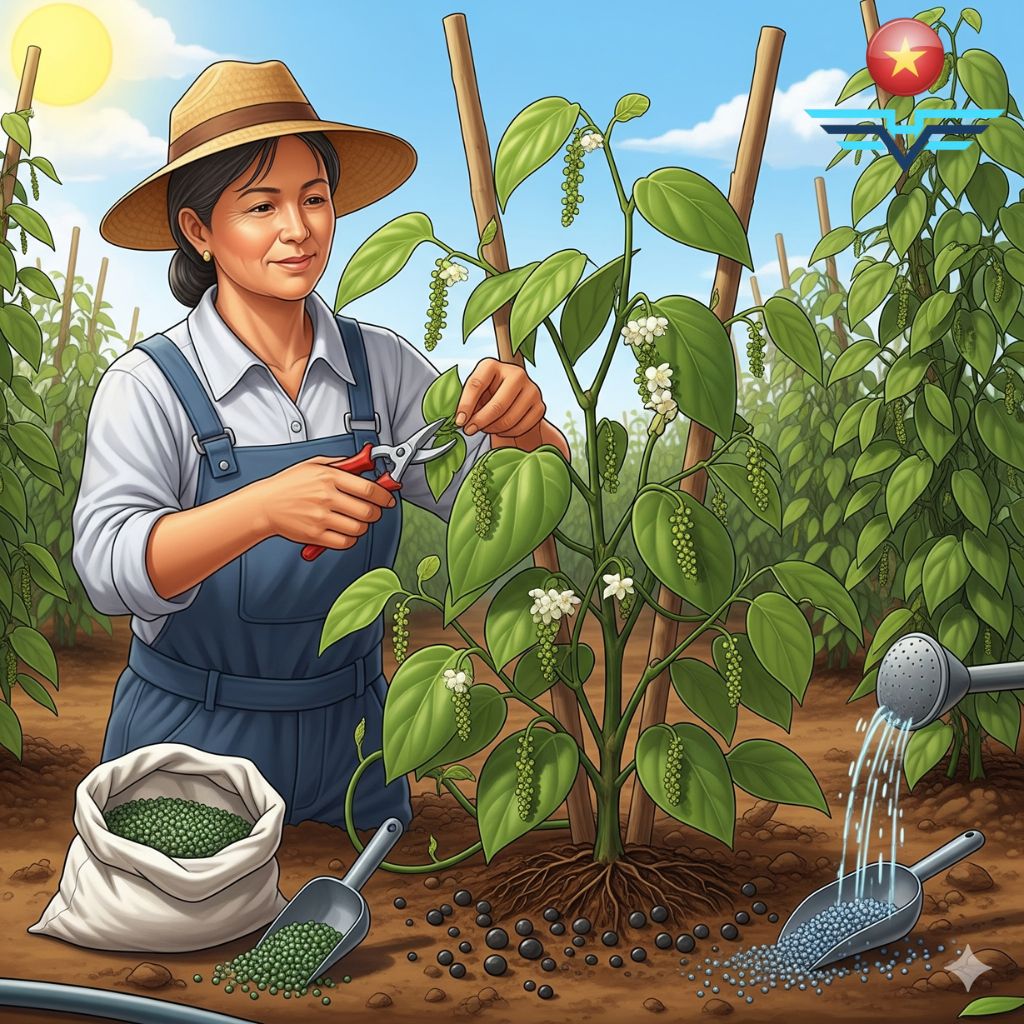
Drawing from years of hands-on experience in his family’s pepper garden, Nguyen Minh Vinh shares practical insights on how to induce flowering in black pepper (Piper nigrum L.)—a critical but often overlooked technique for ensuring high, stable yields.
Why Flower Induction Is Critical
Table of Contents
Among all the skills in pepper cultivation, flower induction is one of the most challenging and least forgiving. Farmers know that beyond pest and disease management, pepper vines can suffer from unpredictable yields—one season plentiful, the next disappointing.
Many growers leave flowering to nature, but relying on the weather alone can mean lost income. Successful flowering requires a combination of factors: pest control, water management, balanced fertilization, and careful plant care.
Understanding Pepper Plant Physiology
To achieve consistent annual harvests, farmers must grasp basic plant physiology and the growth stages of pepper vines. Knowing your local climate, soil conditions, rainfall patterns, and sunlight levels is key. As the old saying goes, understanding “heaven’s timing and earth’s advantage” is as important in agriculture as it once was in battle.
A healthy, disease-free plant with proper year-round nutrition is essential. Each node on a pepper vine contains a latent flower bud, waiting to be “awakened.” Correctly triggering this flower bud differentiation is the secret to reliable yields.
Step 1 – Water Withholding (“Water Stress”)
The core of flower induction is a period of controlled drought, known locally as ham nuoc (water withholding):
-
Post-harvest sanitation:
-
Wash vines with a copper-based or fungicidal spray to remove pathogens and old leaves.
-
Prune away “runner shoots,” basal branches and diseased foliage; burn the debris to prevent reinfection.
-
The ash returned to the soil provides potassium, strengthening the plants.
-
-
Inducing stress:
-
Research shows that after about 15 days of dry conditions, levels of abscisic acid (ABA) in the plant rise while cytokinin and gibberellic acid decrease—ideal for initiating flower bud formation.
-
Because soil moisture often remains after harvest irrigation, experienced growers extend the dry period to 30–45 days, depending on the vine’s vigor.
-
-
Classify your pepper vines:
-
Vigorous vines (“sung”) need the full 30–45 day dry period.
-
Average vines also require controlled drought.
-
Weaker vines (often early-maturing Indian varieties) may already have high ABA and will flower readily with normal care; just maintain balanced fertilization to avoid next-year yield loss.
-
-
Critical timing:
-
If rains arrive early, simulate the stress by spraying copper-based solutions or flowering inducers, which naturally cause 15–30% leaf drop. After 1–2 weeks, follow with foliar fertilizers to trigger uniform bud break.
-
Step 2 – Rehydration and Nutrient Boost
After the dry phase:
-
Irrigate heavily twice in one week, wetting both the root zone and the area beyond the canopy because pepper roots forage far from the trunk.
-
First, apply foliar fertilizers to stimulate new shoots and flowers, then follow with soil-applied fertilizers. Applying soil fertilizers too early can damage roots and waste nutrients.
Overcoming Weather Challenges
Early rains can disrupt water-withholding schedules. By carefully monitoring weather forecasts, farmers can adjust their techniques and still achieve synchronized flowering.
Key Takeaways
-
Healthy vines and balanced nutrition are prerequisites for successful flowering.
-
Controlled water stress for 30–45 days is the heart of flower induction.
-
Post-harvest sanitation and the return of potassium-rich ash enhance plant resilience.
-
Foliar fertilization after rehydration helps vines recover and supports strong flowering.
This flower induction process is only the first step in a longer journey of black pepper production. In Part 2, we will explore subsequent techniques to maintain fruit set and maximize yields.