
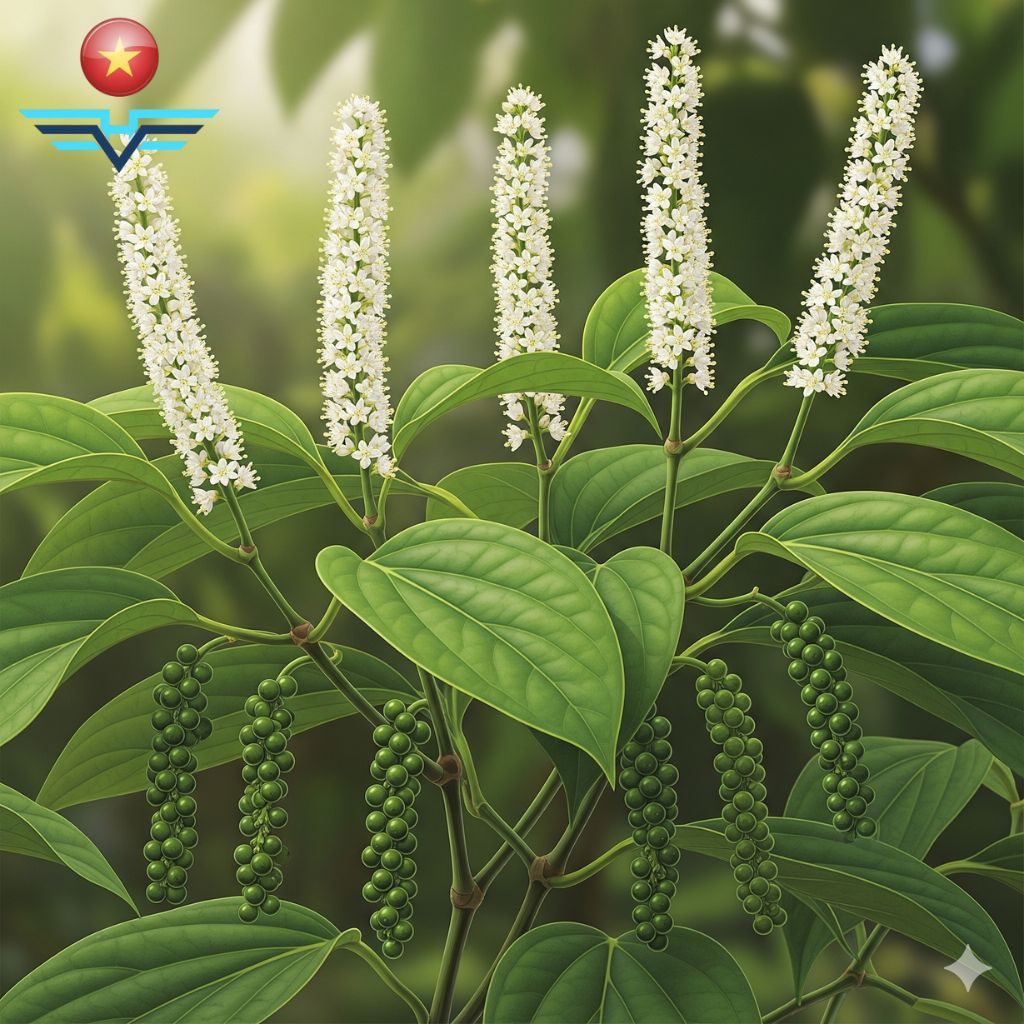
By Nguyen Minh Vinh – Cam My, Dong Nai, Vietnam
In Part 1, we explored how controlled water stress triggers flower bud formation in black pepper (Piper nigrum L.). But flower induction is only the first step. To achieve high, stable yields, farmers must master nutrient management during the entire flowering process.
Fertilization Is the Key to Strong Flowering
Table of Contents
If water withholding is the spark that triggers flower bud differentiation, fertilizer is the key that wakes those buds up. Without sufficient nutrients, pepper vines will continue to put energy into leaf growth instead of flowers.
During this critical stage, the plants require high levels of macro-, secondary-, and micro-nutrients, plus organic matter. Many farmers make the mistake of applying large doses of NPK 16-16-8+TE fertilizer immediately after rewatering and spraying foliar nutrients. At this point the root system is not ready to absorb such a heavy dose, leading to nutrient waste.
Step-by-Step Fertilization Strategy
-
Post-Drought Recovery
After soaking the soil like a heavy rain to revive the vines, start with foliar fertilizers. One week later, apply liquid organic Amino fertilizer at the root zone, combined with nematode and mealybug treatments. Always check product labels to ensure compatibility between fertilizers and pesticides. -
Prevent Pests During Early Flowering
The following week, spray foliar fertilizer combined with insect control for brown planthoppers, thrips, and beetles that feed on young shoots and flowers. -
Main Flowering Fertilization
When buds (known locally as mat cua) and young leaves appear, apply organic NPK+TE fertilizer formulated for pepper.-
Broadcast fertilizer evenly outside the canopy, 40–60 cm from the trunk.
-
Apply early morning or late afternoon for better nutrient uptake.
-
Large plants get more, smaller plants less—avoid direct contact with roots.
-
-
Strengthen the Soil With Organic Matter
Two weeks later, add well-composted farmyard manure or organic fertilizer mixed with Trichoderma to prevent plant stress. You may also add lime to improve soil health. If concentrated organic mineral fertilizers are not available, prepare your own microbial compost.
Critical Points to Remember
-
Do not spray foliar fertilizer during full bloom. Spraying at this time can cause sparse flowering, even though some products claim it is safe.
-
Maintain high humidity around the vines while flowers are opening. Instead of leaving the air dry, mist the surrounding air or water the root zone every three days during the 10–20 day flowering period.
-
Monitor flower type: Most pepper flowers are bisexual, but some varieties (such as certain Indian strains) have more unisexual flowers, which naturally drop and have low fruit set. To offset this, increase organic matter inputs by 150% to maintain high and stable yields.
Nutrient Management Through Fruit Development
-
During flowering and young leaf growth: Spray foliar fertilizers with high nitrogen (N), then gradually reduce nitrogen.
-
When berries are forming: Switch to foliar fertilizers low in nitrogen, high in phosphorus (P) and potassium (K) with trace elements (TE). This prevents off-season leaf flush, which can reduce next year’s yields.
-
Before harvest: Apply Amino fertilizer at the root zone to ensure large, firm berries and to prevent plant stress. At this stage, the root system is less active, and Amino fertilizers are easier for the plant to absorb.
Observation and Timely Action
Always observe the leaves:
-
Small or pale leaves signal nutrient deficiencies.
-
White or distorted young leaves indicate a lack of micronutrients.
-
Signs of anthracnose, lichen, or quick/slow wilt also appear first on leaves.
Experienced farmers can quickly identify problems and adjust fertilization or disease control before damage spreads.
Sustainable Perspective
Like poultry farming, where a small loss is normal, pepper cultivation inevitably faces some plant losses. The key is proactive disease prevention, rapid isolation of infected vines, and proper soil treatment before replanting.
Key Takeaways
-
Fertilizer management is as critical as water stress in inducing pepper flowering.
-
Split fertilizer applications into multiple smaller doses for better absorption.
-
Maintain high humidity during flowering, but never spray directly on flowers.
-
Adjust nutrient formulas as plants move from flowering to fruiting.
With careful observation and consistent care, farmers can achieve stable, high yields year after year, proving that success in black pepper farming is no matter of luck, but of skill and timing.