
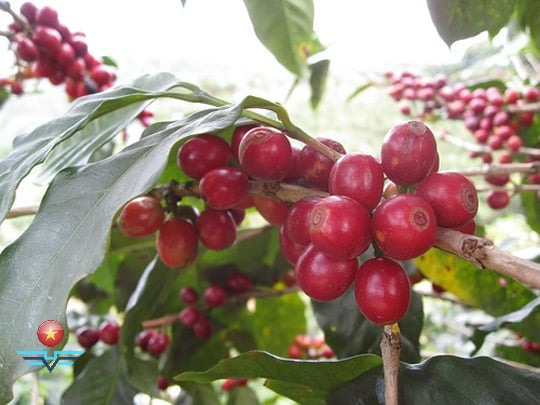
Arabica coffee is a cross-pollinating species. In Vietnam the most common Arabica varieties include Bourbon, Typica, Caturra, Catuai, Mundo Novo and Catimor. Among these, Catimor is now widely grown in provinces such as Lâm Đồng, Đắk Lắk and Gia Lai.
Catimor was first introduced to Vietnam in 1984 from Cuba and again in 1990 from the Oeiras Rust-Resistant Coffee Breeding Center in Portugal.
It is a hybrid of Hybrid de Timor and Caturra, naturally short and compact with short internodes, allowing dense planting. Its outstanding trait is strong resistance to coffee leaf rust. Farmers often call Catimor the “poor man’s coffee” because it is easy to care for and needs little technical input.
Catimor trees have a dense canopy that shades the trunk, helping to limit attack by stem-boring insects (which avoid dark places for egg-laying). With good intensive cultivation, Catimor can yield 4–5 tons per hectare, and because of its high yield, rust resistance and fine cup quality it commands about 1.5 times the price of Robusta and is cultivated worldwide.
1. Planting Techniques
-
Site preparation: Plow and harrow thoroughly and clear weeds before planting. Use rust-resistant varieties (such as Catimor).
-
Spacing and density:
-
On low-fertility soils: 6,666 plants/ha (rows 1.5 m apart, plants 1 m apart).
-
On fertile soils: 5,000 plants/ha (rows 2 m apart, plants 1.5 m apart).
-
On medium soils: 3,333 plants/ha (rows 2 m apart, plants 1 m apart).
-
While the coffee plants are young, intercrop with short-cycle legumes (beans, peanuts, etc.) to increase income, suppress weeds, provide shade, maintain soil moisture, reduce erosion and enrich the soil. Intercrops also supply mulch and green manure—potentially hundreds of kilograms of natural nitrogen per hectare—helping establish a rich community of natural enemies that reduce coffee pests.
Coffee requires shade. Plant shade trees such as Leucaena or Albizia at moderate density, evenly distributed to provide filtered light and protect the coffee from winter frost. Shade must remain airy to avoid encouraging coffee leaf rust.
2. Care and Maintenance
Regularly loosen soil around the base to control weeds and keep the soil friable; then mulch with crop residues or grass. Apply balanced chemical fertilizers together with well-decomposed organic manure to promote strong growth and natural resistance to pests and diseases.
When plants are lush and leafy, the dense canopy further protects trunks from stem borers and bark beetles. Weed control before fertilizing is essential. Poorly maintained plantations favor dieback diseases.
During periods of frost, spray water on the foliage to protect the plants, and after frost provide good care so trees recover quickly and resist pest attack.
3. Pruning and Shaping
Pruning to form a well-shaped canopy is critical. The goal is a structure of well-distributed branches and stems that allows good sunlight penetration for photosynthesis and stable high yields, while still shading the trunk to deter stem borers.
Avoid cutting primary branches (except those diseased). Remove branches infested by red-borer insects, pink disease or dieback. Prune unproductive shoots to keep the canopy open yet still protecting the trunk.
-
Topping height: Usually 1.4–1.6 m from the ground; for Catimor about 1.8 m or sometimes left untopped.
-
When trees reach the desired height, cut the leader just above the last pair of branches (about 1 cm above). After topping, nutrients are directed to remaining branches, stimulating secondary branch growth and fruit set.
After each harvest, cut away dry branches, weak shoots and any that are diseased so that new fruit-bearing branches can grow for the next season.
These combined practices—proper planting, shade management, balanced fertilization and careful pruning—help Arabica coffee, particularly Catimor, achieve high, stable yields and excellent cup quality.