
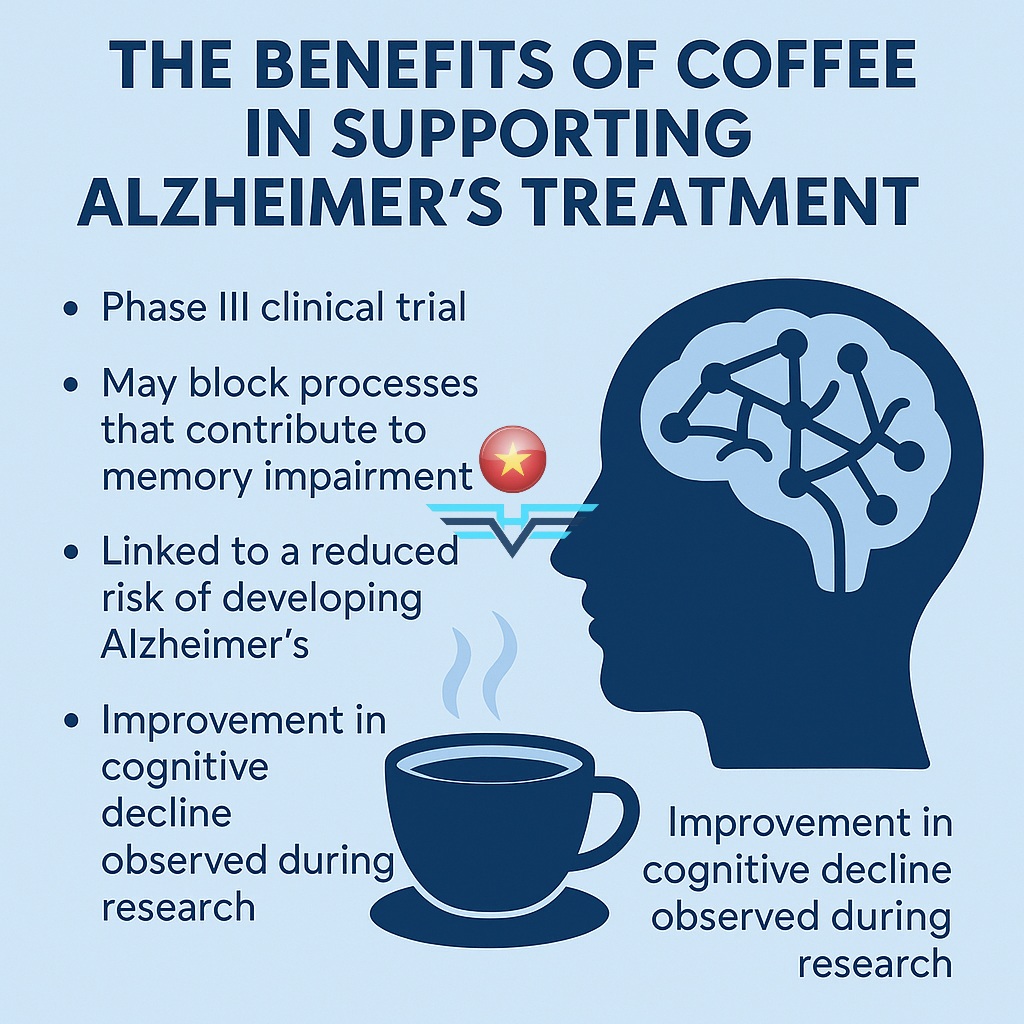
French researchers have decoded the mechanism of caffeine and are now conducting a phase III clinical trial to explore its potential benefits in treating Alzheimer’s-related memory decline.
According to Vietnam News Agency correspondents in Paris, scientists have long suspected caffeine may help slow cognitive decline. Some earlier studies suggested that moderate coffee consumption—about 3 to 5 cups a day—might reduce the risk of developing Alzheimer’s-type dementia with age, but until now, the evidence had not been scientifically confirmed.
Researchers at Inserm and Lille University Hospital recently provided new evidence supporting this hypothesis. In a study published in the journal Brain, they highlighted the mechanism by which caffeine can block processes that contribute to memory impairment. The team is now running a phase III clinical trial, the final stage before regulatory approval if the results prove positive.
How Caffeine May Work
Previous studies showed that A2A receptors—a type of brain receptor—are abnormally elevated in patients with Alzheimer’s disease. However, scientists did not know whether dysfunction of these receptors was linked to the progression of neurodegenerative symptoms (such as memory loss, impaired executive function, and disorientation), or if so, by what mechanism.
David Blum, the lead researcher, explained:
“We know these neural receptors regulate interactions at synapses, where neurons exchange chemical and electrical signals. Therefore, we suspected that an increase in these receptors triggers the synaptic loss that characterizes Alzheimer’s disease.”
To test this hypothesis, the team used genetically modified mice designed to develop the hallmark lesions of Alzheimer’s—amyloid plaques and tau protein tangles. By introducing new genetic changes before the first symptoms appeared, they successfully recreated the increase in A2A receptors observed in human patients.
The result: these animals developed early memory problems, which did not occur in “Alzheimer’s-model” mice with normal receptor levels. Marc Dhenain, research director at CNRS and the Paris-Saclay University Neurodegeneration Laboratory, emphasized:
“These symptoms appeared alongside the typical signs of Alzheimer’s—tau protein accumulation and loss of synaptic connections—showing that these receptors are indeed a trigger for the disease onset.”
The researchers also observed that the pathological rise in A2A receptors disrupted the function of microglial cells, which are involved in inflammatory processes that lead to synaptic loss.
The Clinical Trial
Based on these findings, the team has launched a phase III clinical trial at Lille University Hospital to evaluate the therapeutic benefits of caffeine in 248 patients with early-stage mild Alzheimer’s disease.
Marc Dhenain explained that some patients are receiving 400 mg of caffeine daily for six months—the maximum daily intake recommended by the European Medicines Agency (EMA)—while others are receiving a placebo. By comparing brain biomarkers, cognitive and behavioral assessments between the two groups, researchers hope to observe slowed cognitive decline in those treated with caffeine. The first results are expected in 2026.
Dhenain stressed:
“If this approach proves effective, it could significantly improve quality of life for patients with Alzheimer’s disease.”