
The lives of the residents of Lat commune, Lac Duong district in Lam Dong have become increasingly prosperous thanks to shifting crop patterns—especially coffee. While Robusta and Catimor-Arabica have lifted families out of poverty, locals have not forgotten the old Moka variety, a tree tied to a once-impoverished past.
Just over 10 km from Da Lat city lies Lac Duong town at the foot of majestic Mount Lang Biang. At 1,950 m above sea level, the green Dankia hills are a popular destination for domestic and international visitors.
Years ago, Moka coffee trees could be found everywhere in Lac Duong—around homes, in gardens, on the hillsides. Today, however, spotting a Moka tree is like searching for gold in sand: most have been cut down and replaced with higher-yield Robusta and Arabica varieties.
After much searching, we met 74-year-old village elder Son Cuoc, a Co Ho woman living right at the foot of Lang Biang. At first surprised that we came asking about Moka coffee, she warmed up when she heard we were studying horticulture. She explained her name means “foot of the mountain”—“Son” for mountain, “Cuoc” for foot.
According to her, Moka coffee used to be common across the district. After the war, as farming conditions improved—with electricity and irrigation—Moka was gradually “eliminated,” replaced by higher-yield Robusta and Arabica.
Son Cuoc, who had cultivated Moka for decades, described the plant in detail: its beans were large, oily, and exceptionally fragrant, but yields were far lower than other coffees. Harvesting was difficult too: grown from seed, the trees shot skyward and had to be climbed like pepper vines. Yet Moka was remarkably hardy, rarely failing to produce and extremely drought-resistant thanks to deep taproots. Through long experience, she knew Moka thrived best between 1,500 m and 2,000 m; elsewhere it hardly grows. Many people confuse “Moka” with the so-called “jackfruit coffee,” but only growers can tell the difference.
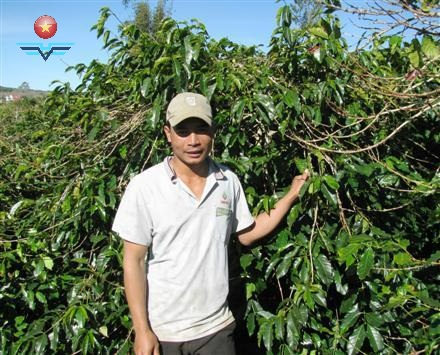
Today only a few pockets of Moka survive in Lat and Da Sa communes. Following her directions, we found young farmer Klai, 27, of the Co Ho Chil group in Bonnor B hamlet. Busy shelling and drying beans, he proudly showed us his lush hillside coffee garden. Hidden beneath the thick Robusta canopy, he pointed to a single Moka trunk.
“Our people treasure it,” he said. “Even when it was common, we were poor.” Like a seasoned agronomist, Klai explained how the Co Ho Chil learned to prune the tall Moka to the height of other coffee trees, making care and harvesting easier. Many trees died from improper pruning, so most households now keep only a few plants—as a living memory and as a genetic reserve should the market ever call for it again.
This quiet, self-motivated effort by the Co Ho of Lac Duong is more than sentiment. It is an act of foresight: preserving the genetic heritage of the rare Moka Arabica. One day, as markets demand more distinctive, high-quality coffee, the area devoted to Moka will surely grow again.