
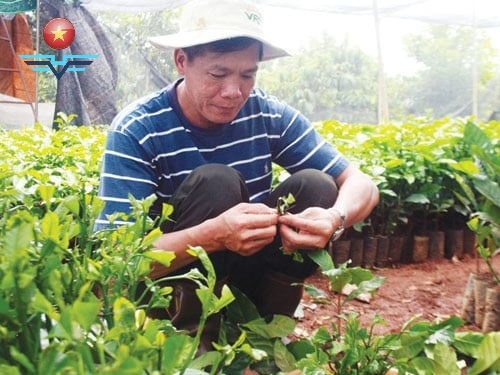
Through years of self-taught grafting techniques and patient experimentation in his own coffee fields, Nguyen Dang Trung (45, Tien Yen Hamlet, Loc Duc Commune, Bao Lam District, Lam Dong Province) has become both a billionaire farmer and a regional celebrity.
From Hardship to Opportunity
Table of Contents
Twenty-seven years ago, in difficult family circumstances and following a government resettlement policy, Trung left his hometown of Loc Phat (Bao Loc) to start a new life in Tien Yen Hamlet. At that time the land was still wild. In addition to the six sào (≈0.6 ha) of land granted to him, he cleared more ground to build a 5-hectare farm, first raising silkworms on mulberry leaves to make a living.
To create short-term income while waiting for longer-term crops, he planted coffee. Within a few years, his coffee trees began to bear fruit and the family’s living standards steadily improved.
By 1992, seeing coffee’s growing profitability, Trung abandoned sericulture entirely and focused on coffee cultivation. Yet after years of farming, his coffee trees aged, pests spread, and yields fell. Moreover, because farmers traditionally allowed vertical shoots to grow unchecked, the trees became tall and hard to harvest, requiring much labor.
Discovering Grafting
Drawing on knowledge from local agricultural training courses, Trung began to think about coffee grafting around the year 2000 and experimented on 2 hectares of his own coffee.
At first he lacked skill in grafting and caring for the grafted plants, so results were poor. He kept learning and selected strong scions to graft onto old coffee rootstocks. Initially he let the grafted shoots grow before cutting the original tree, but this slowed growth because the scions had to compete for nutrients.
After further trials he boldly cut the entire tree at once. Between 2002 and 2004, he completely rejuvenated all 10 hectares of his coffee farm.
Yields More Than Doubled
With proper care, the results were remarkable: within five years yields rose from 3 tons to 8 tons per hectare.
“This method brought our family a much higher income,” Trung said. “Many groups and farmers from near and far came to visit, exchange experiences, and ask me to help improve their coffee gardens and share grafting techniques. At the same time, I began grafting seedlings to supply the market.”
In recent years, Trung’s family harvests 60–70 tons of coffee beans annually from 10 hectares, while each year he also provides about 1 million grafted coffee scions and 100,000 coffee trees grafted onto jackfruit rootstock, earning several billion VND.
Sharing Knowledge and Looking Ahead
“Grafting coffee is actually simple,” Trung explained, “but selecting the right initial varieties is difficult—you must choose those suited to your farming style. During care, you must provide enough nutrients so next year’s yield is not affected.
“My greatest joy is teaching farmers in this region and neighboring areas how to cultivate coffee to clean, sustainable standards that are environmentally friendly and produce high yields of 6 tons per hectare or more. Looking forward, I will work with coffee experts to continue researching and selecting varieties well adapted to the local climate, resistant to disease, and consistently high-yielding to supply to other farmers.”