
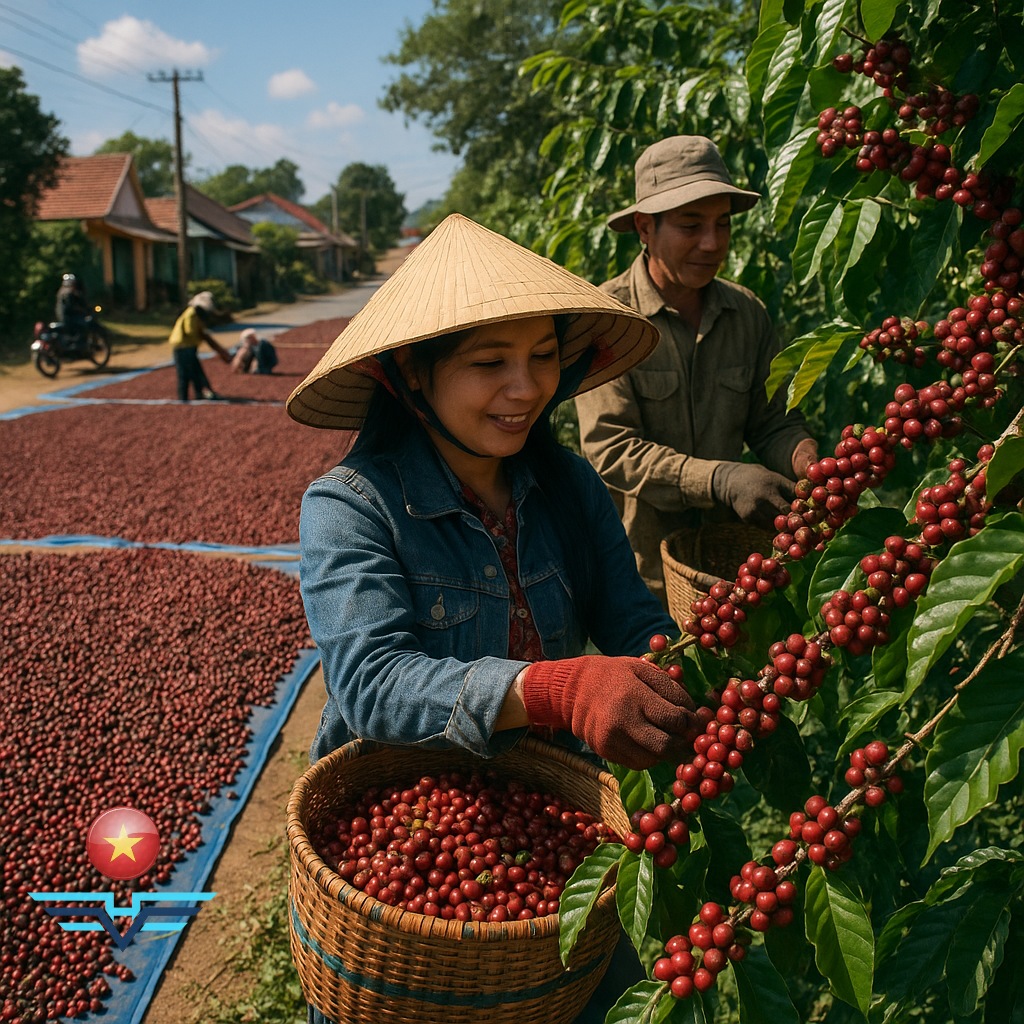
Visiting Lâm Hà District (Lâm Đồng) at harvest time, everywhere you go you’ll hear and see talk of coffee. Here, the heat of the market isn’t measured by gold or the U.S. dollar, but by the price of coffee. Even government officials growing coffee is considered nothing unusual—it’s just part of daily life.
Conversations Always Come Back to Coffee
Coffee is the easiest topic to discuss in Lâm Hà—simply because over 80% of households grow it. From adults to children, everyone in a family takes part in some stage of planting or tending coffee trees. During the busy harvest season, it’s hard to find homeowners at home; everyone is out picking. Every spare patch of yard, no matter how small, is covered with coffee beans laid out to dry.
In Hoài Đức Commune, farmer Đỗ Thị Hoa explains, amid rows of red-ripe coffee cherries: her family settled in Lâm Hà over 20 years ago and now tends 2 hectares of coffee. With prices around 34,000 VND per kilogram this year, after costs they still net nearly 100 million VND—an enviable sum for many farmers. And that’s not counting income from an extra hectare of mulberry. According to the district authorities, there are countless families like hers earning roughly 100 million VND from coffee this season.
Coffee needs year-round care, but harvest time demands the most labor. Lâm Hà has around 40,000 hectares under coffee, which is why workers flock here from neighboring provinces—Đắk Lắk, Phú Yên, Khánh Hòa, even as far as Thanh Hóa and Nghệ An—to pick and process beans. Hoa’s family has hired six pickers, paying about 100,000 VND per person per day; at Nguyễn Như Tùng’s processing workshop, workers earn nearly 3 million VND a month including meals—good wages for unskilled labor. Yet there’s still a shortage of hands. Some labor brokers exploit the situation, and a few unscrupulous people take advance pay and disappear after a few days’ work.
Anticipating these problems, the Lâm Hà district government tightened oversight of temporary workers and strengthened registration and public awareness to minimize losses. To prevent farmers from picking green cherries early out of fear of theft—lowering quality—many communes have also organized community self-defense teams funded by residents to patrol during harvest. These teams have sharply reduced cherry theft.
When Officials Are Also Farmers
On a trip toward Phúc Thọ and Hoài Đức, the district driver and deputy chief of the district People’s Committee Office chat about whether cherries are ripe and how yields look—because in Lâm Hà, about 90% of district and commune officials also grow coffee. It’s common for senior local leaders to be among the district’s highest-earning coffee farmers and largest taxpayers.
For example, Hoàng Sơn, deputy head of the district Party office, and Nguyễn Danh, chairman of Phúc Thọ Commune, each manage 5–6 hectares of coffee and run coffee-buying and processing workshops handling 500–600 tons a year. Hoài Đức’s chairman Nguyễn Khánh Cường has 5–6 hectares; its party secretary Nguyễn Văn Đức cultivates 8–9 hectares; district Party secretary Trần Thanh Phương, deputy Party secretary Phạm Văn Khả, and district chairman Trần Văn Tự all own one or two coffee plantations.
Thanks to coffee, many officials have built homes, bought cars, and sent their children to elite schools in Đà Lạt or Ho Chi Minh City. Though officially their farms are a “side job,” coffee often yields far more income than their government salaries.
Lâm Hà itself was formed in 1987 by merging Hanoi’s New Economic Zone in Lâm Đồng with five communes from Đức Trọng District. Most residents are migrants from northern provinces—Hà Nội, Hà Tây (old), Ninh Bình, Thái Bình, Nam Hà, Bắc Ninh—who settled two or three generations ago, clearing land and building livelihoods. Coffee became one of their most successful ways to make a living. Local officials, often early adopters of new agricultural techniques, invested confidently and know the craft well—sometimes better, as one leader jokes, than newly minted agricultural engineers. Although their government jobs keep them busy, they hire workers to manage and harvest their coffee plantations, visiting mostly on weekends.
Looking Ahead
As this successful harvest draws to a close, farmers already worry about the next season: rising fertilizer costs, whether the rains will be timely, how abundant the blossoms will be. With experience, determination, and hopefully some favor from nature, the coffee growers of Lâm Hà look forward to another season where the smiles of a bountiful crop will return.