
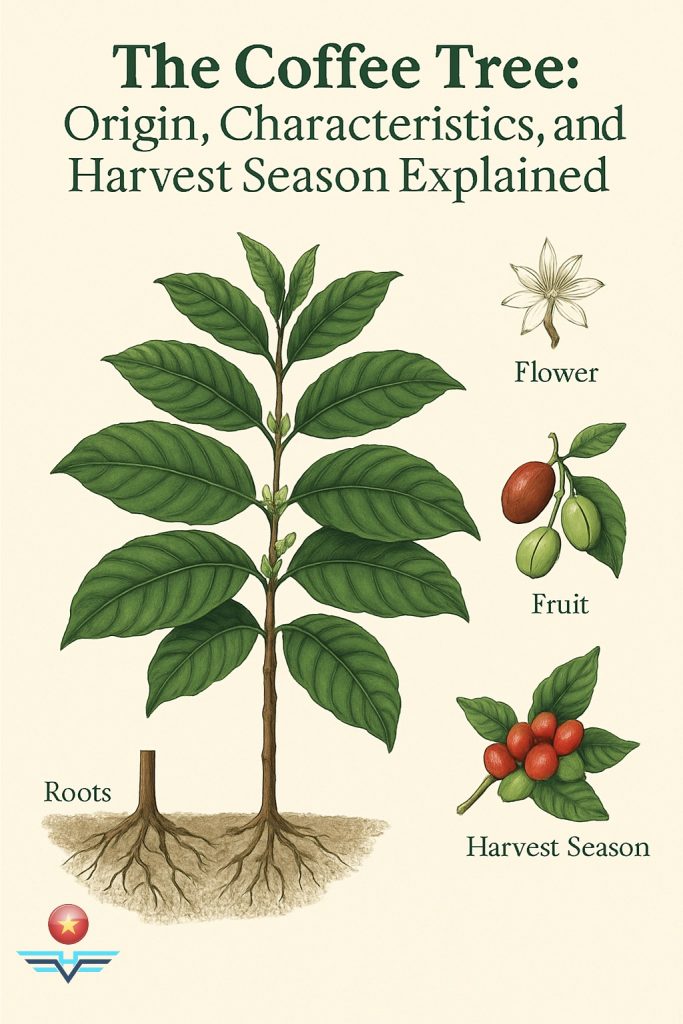
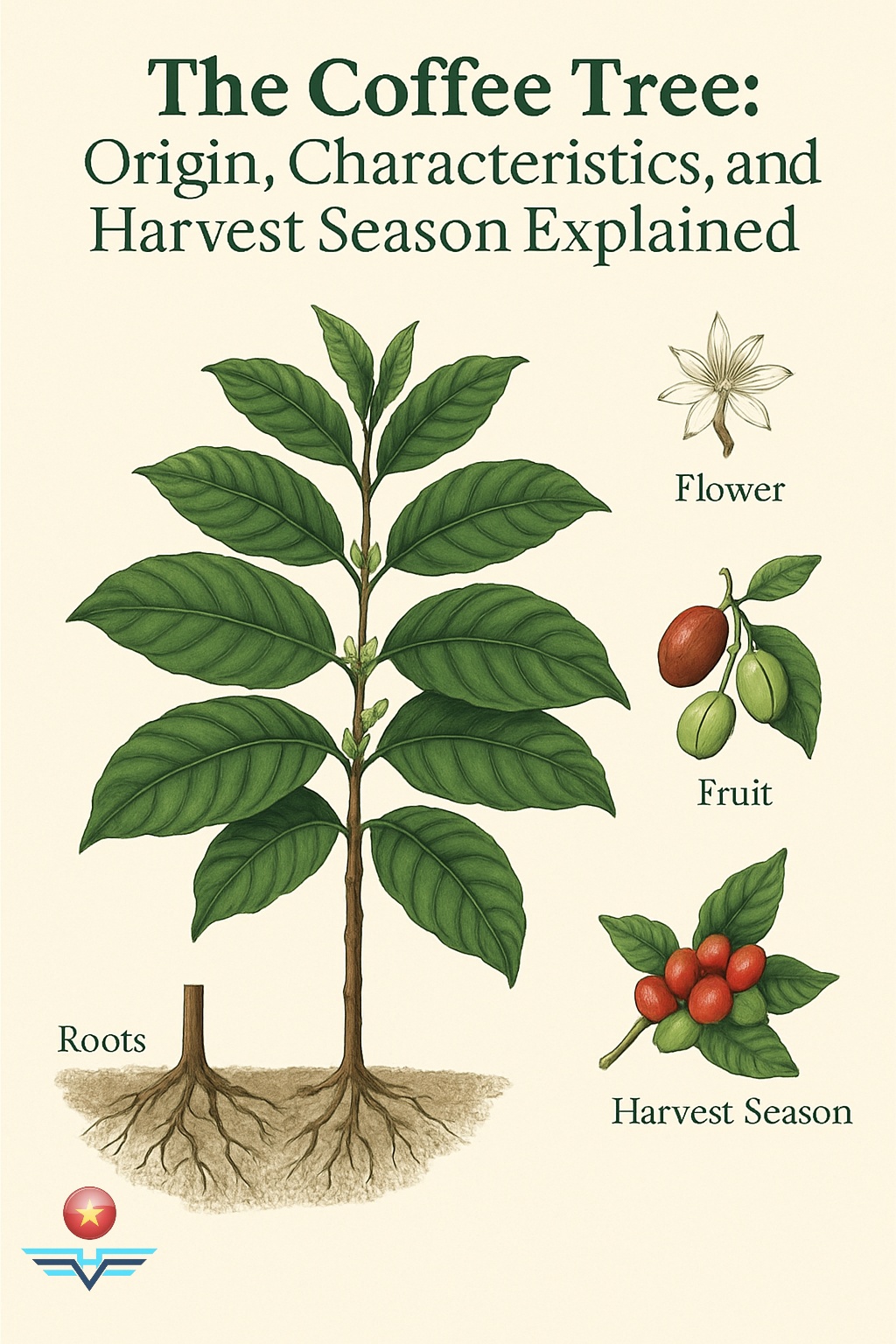
Coffee is the name of a genus of plants belonging to the Rubiaceae family. This family includes about 500 different genera with more than 6,000 tropical plant species.
The Coffea genus comprises many perennial species. However, not all of them contain caffeine in their seeds—some species are quite different from the coffee plants we commonly know.
Only two species of coffee have significant economic value. The first is Coffea arabica, commonly known in Vietnamese as “cà phê chè,” accounting for about 61% of the world’s coffee production. The second is Coffea canephora, also called Coffea robusta or “cà phê vối,” making up roughly 39% of global production. In addition, there are Coffea liberica and Coffea excelsa (known in Vietnam as “cà phê mít”), though their production volume is negligible.
Trunk
Table of Contents
The trunk of the robusta coffee tree, when cut, is often used for woodcarving or handicrafts.
Arabica coffee trees can grow up to 6 meters tall, while robusta trees may reach 10 meters. However, on coffee farms, they are usually pruned to a height of 2–4 meters to make harvesting easier. Coffee trees have slender branches and dark green, oval-shaped leaves with short petioles. The upper surface of the leaves is darker than the underside. Leaves are about 8–15 cm long and 4–6 cm wide.
Coffee trees have a deep taproot system extending 1–2.5 meters underground, with many lateral roots that spread out to absorb nutrients.
Flowers
Coffee flowers are white with five petals, usually blooming in clusters of two or three. Their color and fragrance resemble jasmine. Flowers last only 3–4 days, and the pollination period lasts just a few hours. A mature coffee tree can produce between 30,000 and 40,000 blossoms.
The flowering and fruiting stages allow farmers to estimate the upcoming harvest. In major coffee-producing countries, this plays an important role in predicting market trends and prices. However, severe cold or drought can disrupt these forecasts and cause major market fluctuations.
Fruits
Coffee is a self-pollinating plant, meaning wind and insects play a key role in reproduction. After pollination, it takes 7–9 months for the fruit to mature. Coffee cherries are oval and resemble small cherries. As they ripen, their color changes from green to yellow, then red, and finally dark when overripe.
Because flowering and fruiting occur over an extended period, it is common to see blossoms and ripe cherries on the same tree.
Each coffee cherry usually contains two seeds (beans) surrounded by a layer of pulp. The two beans are pressed together—flat on the inside and rounded on the outside. Each bean is covered by two thin layers: a white, tight parchment-like inner layer, and a looser yellow outer layer. The beans can be round or elongated and appear grayish-yellow to green when fresh. Occasionally, cherries have only one bean, known as a “peaberry,” due to incomplete seed development or fusion of the two beans.
Harvest Season (Crop Year)
In Vietnam—the world’s largest producer of robusta coffee—the crop year runs from October through the following September (according to the Gregorian calendar).
In the Central Highlands (which accounts for around 80% of Vietnam’s total output), the harvest typically lasts four months, from late October to the end of January.
Immediately after the harvest, farmers begin watering and fertilizing their coffee trees in multiple short cycles. This care period continues until April each year.