
Discovery
Table of Contents
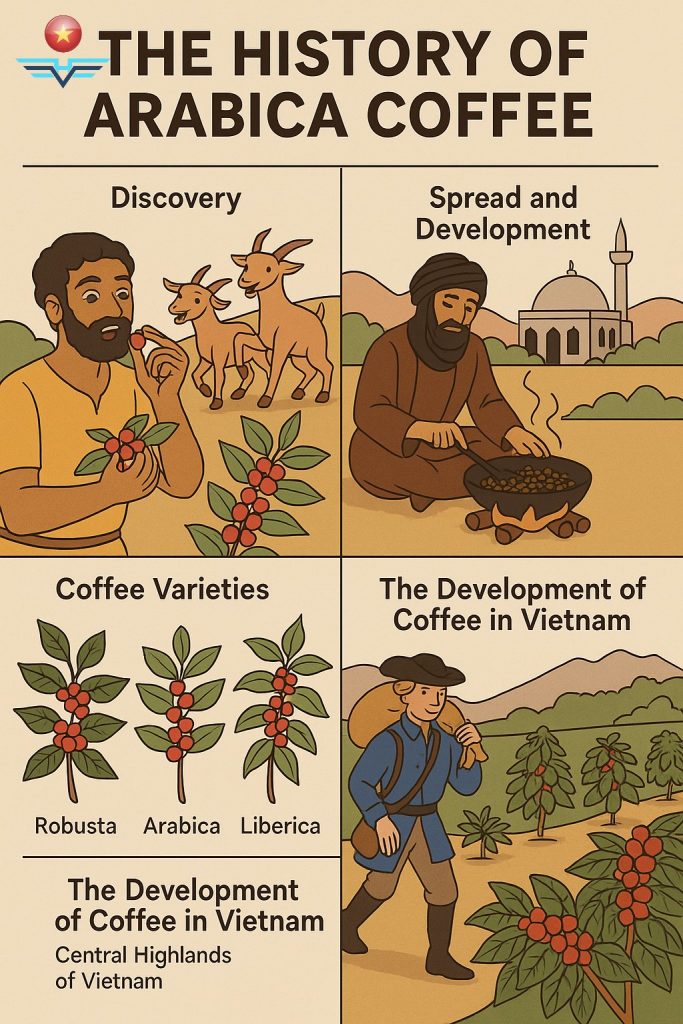
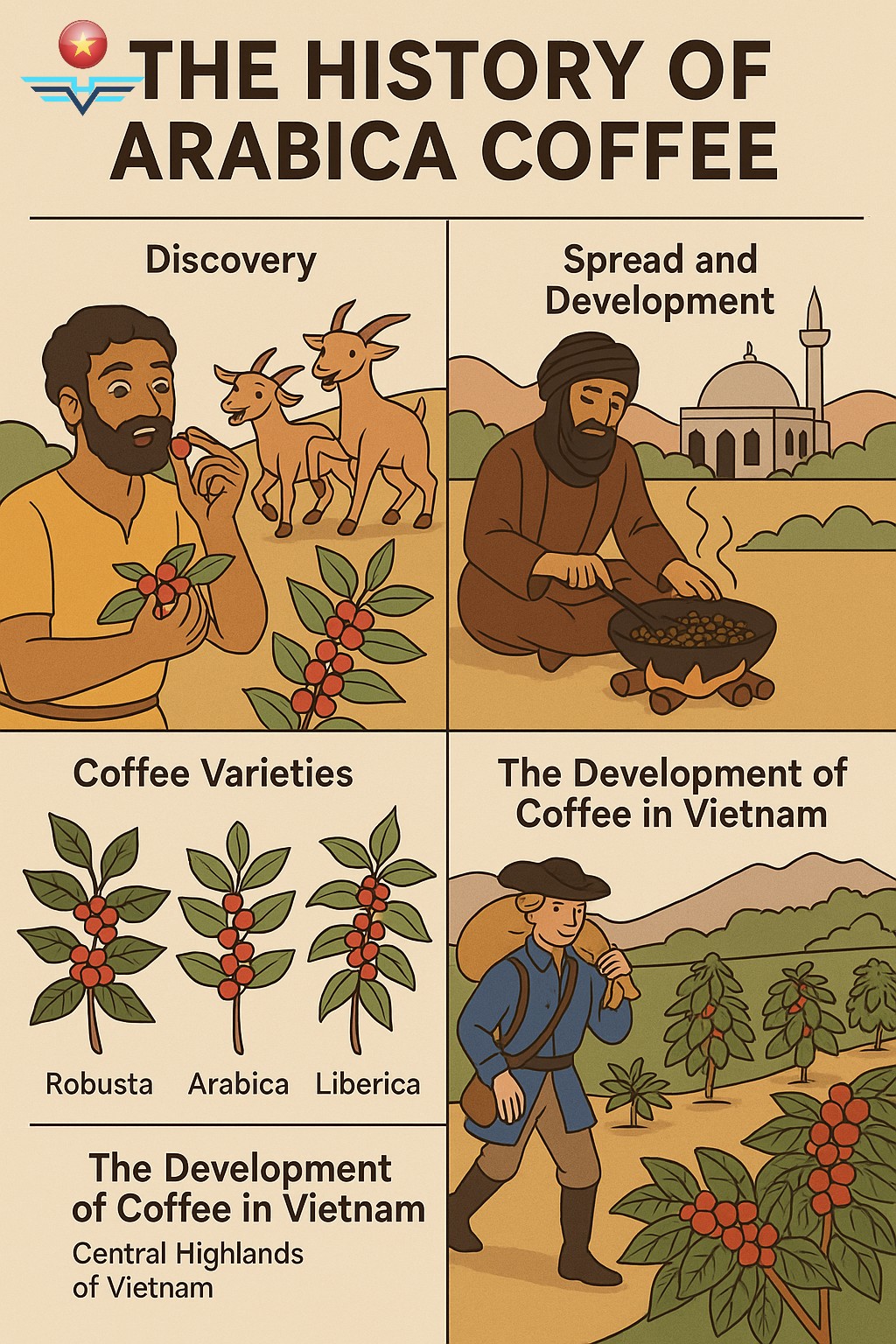
According to legend, the discovery of coffee dates back to around the year 600, beginning with Arabica coffee. The mythical story of coffee’s origin is tied to a goat herder named Kaldi, who lived in the mountainous regions of present-day Ethiopia. One day, while Kaldi was resting, his goats wandered off. When he awoke, he was alarmed to find them missing. After searching, he discovered his herd jumping excitedly on their hind legs, full of energy. Kaldi noticed they had eaten red berries from a strange tree. Fearing they might be poisoned, he drove them home anxiously.
The next day, the goats returned to the same bushes and ate the red fruits again. Seeing that they were unharmed, Kaldi tasted a few berries himself and immediately felt refreshed and alert. He took some of the berries home and told his parents about his discovery. His parents shared them with local monks, who found that chewing the berries helped them stay awake during long hours of prayer. The monks began drying the berries to transport them to distant monasteries, where they soaked them in water to make a stimulating beverage — the earliest form of coffee.
Spread and Development
After Kaldi’s discovery, news of the energizing red berries spread across the Middle East. Coffee berries were brought from Ethiopia to the Arabian Peninsula, where they were cultivated in Yemen. In Yemen, people used the coffee cherry husks to brew a tea-like drink. When coffee reached Turkey, people began roasting and grinding the beans, creating the form of coffee we know today.
For centuries, the Arabs kept the coffee plant a closely guarded secret. No one was allowed to take live plants or unroasted beans out of Arabia—only roasted coffee could be traded. By around 1640, roasted coffee was already popular in England and Europe, yet only the Arabs knew how the plant actually looked and how to grow it.
In the early 1700s, the Dutch managed to steal a coffee plant from Yemen, introducing it to Java, Indonesia. From there, coffee spread rapidly around the world. Coffeehouses began to flourish across Europe, becoming intellectual centers for discussion and exchange of ideas.
By the 18th century, coffee reached the Americas thanks to a French naval officer who carefully nurtured a coffee plant throughout his long transatlantic journey. He planted it on the Caribbean island of Martinique, where it thrived—producing over 19 million coffee trees within 50 years. From this small beginning, coffee cultivation expanded across tropical regions of Central and South America.
At that time, the U.S. Congress even declared coffee the national beverage, partly as a protest against Britain’s heavy tea tax.
Today, coffee cultivation and processing have become a global industry, employing over 20 million people. Coffee is the second most traded commodity in the world, after oil, with annual consumption exceeding 400 billion cups across more than 80 producing countries.
Coffee Varieties
The two main commercial species are Coffea canephora (Robusta) and Coffea arabica (Arabica). In some regions, Coffea excelsa (Liberica) is also grown, though its market demand remains limited.
Arabica (Coffea arabica) – often represented by the Catimor variety, a hybrid of Hybrido de Timor and Caturra developed in the 1980s – is a short tree reaching about 2.5 meters. Catimor’s beans have lower acidity and aroma compared to other Arabica types.
Robusta (Coffea canephora) – has larger leaves, rounder beans, and can grow up to 10 meters tall. It produces a stronger, more bitter brew that some markets prefer. Robusta is often blended with Arabica to balance flavor and strength.
Liberica (Coffea excelsa) – has the largest, roundest leaves and can exceed 10 meters in height. Its production is low, flavor more bitter and acidic, and harvesting is difficult due to its height, so cultivation is declining.
The Development of Coffee in Vietnam
The French introduced coffee to Vietnam around 1850. By the early 1900s, it was planted in northern provinces such as Tuyên Quang, Lạng Sơn, and Ninh Bình, as well as Nghệ An and Hà Tĩnh in the central region. Although Arabica was the first species introduced, Liberica was also planted widely at that time.
Later, the French expanded coffee cultivation to the Central Highlands (Tây Nguyên). Initially, Arabica was planted there, but severe leaf rust disease caused it to deteriorate, leading to its replacement with Robusta and Liberica. In Quảng Trị, the French also planted early coffee trees, which were later replaced by Liberica.
During the 1990s, Vietnam’s coffee output increased dramatically due to several factors:
-
The government’s land allocation policy giving farmers ownership of coffee land;
-
High coffee prices during 1994 and 1996–1998;
-
The migration and resettlement policy, which brought lowland farmers to the Central Highlands for intensive cultivation.
This expansion was most notable in Đắk Lắk, which became Vietnam’s largest coffee-growing province, accounting for nearly half the country’s total output.
In recent years, the government has sought to stabilize coffee acreage at around 500,000 hectares, to prevent deforestation during price booms. Today, Vietnam ranks second in the world in total coffee exports—after Brazil—and is the largest global exporter of Robusta coffee, holding about 14% of the world market share.