
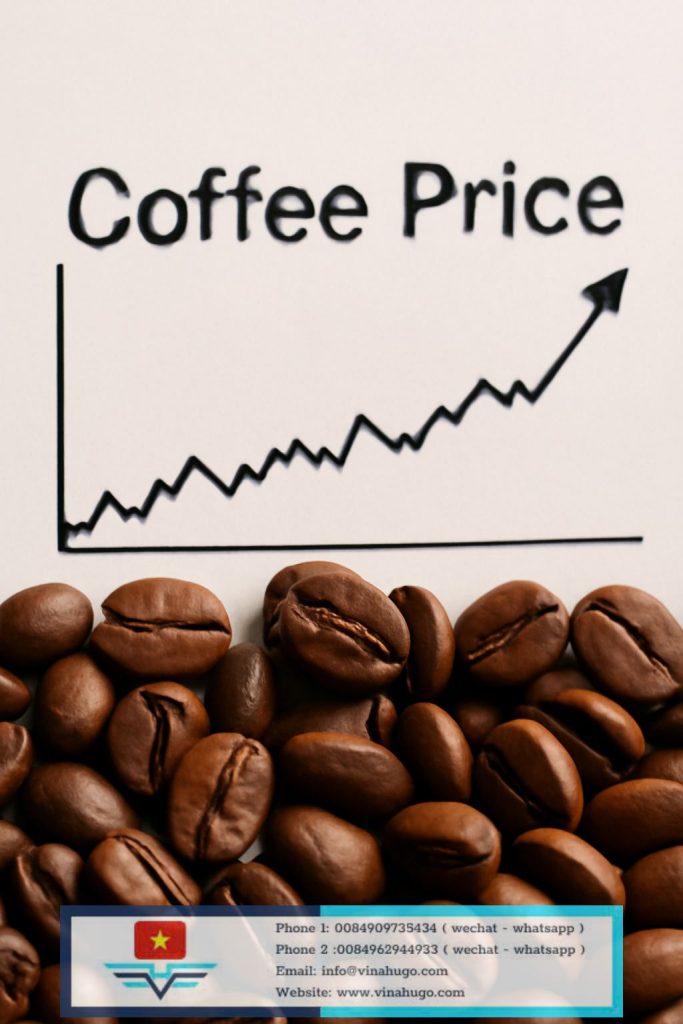

Currently, coffee price forecasts are a concern not only for macroeconomists and multinational companies but also for everyone whose life is tied to coffee beans.
Various Coffee Price Predictions
Recently, Y5Cafe’s community has been reading numerous articles regarding coffee price predictions, such as “The Coffee Market Rises” by Nguyen Quang Bich published in The Saigontimes, “The Robusta Coffee Price Rise is About to End” by Keith Flury, a senior analyst at Rabobank, “Coffee Prices Will Trend Down Until the End of the Year” by Rabobank (according to TTVN/Bloomberg), and recently “Holding Coffee Until Price Increases: Is It Profitable?” by Cong Hoan on SGGP Online, etc.
Each article presents its own analysis; some authors focus on technical market factors, others analyze the quantity of coffee shipped to ports in January and February 2012 from Vietnam, and some discuss production increases. All of these reasons suggest that the price of Robusta coffee will fall rapidly?
One thing is certain, readers are always cautious and thorough in analyzing the content of each article to identify the subjective opinions of the authors.
Some authors provide genuine information, backed by experience and market analysis capabilities, while others write for certain purposes.
For example, if you are the representative of a foreign company tasked with sourcing Vietnamese coffee at the request of Western clients, how can you offer honest opinions to the sellers? There are also authors who are PR agents for specific individuals, like the CEO who has faced nearly a decade of continuous losses and has sold off company assets but is still portrayed in the media as a hero and a business icon of Vietnamese coffee.
There are also currency traders who, naturally, want their money to flow smoothly for profits. But when the market is blocked, how can they not try to break the deadlock?
According to Rabobank, “Fundamentals will return to drive prices, not speculative activity?” But Rabobank did not specify what these fundamentals are that would adjust coffee market prices to $1,600 – $1,650/ton? Of course, coffee prices can be at this level, rise higher, or even fall lower, as we still lack clarity about the price.
Vietnam’s coffee prices have long been decided by external speculators due to a nascent market, weak financial infrastructure, and an unclear strategic direction for Vietnam’s agricultural exports. Vietnamese coffee exporters operate without coordination, while farmers face ongoing challenges.
Vietnam’s coffee exports currently amount to approximately 1,200,000 tons per year. Meanwhile, domestic consumption is on the rise, and Vietnam’s production could drop to 4th or 5th place globally if a $2/ton fee isn’t imposed to “protect” it, according to the Chairman of Vicofa.
Rabobank forecasts Vietnam’s next coffee crop will reach 21.5 million bags, equivalent to 1.28 million tons. Does this mean farmers will have a bumper harvest? How can farmers, who endure tough conditions, not be uncertain about their yield for the 2012/2013 season?
The Central Highlands region is experiencing sudden weather changes this year, with cold and rainy weather just before and after the Lunar New Year. The coffee flowers bloomed in multiple rounds, and in some areas, farmers couldn’t irrigate. Coffee trees need dry weather to trigger flower differentiation, and the flowers will only set fruit uniformly if there is sufficient irrigation and fertilization. As a result, some farmers will lose up to 10-15% of their yield. So, where will the large quantities of coffee come from?
Holding Coffee, Waiting for Prices: What Will Happen?
According to Cong Hoan’s analysis, farmers are holding coffee to wait for higher prices. However, this “only partially true” because the analysis indicates that only 30% of households are still holding stock, meaning that about 300,000 tons of coffee, or 30% of Vietnam’s total coffee export production, is still in the hands of farmers.
It’s also noted that holding coffee is not a market regulation factor, as it’s “not quite accurate.” In 2010-2011, the government decided to temporarily store 300,000 tons, and the world coffee market immediately adjusted. So while farmers may be holding coffee, it’s more about them stepping in where the government could have done so, temporarily storing coffee in a way that benefits the entire country.
In fact, this behavior isn’t new for farmers. More than a decade ago, many households saved small amounts of coffee each year and sold it after a few years. However, back then, their stored coffee was often seized and sold off by others. Now, farmers are holding onto their coffee at home, and “speculators” who typically buy and sell immediately find that holding stocks in the hands of farmers positively impacts the market.
With increasing demand and restricted supply, coffee traders are “squeezing prices.”
According to the ICO’s forecast, global coffee production is currently down, with Robusta coffee traded in London mostly from Vietnam. The upcoming crop will likely be smaller for Vietnam. In 2010-2011, Robusta coffee prices in London reached $2,800/ton. So, we’ll have to see what happens compared to these forecasts.