
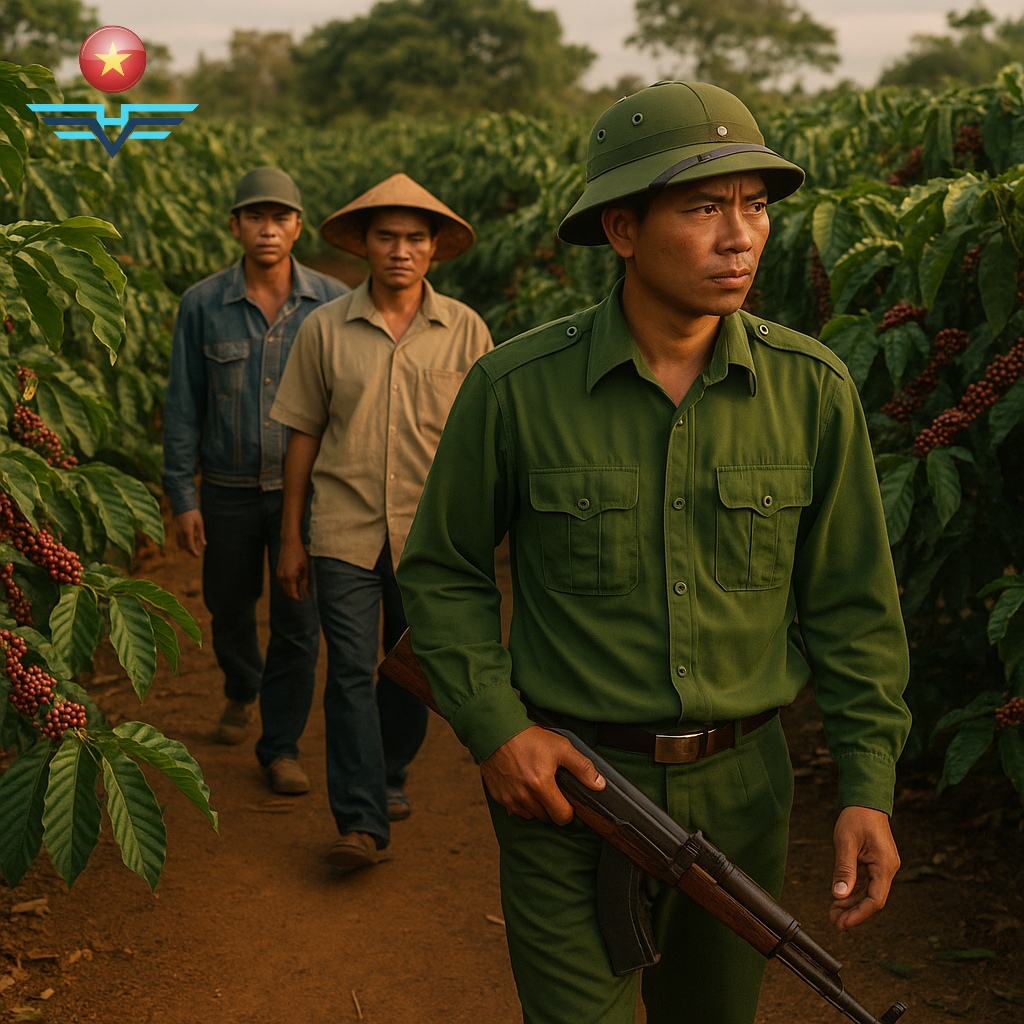
The Central Highlands is entering its coffee harvest season. Along with the excitement of high coffee prices, farmers are also facing a wave of coffee thefts and soaring labor costs. As a result, many have been forced to harvest their crops while the cherries are still green, despite knowing this will hurt both yield and quality.
Picking Early to Avoid Theft
Although his coffee cherries are still unripe, for over a month Vũ Minh Khương’s family (Đống Đa Ward, Pleiku City, Gia Lai) has had to station people full-time in their fields to guard against thieves. With over three hectares of coffee, he has hired two extra workers to take turns watching the crop day and night.
“To prevent theft, we have to live right out in the plantation—eating and sleeping there to keep watch. This year the drought has cut yields by about a third compared to last year, but at least the price of coffee is quite good,” Khương shared.
K’sor Rel (Thắng Lợi Ward, Pleiku) added that recently thieves have become brazen, not only stealing but openly grabbing coffee bags from the fields. They wait until the cherries are picked and bagged, then strike when family members are distracted. Even though only half of his two hectares of coffee is ripe, his family has had to start harvesting early, accepting the loss.
Coffee theft has become almost routine across Gia Lai and the Central Highlands. Thieves usually work in groups, taking advantage of darkness, midday quiet, or dense groves to sneak in. Some even use motorbikes or farm trucks to strip entire rows of coffee—branches, leaves and all—then haul the harvest home to process.
Community Vigilance
In K’Dang Commune (Đak Đoa District), where villagers grow hundreds of hectares of coffee alongside rice, strong community solidarity has kept theft at bay.
“Our coffee is about 70% ripe but we’re in no rush,” said Đinh Gơih of K’Dang Village. “We finish harvesting rice first, then pick coffee when it’s fully ripe. Our village has four cooperative work groups, each with 30–40 people, harvesting one family’s crop after another.”
In Ia Dêr Commune (Ia Grai District), with over 1,000 hectares of coffee (nearly 700 hectares cultivated by ethnic minority households), local authorities and security forces mobilize each harvest season. Families set up tents in their fields and string electric lights to guard through the night. Village patrol teams regularly check households and warn residents to watch for thieves.
Deputy Commune Police Chief Puih Rên explained that during the harvest, police and militia patrol day and night, inspect household registrations, and promptly handle any theft. Families with members caught stealing coffee face strict legal action.
Protecting Quality and Long-Term Yields
Coffee experts emphasize that when local authorities and producers coordinate closely and strictly enforce harvest guidelines, security can be maintained without compromising quality. Growers and companies must follow proper picking techniques and wait until about 90% of cherries are ripe to ensure both yield and long-term tree health.
Tam Ba Farm (Nghĩa Hưng Commune, Chư Pah District) is a model example. With more than 100 hectares of coffee, the farm works closely with local authorities and even contracts military units for protection. This allows them to wait until cherries are fully ripe before harvesting.
“We usually harvest late in the season,” said farm manager Cao Xuân Hưởng. “That way, labor is easier to find and the hiring rates are lower.”
With more than 80,000 hectares under cultivation, coffee is a key crop and primary source of income for Gia Lai Province. To protect both coffee quality and sustainable production, local governments and agencies are urged to enforce strict rules on harvest timing—especially requiring about 90% ripeness—and to tighten security throughout the harvest season.