
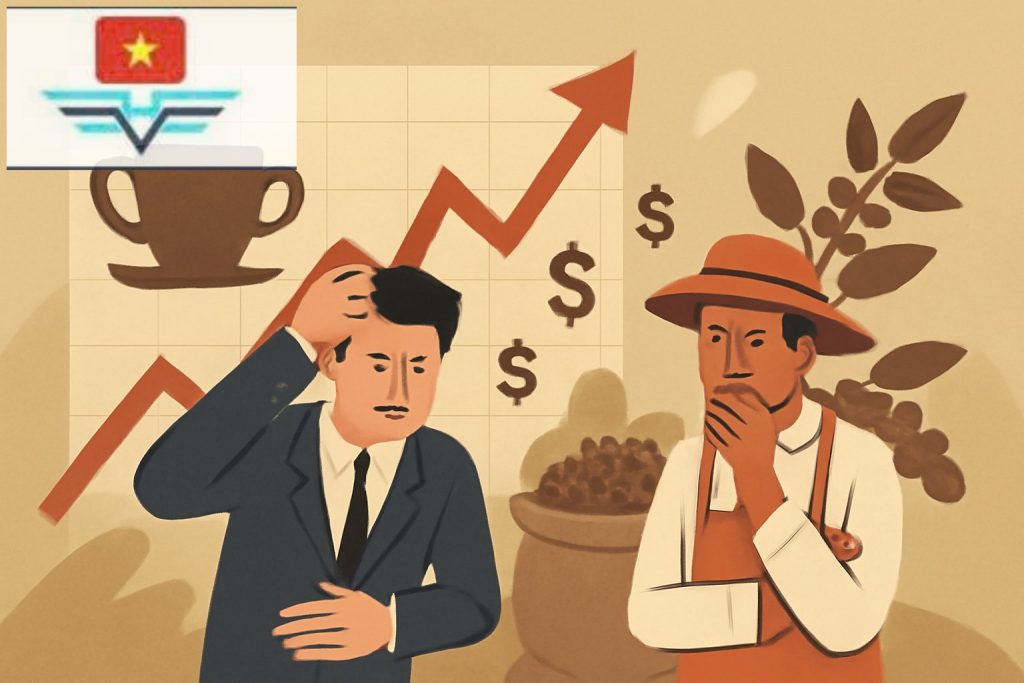
At first glance, you might be surprised by the title, “The Negative Impacts of Price Increases,” because we all hope for higher prices to benefit coffee farmers. However, it’s not necessarily a good thing if prices increase dramatically when traders have sold short.
Let’s consider an example scenario with the following details:
Around August or September 2010, some companies sold futures contracts for coffee to be delivered in November 2010, with a $120/ton discount, FOB Ho Chi Minh. They believed that prices would likely decrease as harvest season began in November.
These companies thought that prices would decrease in November, so they fixed prices earlier, for instance, they locked in $1,600 – 120 = $1,480/ton.
Recently, we’ve seen coffee prices fluctuate—falling by a large margin and then rising sharply. And now, those companies are starting to reach their delivery deadlines, which means they have to buy coffee to fulfill their contracts.
As we can easily see, the current coffee price is around 33,800 VND + packaging + transport to the port + processing, which totals approximately 34,350 VND/kg. This is equivalent to $1,760/ton, which means they are losing about $280/ton, or around 5.4 million VND/ton.
Not only that, but they face a second problem: it will be difficult to buy coffee from farmers at this time, as farmers tend to hold onto their coffee when they see prices rising. In this situation, they’re essentially stuck in a “dead-end,” unable to escape.
To get out of this “live-or-die” situation in the coffee market (and similarly in stock markets), there’s a term called wash-out, which I translate as “getting rid of the position.”
In this case, the wash-out would be carried out through brokers or buyers, where the seller would place an order to buy coffee in response to market movements, in order to meet the quantity they had previously sold, so they can deliver that quantity to their buyer. If they fail to do this, they would risk defaulting on their contract. It’s a painful situation for our coffee traders. Sometimes, those in business suffer more from pride than from actual failure.
When a country that is the second largest coffee exporter in the world has many traders scrambling to buy coffee (now they are buying, not selling) to fulfill contracts, the market price will artificially increase. Who benefits from this price increase? Well, it might just be those who bought coffee from us earlier.
I am writing this article not just to casually discuss the coffee market for fun, but to highlight an issue for farmers to understand the struggles coffee traders face. It is not easy to navigate a business when the price can cause both success and failure. The bigger the boat, the bigger the waves. Without businesses, who will bring coffee to the global market?
Through this, I also hope that economists and macro researchers can come up with strategic solutions for Vietnam’s coffee industry.