
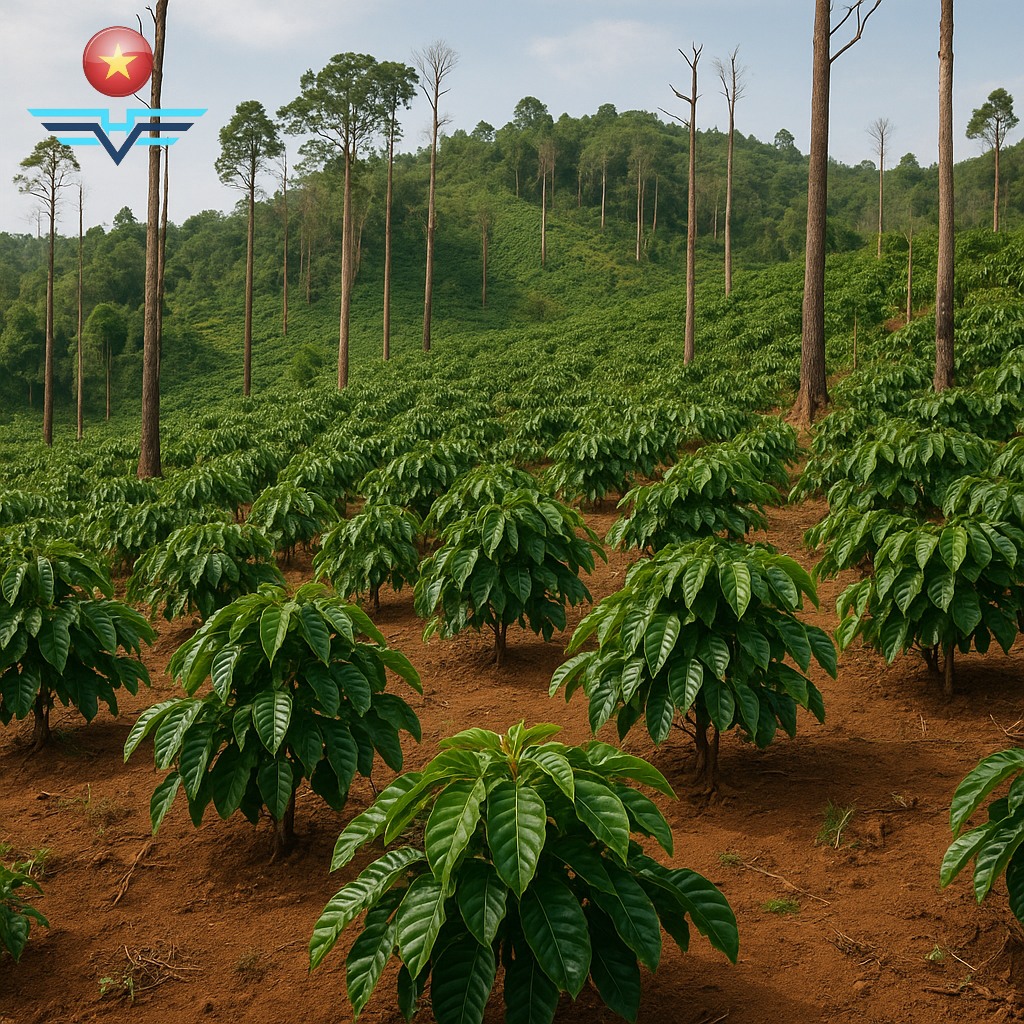
Authorities in Ea H’leo District (Dak Lak Province) recently uncovered a startling case: nearly 50 hectares of coffee were found growing on land that the provincial People’s Committee had leased to Loc Phat Trading and Production Co., Ltd. for forest plantation purposes.
Deliberate Violation
In 2008, under then–Chairman Lu Ngoc Cu, the Dak Lak People’s Committee approved leasing 362 hectares of unused hilly land in sub-zone 106, Ea Hiao Commune, Ea H’leo District, to Loc Phat Company for afforestation.
From then until late 2012, key provincial agencies such as the Department of Agriculture and Rural Development (DARD) and the Department of Planning and Investment failed to monitor the project’s progress. Acting on local reports, the Ea H’leo District People’s Committee ordered the district’s DARD office, Forest Protection Unit, and Ea Hiao Commune authorities to inspect the site.
Inspectors discovered 48.178 hectares of Arabica coffee, including 36 hectares planted in 2008–2009. On November 1, 2012, the team found two excavators and about 20 workers still clearing forest land to plant more coffee.
When questioned, Ho Dac Dung, Director of Loc Phat Company, argued that the coffee planting complied with Decision 178/2001/QĐ-TTg of the Prime Minister on “benefits and obligations of households and individuals allocated, leased, or contracted forest and forestry land.”
Dung claimed that households or individuals leasing forest land for production are allowed to use up to 20% of the area for agriculture or aquaculture. But everyone knows coffee brings far greater economic returns than forest trees. The Central Highlands has no policy allowing private firms—except state-owned coffee enterprises—to lease forest land specifically for coffee cultivation.
Cut Down or Lose the Project
On January 15, during a meeting with provincial agencies and the Ea H’leo District People’s Committee, Loc Phat finally admitted that planting coffee on forest land violated regulations. However, Dung proposed an alternative: interplant forest trees among the coffee, continue harvesting coffee, and remove the coffee only after the forest canopy closed.
The authorities concluded that planting over 48 hectares of coffee violated the approved land-use plan, the investment project appraisal, and local land-use zoning. Furthermore, the company was not eligible for the benefits under Decision 178/2001/QĐ-TTg.
The Forest Protection Sub-department recommended revoking the entire project. The meeting ultimately agreed to allow Loc Phat to continue the project only if it committed to cutting down the coffee and replanting forest in 2013.
If by February 15 the company failed to submit a written commitment, the provincial DARD would report to the Dak Lak People’s Committee to revoke the entire leased area without compensation for any investment costs. The provincial authorities are now reviewing these recommendations. The case underscores the need for strict enforcement to prevent forest-planting projects from being turned into agricultural ventures.
Related Disciplinary Action
Earlier, Lu Ngoc Cu had been disciplined by the Party Central Inspection Commission (11th term) and removed from his position as Chairman of the Dak Lak People’s Committee to take a post with the Central Highlands Steering Committee. Among his violations was allowing Loc Phat Company to lease land in a watershed protection forest in Krong Nang District for rubber planting, even as local residents lacked land for cultivation.
Separately, Y Manh Adrong, Vice Chairman of the Ea H’leo District People’s Committee, revealed that Loc Phat had once transferred a forest-planting project in the district to another company for billions of dong. This was a joint forest-planting project between Loc Phat and Ea H’leo Forestry One-Member LLC, a provincial state-owned enterprise. In 2008, Loc Phat transferred the project to Tan Hung Long Paper Materials Co., Ltd. (Khanh Hoa), but Tan Hung Long has yet to receive provincial approval for the land lease and is still investing in managing and tending the planted forest area.