
With 162,000 hectares of coffee plantations producing about 320,000 tons of beans annually, Đắk Lắk Province leads both the Central Highlands and Vietnam in coffee production. Yet despite this scale, 80% of the province’s coffee is still harvested, processed, and stored by smallholder farmers using traditional methods, resulting in:
-
High post-harvest losses
-
Low, inconsistent quality
-
Failure to meet international technical standards
The Challenge: Traditional Processing Limits Quality
Table of Contents
Although Đắk Lắk has over 100 coffee processing companies, only about 20 own plantations and operate modern closed-loop systems, covering just 20% of total output. The remaining 80% relies on basic, traditional methods that cannot ensure uniform quality or efficiency.
The Breakthrough: Pilot Wet-Processing Project
Project Overview
To tackle these challenges, a pilot project funded by the National Industrial Promotion Program and local agencies was launched in Pơng Drang commune (Krông Búk district).
-
Total investment: 310 million VND
-
150 million VND from the national program
-
160 million VND from other sources
-
-
Implementation period: May–December 2005
-
Operator: Ea Tút Agricultural–Electricity Service Cooperative
-
Capacity: 1 ton/hour — equivalent to 500–700 tons of fresh cherries annually
This project—“Building a Pilot Household-Cluster Wet Coffee Processing Model in Krông Búk District”—has since become a blueprint for replication across other coffee-growing clusters in Đắk Lắk.
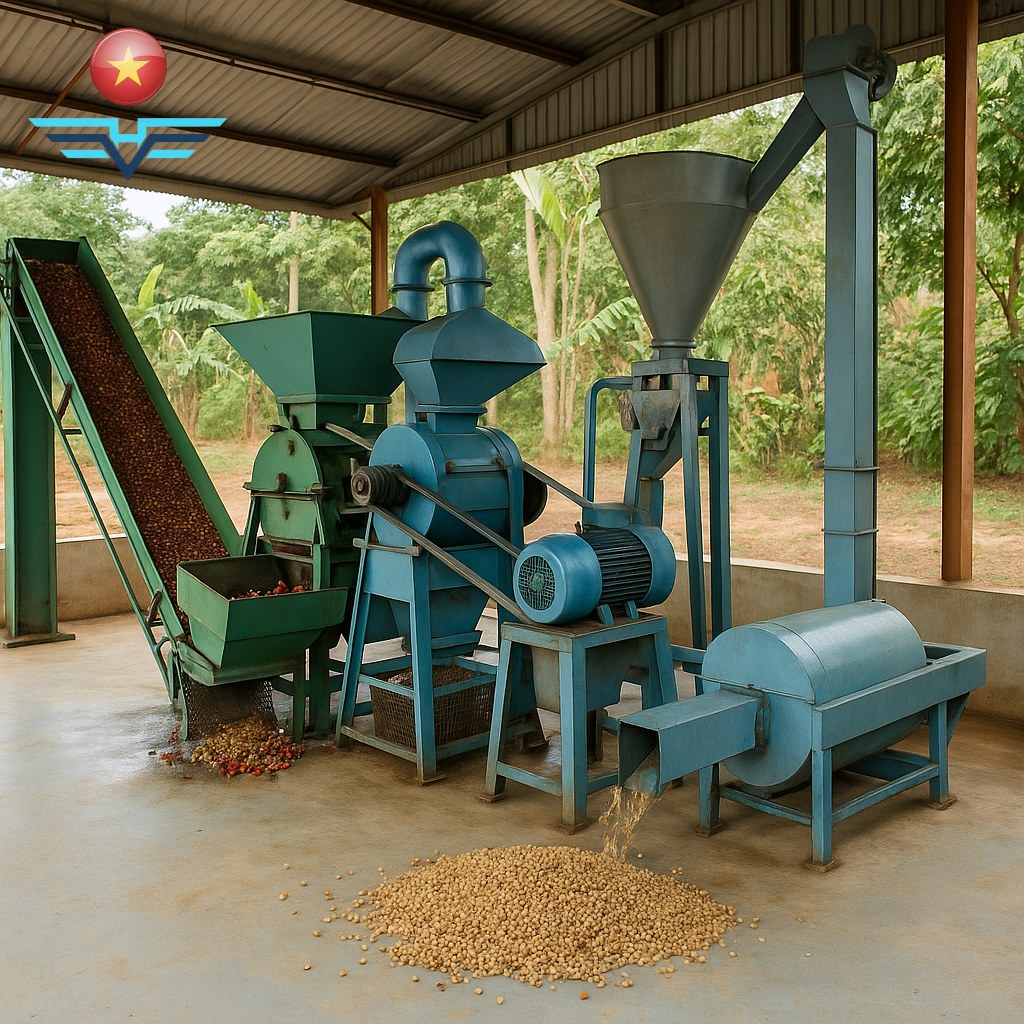
How the Wet-Processing Line Works
-
Cherry Reception & Cleaning – Freshly picked cherries are cleaned to remove impurities.
-
Pulping – A bucket elevator moves high-quality cherries to the pulping machine, which separates the beans from the pulp.
-
Washing & Mucilage Removal – Beans are washed to remove mucilage.
-
Static Drying – Beans are machine-dried into parchment coffee, ensuring consistent moisture and clean removal of the mucilage.
Technical Specifications
-
Power requirement: 19.5 horsepower
-
Water consumption: 5–5 m³ per ton of cherries
-
Husk removal & bean breakage: <4%
Economic Benefits
-
Conversion efficiency: 4.5 kg of fresh cherries → 1.28 kg of dried parchment coffee
-
Price advantage:
-
Fresh cherries: ≈ 2,500 VND/kg
-
Dried parchment coffee: ≈ 10,000 VND/kg
-
This value addition yields significantly higher profits than traditional dry processing.
Social & Environmental Impact
For Farmers
-
A single wet-processing line can handle 40–50 hectares, serving about 10 member households.
-
Creates 15–20 local jobs.
-
Farmers can choose direct sale, consignment, or contract processing, reducing the need for individual investments in drying yards or storage.
Environmental Benefits
-
Low wastewater generation; by-products can be reused for irrigation or as fertilizer, making the system environmentally friendly.
Training and Knowledge Transfer
-
One vocational training class on wet coffee processing.
-
Two seminars with nearly 200 delegates and hundreds of local farmers to showcase the model.
The Đắk Lắk pilot wet-processing model demonstrates how modern processing technology can:
-
Raise coffee quality to international standards
-
Increase farmer incomes
-
Create sustainable, community-based processing clusters
By scaling this model across the Central Highlands, Vietnam can further strengthen its position as a leading global coffee exporter while improving livelihoods for smallholder farmers.