
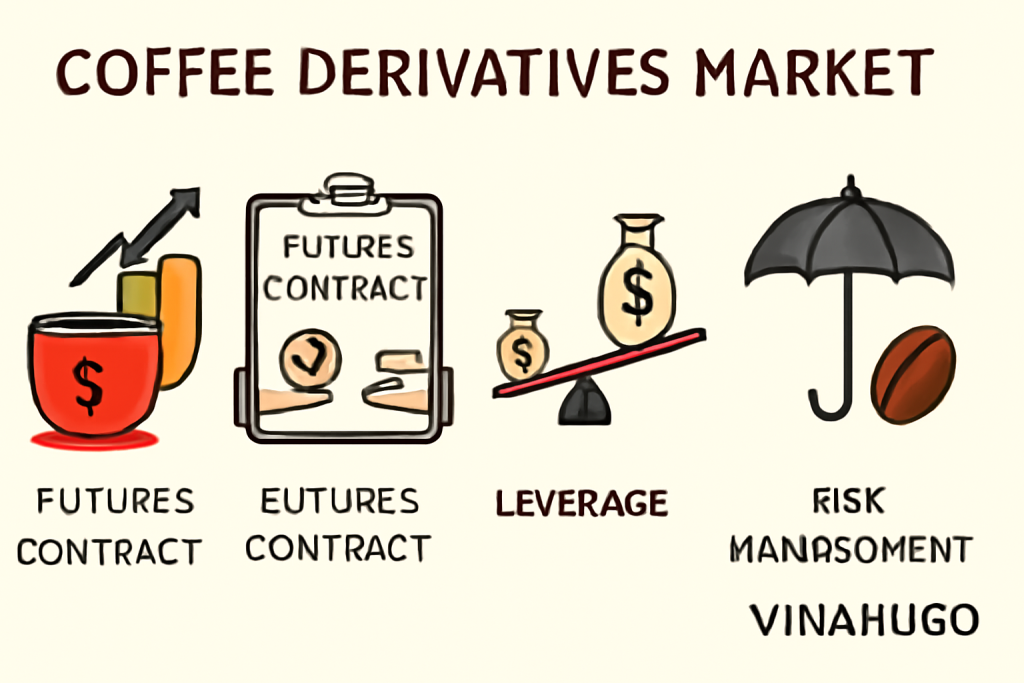
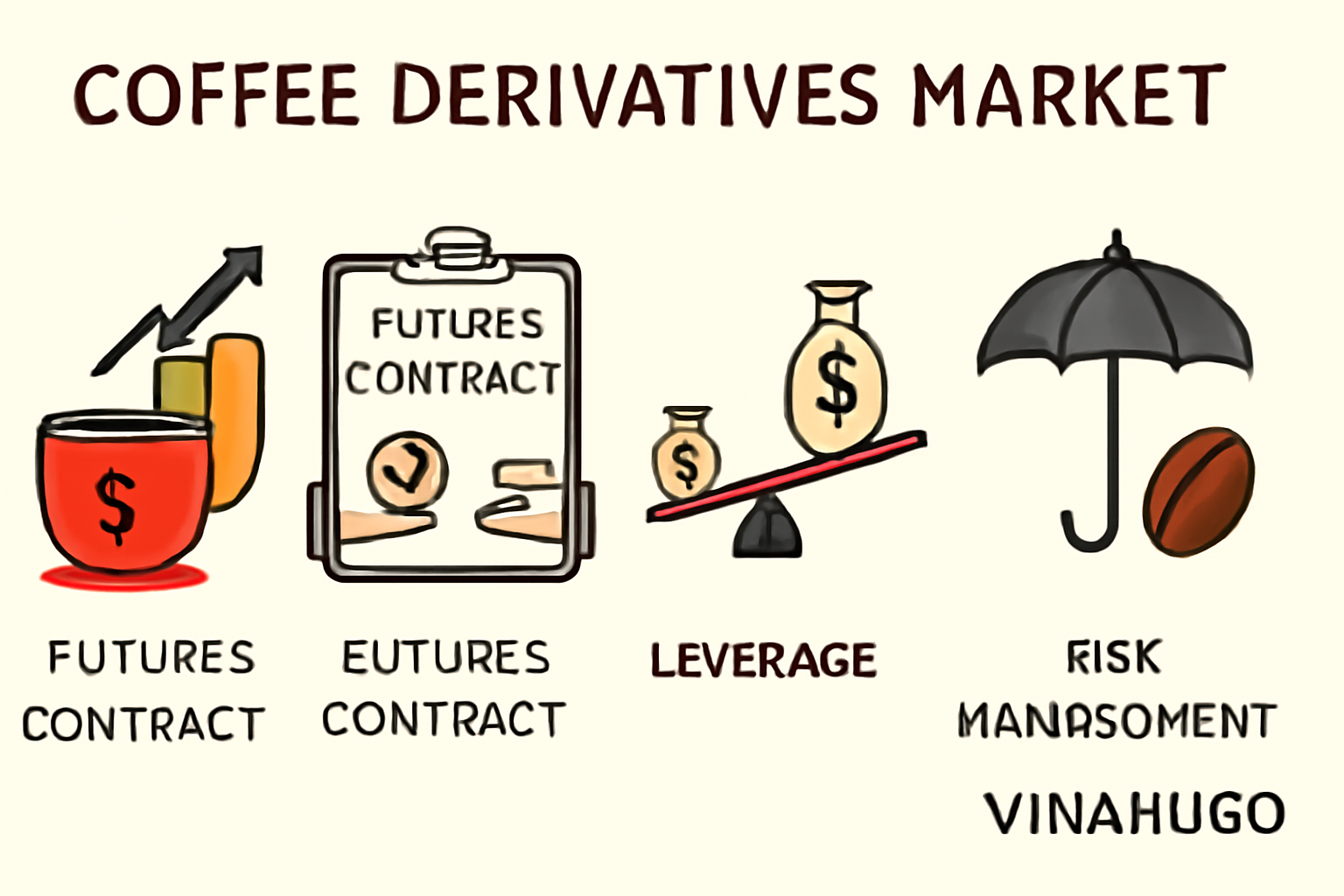
1. Concept of the Derivatives Market
Table of Contents
The derivatives market is where agreements are made for trading derivative products—financial instruments whose value is derived from an underlying asset, such as commodities, stocks, bonds, or currencies. The value of a derivative depends on the price movement of the underlying asset.
2. Types of Derivative Contracts
Forward Contracts
-
Definition: An agreement between a buyer and seller to trade an asset at a predetermined price at a future date.
-
Characteristics:
-
Traded in the over-the-counter (OTC) market.
-
Flexible terms, not standardized.
-
High liquidity risk as contracts may be difficult to sell.
-
High payment risk because the parties agree to a fixed price, regardless of market changes.
-
Futures Contracts
-
Definition: A standardized contract traded on exchanges, where the contract value is adjusted daily.
-
Characteristics:
-
Traded through exchanges via brokers.
-
Standardized terms.
-
Requires margin payments from both parties.
-
Most futures contracts are liquidated before their expiry.
-
Option Contracts
-
Definition: A contract where the buyer has the right, but not the obligation, to buy or sell an asset at a predetermined price on a future date. The buyer pays a premium for this right.
-
Characteristics:
-
Two types: Call options (buy) and Put options (sell).
-
Traded on both formal and informal markets.
-
Swap Contracts
-
Definition: A series of cash flows exchanged between two parties at agreed dates in the future, with no upfront cash settlement.
-
Characteristics:
-
Conducted on a net basis, reducing credit risk.
-
Initial value is zero, with no upfront payment.
-
3. Coffee Futures Contracts
-
Definition: A standardized contract to trade a specific quantity and type of coffee at a predetermined future date for an agreed price.
-
The buyer and seller are obligated to either receive or deliver coffee, but most futures contracts are closed (settled) before the actual delivery.
Margin and Leverage
-
Margin: A deposit required to guarantee the execution of the contract.
-
Leverage: Futures contracts provide the opportunity to use leverage. This means an investor can control a large position with a smaller margin deposit. For example, buying an arabica coffee futures contract for $56,250 with a margin of $3,000, and selling it when the price increases by 15 cents/lb, will give a profit of $5,625 (187.5% return on the initial margin).
4. History of the Coffee Derivatives Market
-
1848: The Chicago Board of Trade (CBOT) was established to standardize the trade of grains with contracts.
-
1865: CBOT officially launched futures contracts.
-
1882: The first coffee futures exchange was created in New York.
-
2007: NYBOT merged with the Intercontinental Exchange (ICE), which now owns the coffee futures market.
5. Major International Coffee Derivatives Exchanges
-
ICE New York: Primarily trades arabica coffee.
-
Liffe London (Euronext): Primarily trades robusta coffee.
-
BM&F Brazil, SICOM Singapore, Tokyo Grain Exchange (TGE).
6. Coffee Pricing Principles
-
When futures contracts mature, the official trade price (FOB price) is calculated based on the future price plus or minus a differential (e.g., transport costs, quality adjustments).
-
This pricing mechanism is common for most coffee globally, except for some special varieties like Kenyan coffee, which is auctioned nationally and adjusted in future trades.
7. Characteristics of Coffee Futures Contracts
Arabica – ICE
-
Contract size: 37,500 lb (~250 bags).
-
Trading hours: 3:30 – 14:00 (New York).
-
Price unit: cents/lb.
-
Trading months: 3, 5, 7, 9, 12.
Robusta – ICE (Liffe)
-
Contract size: 10 tons.
-
Trading hours: 09:00 – 17:30 (London).
-
Price unit: USD/ton.
-
Trading months: 1, 3, 5, 7, 9, 11.
Conclusion
The coffee derivatives market provides an important mechanism for managing price risks, creating liquidity, and offering investment opportunities. However, it also carries significant risks, especially when leveraging financial instruments. Investors must understand the rules, mechanics, and risk management strategies to engage effectively.