
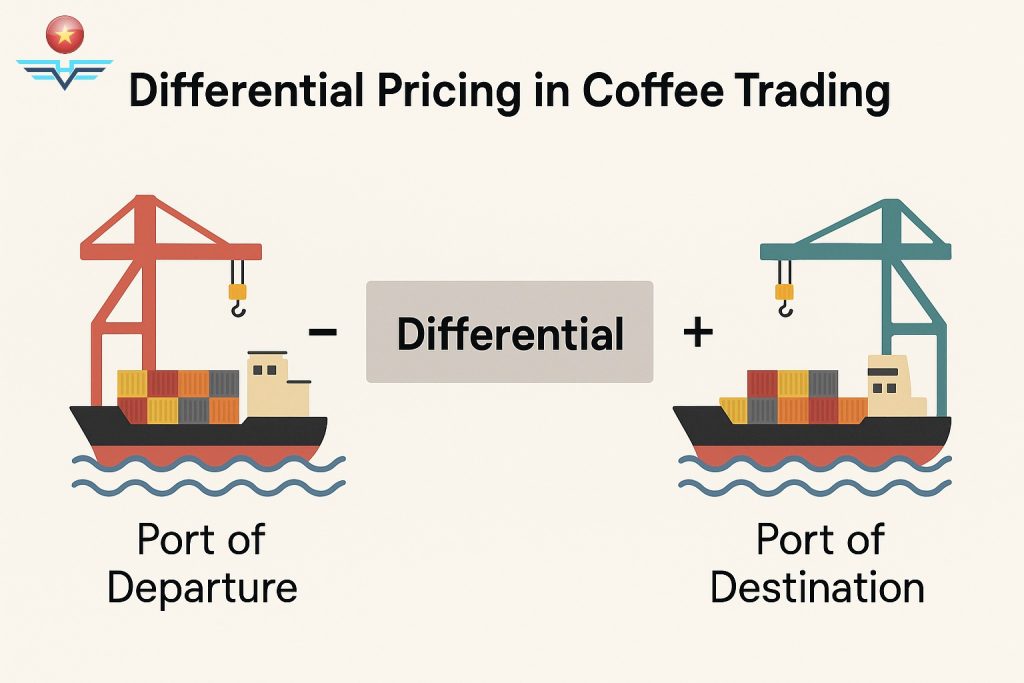
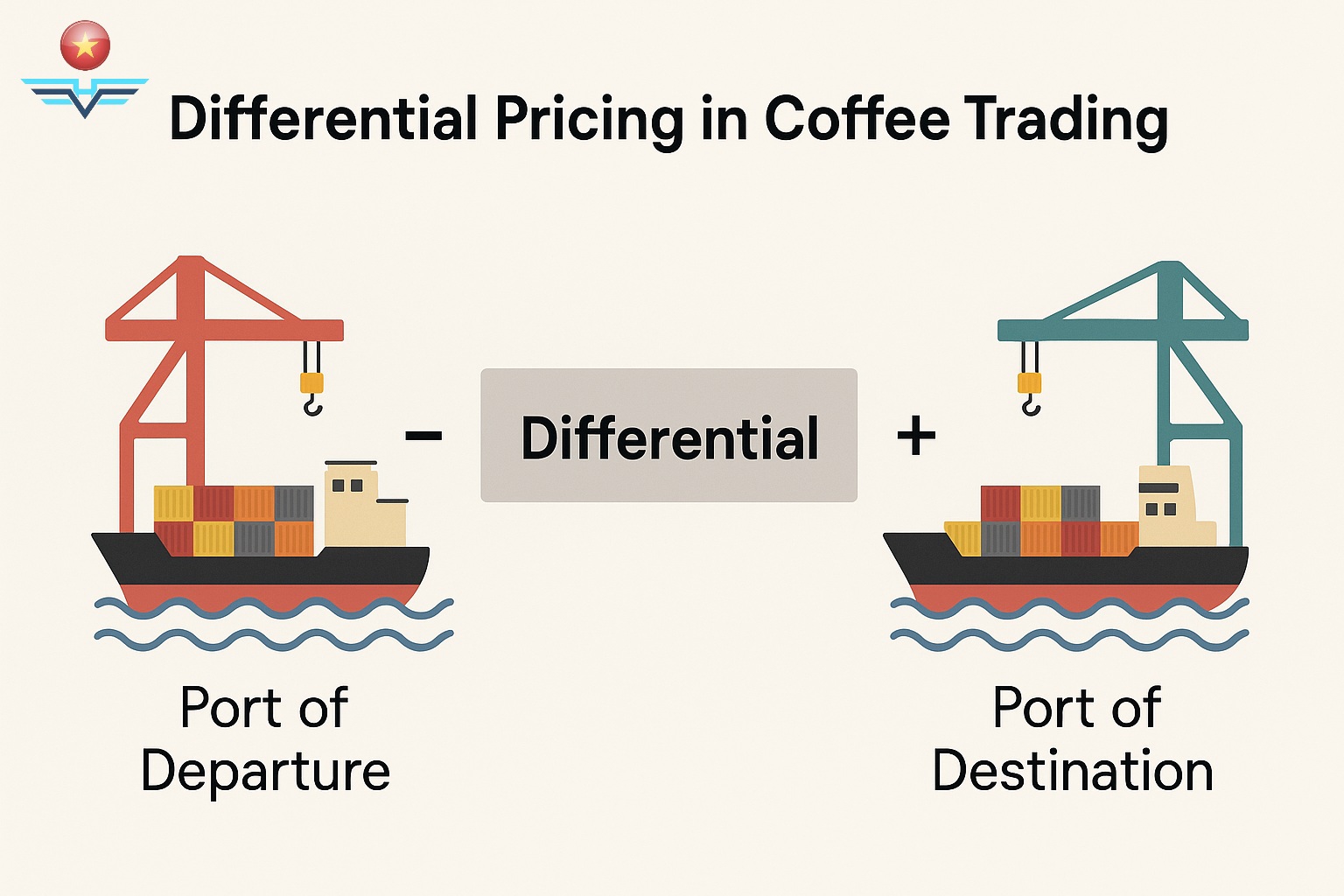
When discussing differentials in coffee trading, we must first clarify that the global coffee price we see on electronic boards (such as on Giacaphe.com) refers to the price of coffee delivered at the port of destination.
Understanding Differential Pricing
Table of Contents
In theory, when someone says:
“The price of coffee for September delivery at Port A closed yesterday at USD 1,730,”
—this means that if the buyer only requests delivery at the seller’s port (commonly referred to as FOB Ho Chi Minh City or FOB Hai Phong), the buyer must naturally deduct certain costs (such as freight and insurance).
Over time, however, this deduction—known as the differential—has come to reflect not only logistics costs but also differences in quality, origin reputation, and brand reliability between countries. Thus, when we say “London coffee for September is USD 1,730/ton,” that’s actually shorthand. In the trade, everyone implicitly understands that this refers to a standard quality grade — typically R2, with 1% impurities, 5% black or broken beans, 13% moisture, and 90% above screen 13 (5mm) — a grade that Vietnam could historically produce.
If another country produces coffee of higher quality during the same period, their differential would naturally be smaller (less negative).
Today, thanks to advances in processing technology, Vietnamese exporters have achieved far better quality standards. As a result, some shipments are even sold at “London plus” — meaning the London futures price plus a premium — instead of at a discount.
Gone are the days when foreign buyers exploited conditions: asking for “8% black/broken” in dry years (to deduct more) or “5% black/broken” in wet years. Those tricks are now well exposed.
How Differential-Based Sales Work?
Let’s say, in July, I agree to sell 10 tons of coffee to a buyer at London September price minus USD 100.
This means that from now until the First Notice Day (FND) of the September contract (around October 2), I can choose any day I wish to fix the price — even immediately after signing the contract.
Hence, selling with a differential isn’t inherently risky or wrong. The real risks lie elsewhere.
The True Issues Behind Differential Trading
-
Vietnamese exporters don’t control the differential.
It is almost always set by the buyer, whether they’re in Europe or the Americas. Strangely, these buyers can coordinate and maintain a consistent differential at any given time — something Vietnamese sellers have never managed to do collectively. -
By selling on differential terms, we allow buyers to know exactly how much coffee we’ve sold but not yet priced, effectively revealing our entire position. Thus, they can patiently wait for favorable timing, while we sit exposed to market fluctuations. Buyers only raise bids when extreme events (like a volcanic eruption in Brazil) threaten supply.
Meanwhile, in Vietnam, we lack any reliable statistics on how much of our coffee has been sold on differential contracts and at what levels. If that data existed, traders could strategize much more effectively.
-
Because buyers already know the supply in their hands, it becomes harder to fix prices later. The queue of sellers waiting to fix is long, and anxiety over falling prices leads them to cut their offers. The result? A cascade — prices slide downhill, and even those who once sold at “London plus” lose money.
Why Do Vietnamese Exporters Keep Selling on Differential Terms?
There’s nothing inherently wrong with differential sales — if there were a macro-level mechanism to coordinate a national trading strategy. The real issue lies elsewhere:
-
Many Vietnamese coffee exporters face financial fragility.
Foreign traders are well aware of this. Often, local coffee prices exceed global prices. In such times, selling — whether at fixed or differential prices — almost guarantees a loss. -
Yet, exporters must sell to obtain contracts, which serve as collateral for bank loans.
Ironically, that borrowed money is often not used to buy coffee, but to roll over existing bank debts. -
In these situations, they cannot sell at fixed prices, so they resort to differential sales to keep the hope alive that prices might rise before they fix.
In essence, Vietnamese exporters still lack the financial independence to decide when to sell or when to wait.