
Because of differences in the physical and biological properties of green coffee beans compared with parchment coffee, green beans are more prone to deterioration. Once the protective parchment and silverskin are removed, the beans are directly exposed to the environment, so storage conditions and quality control must be stricter than for parchment coffee.
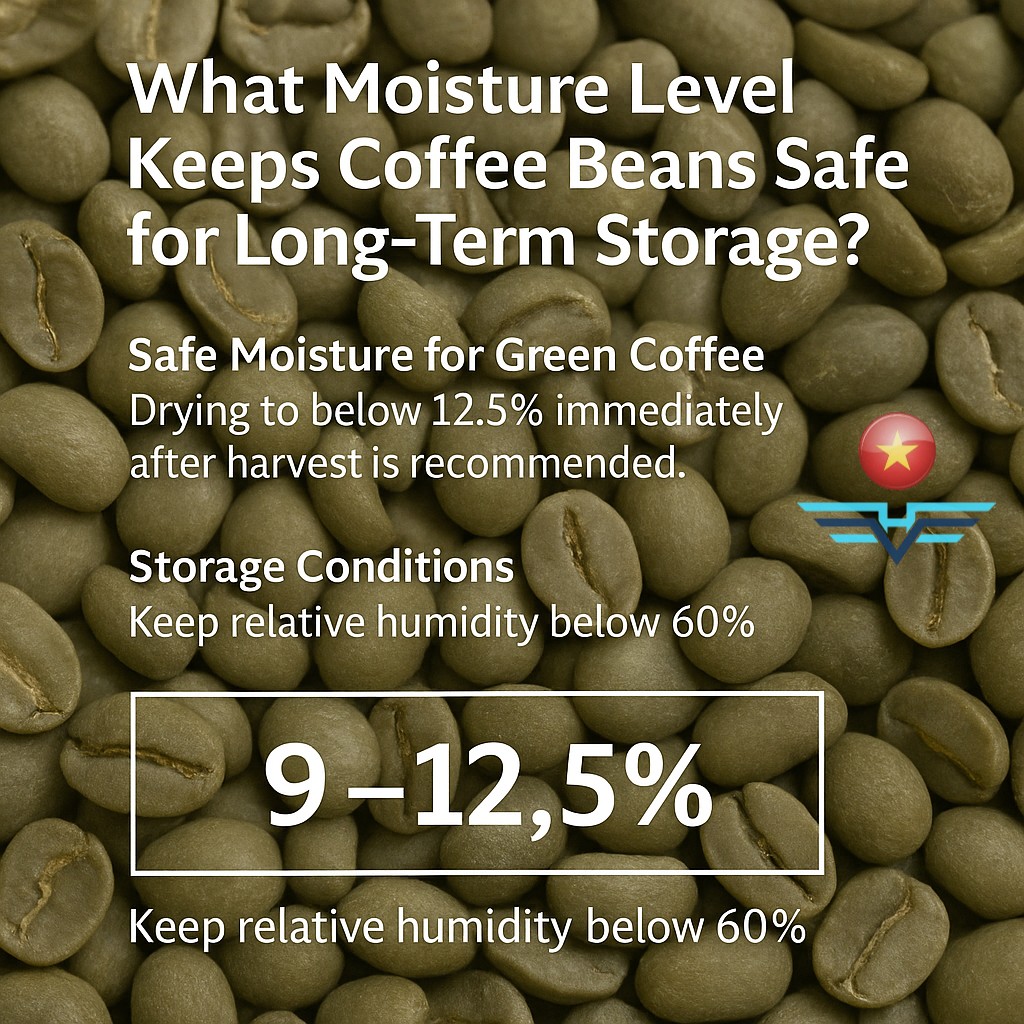
Safe Moisture for Green Coffee
Green coffee with moisture above the basic standard of 12.5 % can quickly lose quality due to bacteria, fungi, or mold. In severe cases the beans may become completely “dead,” and even partial damage from enzymatic activity will negatively affect the cup quality.
Therefore, parchment coffee must be dried to below 12.5 % moisture immediately after harvest.
When the surrounding air humidity is about 70 %, the beans naturally stabilize at around 12.5 % moisture. For this reason, exporters typically dry green coffee to 9 – 12.5 % (±0.35 %), which is the industry’s standard buying and selling range.
If green coffee is dried below 9 %, the beans become brittle and can develop undesirable flavors in the cup.
Storage Conditions
Once beans are at the recommended 9 – 12.5 % moisture, they can be stored for up to a year if the warehouse maintains proper humidity and temperature.
A standard warehouse should keep relative humidity below 60 %, and because humidity varies with ambient temperature, regular monitoring is essential.
Coffee stored in its parchment husk offers the best protection during storage.