
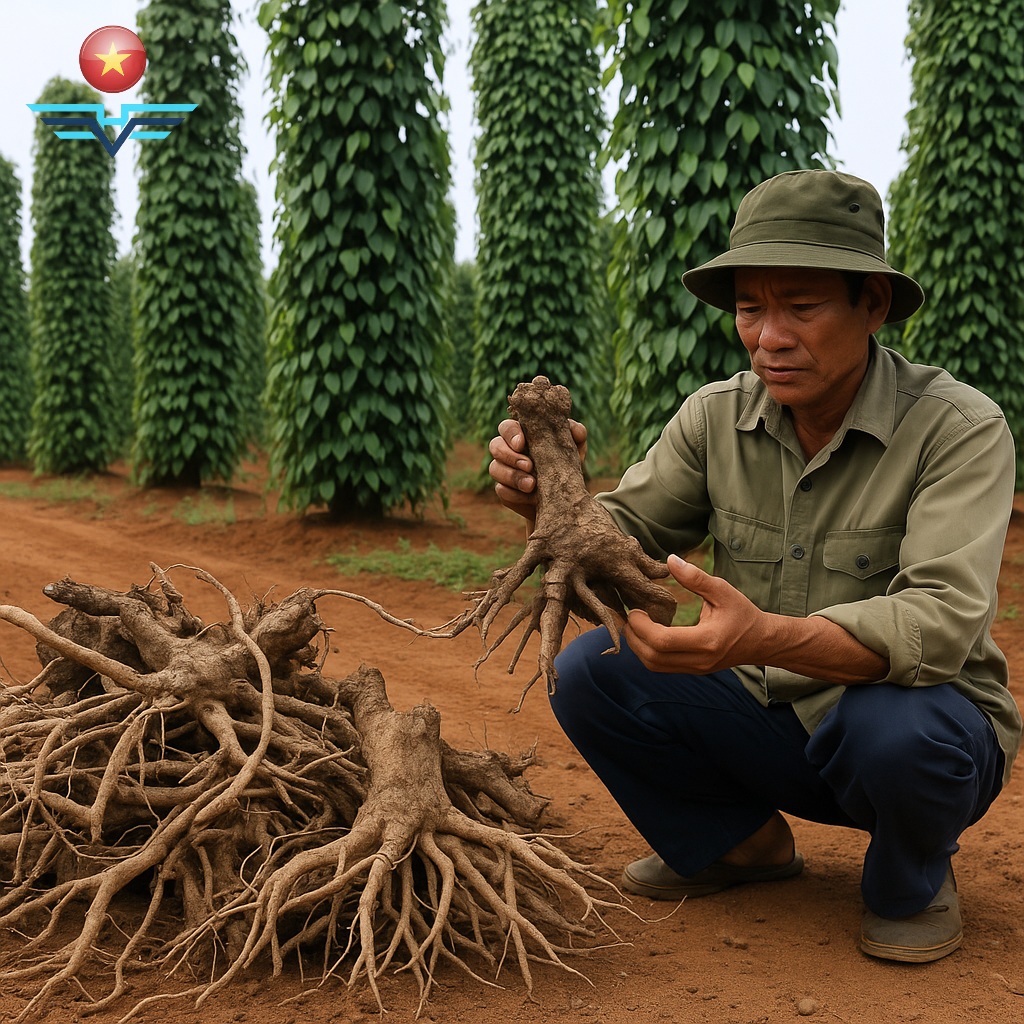
Recently, pepper farmers in Chu Se District, Gia Lai Province have been abuzz with rumors that Chinese traders, working through local middlemen, are scouring the area to buy pepper plant roots and stumps at high prices.
So far, villagers in Hamlet 4, Ia Blang Commune remain puzzled about why these traders want pepper roots. At present there is no widespread collection—only one family has gathered roots and stumps from old, degraded pepper gardens being cleared for replanting. Yet many locals worry that unscrupulous buyers might deliberately raise prices to lure people into cutting down healthy vines. Some fear that less-informed farmers, tempted by quick profit, could even destroy their own pepper fields or resort to stealing roots to sell.
Better Safe Than Sorry
Introduced to Vietnam in the 17th century, pepper has grown into a global giant of agriculture. Although a relatively new export crop for Vietnam, the country has long held the world’s number one position, exporting to more than 80 countries and territories and accounting for over 50% of global pepper trade.
According to the Ministry of Agriculture and Rural Development, in 2012 Vietnam exported 118,000 tons of pepper worth USD 802 million—down 4.3% in volume but up 9.6% in value compared with 2011. The largest import markets remain the United States (14.7%), Germany (10.1%), and the United Arab Emirates (8.48%).
Experts note that with such high value—typically 5–7 tons of pepper per hectare per year, worth 600 million to 1 billion VND—farmers would be foolish to cut down their vines just to sell roots, which fetch far less. Yet precisely because of this great value and potential, some suspect pepper could become a target for hostile economic tactics by neighboring competitors. Before widespread root-buying occurs, authorities must quickly inform and advise farmers to prevent malicious actors from sabotaging production.
Unanswered “Why?”
Why do these traders want such odd goods?
Years ago, Chinese traders in Vietnam’s rural markets offered exorbitant prices for water buffalo hooves—sometimes paying more for the four hooves than for the entire buffalo. Vietnamese farmers, and even cattle thieves, rushed to cut off the hooves and sell them, still profiting from selling the carcass for meat. In a short time, the draught power of poor farmers was decimated. Soon after, Chinese “buffalo dealers” crossed the border to sell more buffalo—some even marketing “iron buffalo” (tractors). Only then did locals realize the purpose of the hoof-buying frenzy.
Likewise, in the mid-1990s, Chinese merchants once bought cats, pythons, and snakes in unlimited quantities. After these animals were removed, harvests across many regions were devastated by rat infestations. Yet to this day, no Vietnamese state agency has ever answered why these traders sought cats so aggressively back then.
Nor have authorities explained later waves of mysterious buying: ironwood cutting boards, star anise roots, young corn silk, golden apple snails, scrap copper, fiber-optic cables, redwood (sua), leeches, and more recently buffalo dung, lychee leaves, cashew leaves…
On February 18, 1998, the Prime Minister was forced to issue Directive 09 outlining urgent measures to control rats and protect crops during a nearly five-year rat plague. The directive, signed by Deputy Prime Minister Nguyen Cong Tan, demanded strict punishment for hunting predators of rats for export or food—especially the theft and trade of cats across the border.
Today, it may again be time for similarly strong directives to stop the mysterious purchases by Chinese traders. If not, after star anise roots, lychee leaves, and cashew leaves, Vietnamese coffee roots—or even rice seedlings—could be next on the list.
Boxed Comment
“In today’s sensitive context, trade goods may have aims beyond normal commerce, sometimes even political motives. State management agencies—especially in import-export, market supervision, and customs—must exercise great caution. For any violations, responsibilities must be clearly investigated. Authorities must act to cleanse the market and prevent dark schemes.”
— Le Nhu Tien, Deputy Chairman of the National Assembly’s Committee for Culture, Education, Youth and Children