
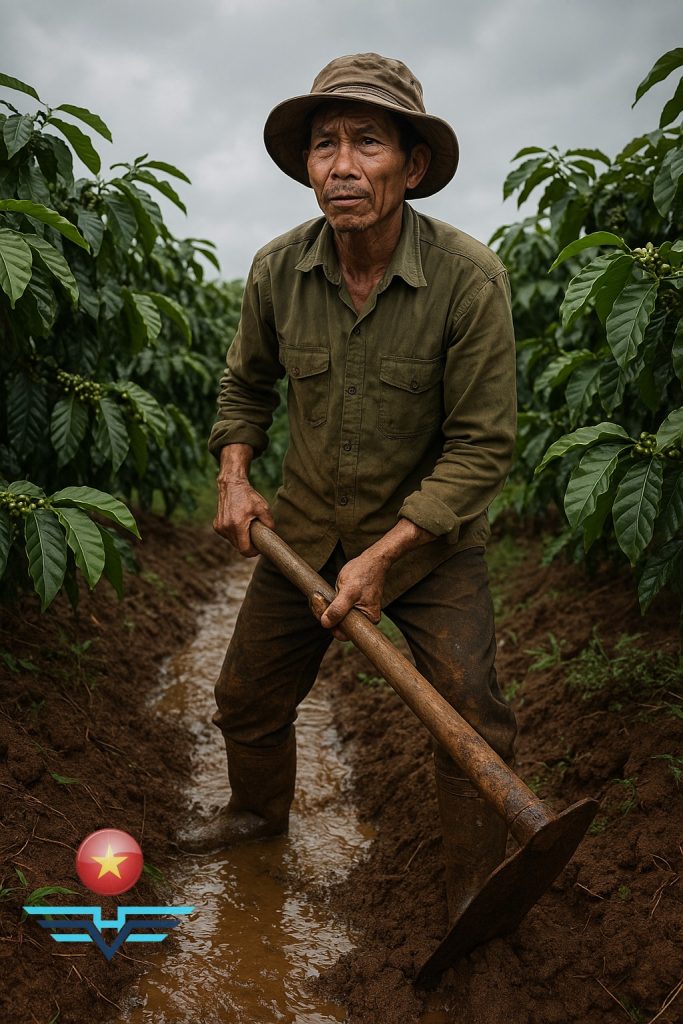
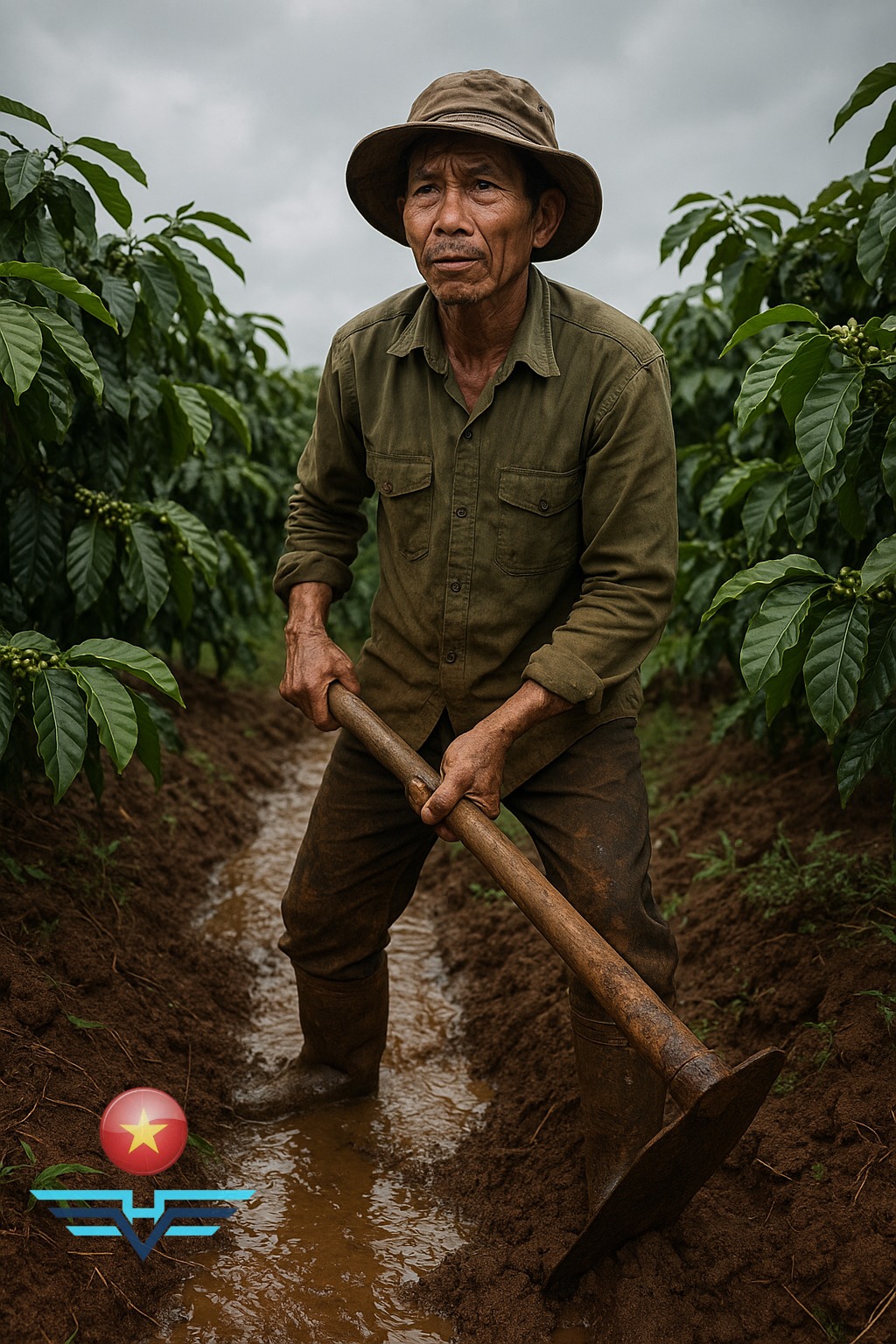
It is the rainy season in the Central Highlands. Taking advantage of the rain, farmers head out with hoes to build basins and dig channels to guide every drop of rainwater into their coffee and corn fields. Watching them struggle to trap and save the rain shows just how precious water is here.
Waiting for the Rain
The fertile coffee belt stretches some 30 kilometers along National Highway 26 and widens 15–20 kilometers toward Buôn Hồ in the west and Krông Bông in the south—one of Đắk Lắk’s premier coffee regions.
Many farmers can only fertilize their coffee after the rains, because irrigation is beyond their control. Trần Văn Minh, 86, from Hamlet 6, Hòa An Commune, Krông Păc District, explained that the best plots—fertile land with reliable water—are already in the hands of state farms and companies. Most local residents cultivate marginal lands. “Because we don’t have reliable water, I only tend my three sào (about 0.3 ha) of paddy fields in the valley,” Minh said.
Nguyễn Thị Phi, 52, of Hamlet 2, Ea Knuec Commune, said her family sold all their land near the lowland ponds to buy seven sào of land near a stream deep in the Tân Hòa forest to plant coffee. Lê Thanh Dũng, 68, from Phước Lộc 2 Hamlet, Ea Phê Commune, has staked his life on coffee even though lack of irrigation has limited his yields to only 1.2 tons of coffee beans per hectare (where proper watering can yield 2.5–4 tons). He mortgaged three land-use certificates to borrow 40 million VND and drill two wells, hoping his 1.3 hectares of coffee will no longer suffer from “thirst.”
Here, having water means having a livelihood. Cooperatives with lowland plots have built reservoirs and charge neighboring coffee gardens 200,000 VND per hectare per year for three irrigation cycles. Large and small reservoirs—such as Hồ 31, Giếng Xối, “1-4,” “1-5,” Furo, and Phước Mỹ—charge even their own employees 600,000 VND per hectare per year. Drop a pump into the reservoir and you must pay, with fees recorded the moment the engine starts.
Poor families near these reservoirs sometimes sneak water. Some report only one or two irrigation cycles instead of three; others piggyback on a neighbor’s pumping session to avoid fees. Landholdings here are long established: most farmers have only 1–2 hectares of coffee. Larger plots belong to traders or merchant families. Young people mostly leave to work elsewhere—Ho Chi Minh City, Bình Dương, Đồng Nai—returning home only for Tết, said Doãn Tâm of Ea Kênh Commune.
Clinging to the Land
Doãn Tâm manages 1.1 hectares of coffee under contract with a state coffee company. After turning over the required quota, he keeps only 5 quintals (500 kg) of beans—about 17.5 million VND in revenue if sold at 35,000 VND/kg. After a year of hard labor, 300–500 hired workdays, and expenses for fertilizer and irrigation, he calculates his net return is like earning a daily wage of about 40,000 VND.
For the past two years his wife has taken odd jobs—weeding, pruning, picking coffee for others—while Tâm himself works as a mason. More than half the year they live on wage labor, tending their small plot only part-time.
Highlanders complain that lowlanders hear “coffee prices are 35,000–38,000 VND/kg” and assume coffee farmers are getting rich. But that’s a misunderstanding. Shopkeepers note that farmers once bought beer by the case; now they cannot. “We don’t have money to buy fertilizer to feed the coffee—how can we spend lavishly or boast of being coffee farmers?” said Nguyễn Cao Thiện, 57, former chairman of the Phước An Farmers’ Association.
Thiện explains that when coffee sold for 35,000–38,000 VND/kg fifteen years ago, rice cost 3,000–5,000 VND/kg, pork 25,000–30,000 VND/kg, diesel 4,500–5,000 VND/liter, and NPK fertilizer 1,500 VND/kg. Today, while coffee prices are similar, the prices of rice, pork, and diesel have more than doubled. Coffee trees still require the same amount of fertilizer; the dry season still demands irrigation; families still need three meals a day. “Coffee prices can’t keep up with food and farm input costs!” argued Phạm Văn Tuyển, 25, from Thắng Lợi Coffee Farm, Hòa Thắng Commune, Buôn Ma Thuột. His wish: that food, fertilizer, and pesticide prices would fall—and at least that coffee prices don’t drop further. “If coffee prices go lower, farmers will be finished.”
Farmers note that 1.2 million VND once bought three 50-kg bags of NPK fertilizer; now it buys only one bag (a hectare requires about 40 bags). Many farmers now make their own fertilizer, cutting purchases of potassium, urea, and NPK. Instead of taking freshly harvested cherries to agents for hulling, they process them at home to use the husks as fertilizer. Every household has become a mini bio-organic fertilizer workshop. Thiện even collects dry coffee leaves, straw, corn cobs, and bean pods, chops them, mixes with lime, and composts for months.
“I’ve cut my fertilizer costs by half with homemade compost to keep the farm profitable,” Thiện said. Like him, many highland farmers no longer stake their family’s future solely on coffee. They diversify—raising chickens, pigs, rabbits, cattle, and planting vegetables, beans, melons, and corn. Those lucky enough to have small, once-neglected swampy rice fields now treasure them: clearing weeds and irrigating to plant rice, so they won’t have to buy as much rice. “It’s tough, but we have to cling to the land—otherwise, what else can we hold on to?” Thiện said.