
A recent survey of Robusta coffee plantations in Đắk Lắk Province revealed that only 30% of farms meet “Grade A” standards. Within each hectare, about 30–35% of trees produce very low yields and should ideally be replaced.
Traditionally, growers cut down unproductive trees and replant, but this method is costly and inefficient:
-
It takes around three years before replanted trees bear fruit.
-
Young plants are prone to root rot, stunted growth, or even death.
The Bud-Grafting Breakthrough
Table of Contents
Developed by the Central Highlands Agricultural Science Institute
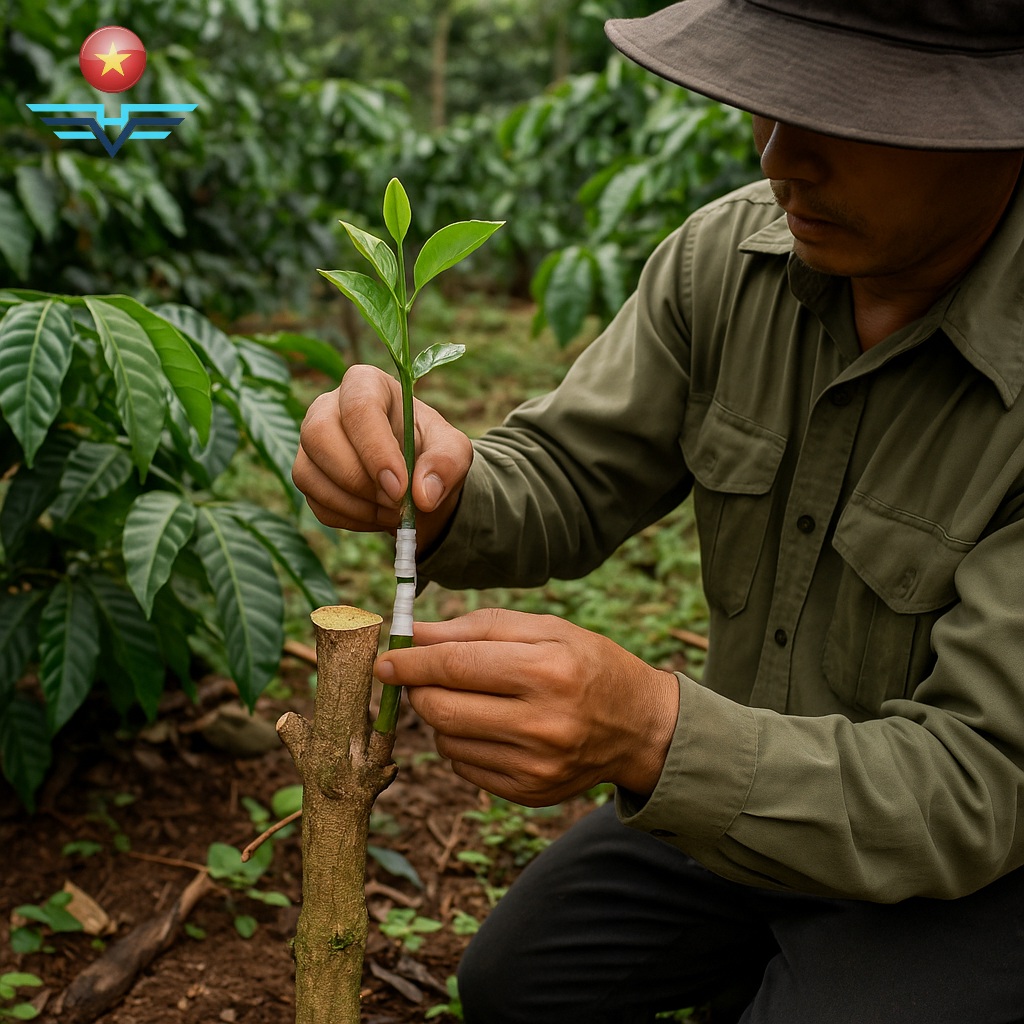
To overcome these challenges, the Tây Nguyên (Central Highlands) Agricultural Science Institute introduced a bud-grafting technique to rejuvenate low-yield Robusta trees.
How It Works
-
Select elite “mother” coffee trees as scion sources.
-
Survey and mark trees in need of improvement.
-
Establish nurseries for grafted plants and scion shoots.
-
Cut old stems and graft high-yielding, high-quality Robusta varieties onto the existing rootstock.
Rapid Results and Superior Growth
Impressive Early Performance
-
After one year, about 80% of grafted trees reached the desired topping height of 1.2 m.
-
By the second year, they were already bearing fruit.
Growth Comparison
Compared with seed-grown trees planted at the same time, grafted coffee plants showed:
-
30–50% greater growth in height, number of branch pairs, and trunk diameter.
-
Stronger resistance to coffee leaf rust.
-
Bean size 20–60% larger than older seed-grown varieties.
Economic and Environmental Benefits
Higher Yields and Better Quality
-
Average yield increase: about 0.5 tons of green coffee per hectare per year.
-
Higher proportion of top-grade (Grade A) beans, boosting production without expanding cultivated area.
Reduced Pesticide Use
Stronger rust resistance means less need for chemical pesticides, lowering production costs and supporting sustainable farming practices.
The bud-grafting technique offers coffee farmers in Đắk Lắk, Gia Lai, and Lâm Đồng a simple, effective, and high-return method to rejuvenate old, low-yield Robusta trees. By adopting this innovative practice, farmers can increase yields, improve bean quality, and protect the environment, ensuring a more profitable and sustainable coffee industry in Vietnam’s Central Highlands.