
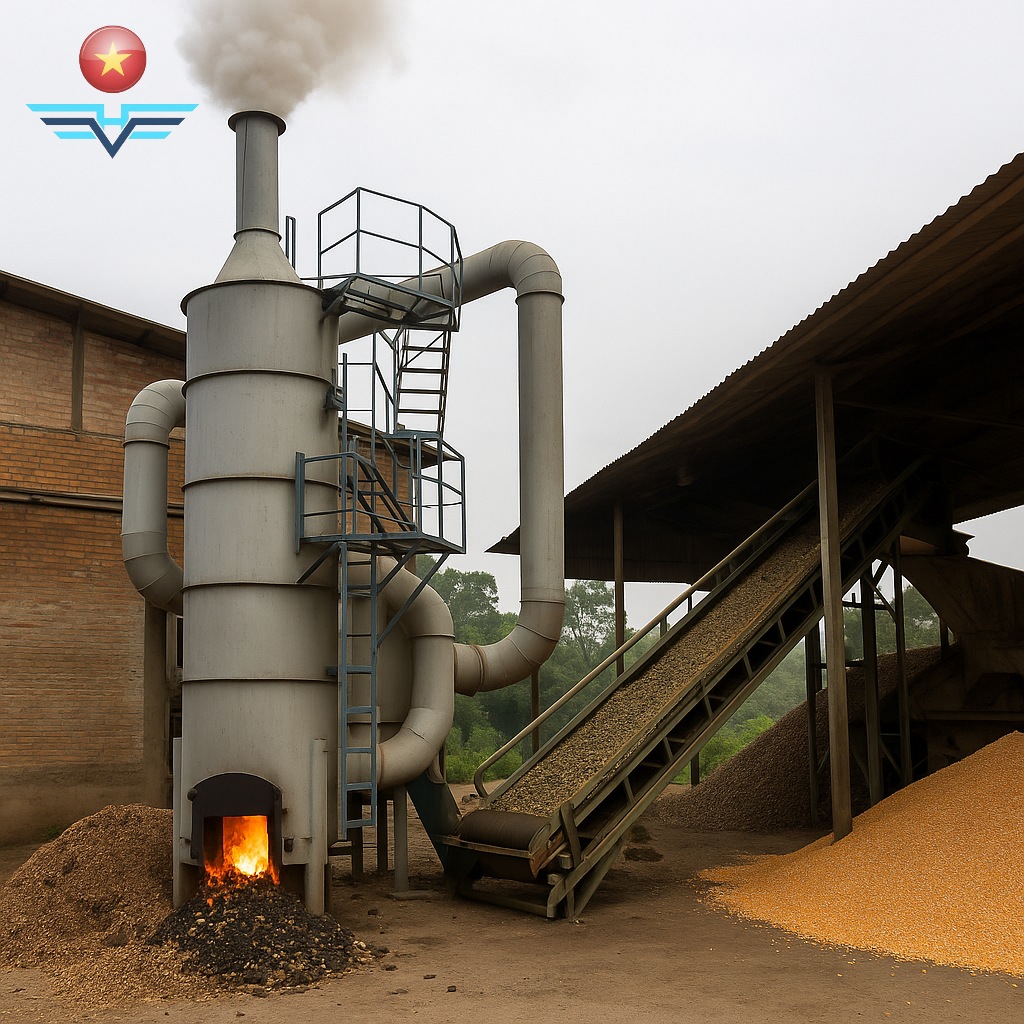
At Son La Coffee Company, a fluidized-bed combustion technology that burns biomass waste—such as rice husks, sawdust, and wood scraps—has generated 700–800 kWt/h of heat, partially replacing coal for drying coffee and corn and delivering major economic benefits.
Turning Biomass Waste into Energy
This model, successfully tested by the Institute of Agricultural Engineering and Post-Harvest Technology, demonstrates a new, environmentally friendly energy source.
While rural electricity access in Vietnam has expanded—nearly 100% of communes, 85–99% of villages, and 94–98% of households now have electricity—only about 7% of total electricity goes to agricultural processing and drying.
Meanwhile, biomass residues—rice husks, coffee husks, sawdust, wood scraps—are abundant yet underused. Every year, Vietnam’s agro-forestry processing industry produces an estimated 8–11 million tons of biomass waste.
Producing 1 kWh of electricity from this material requires 3–4 kg of biomass, meaning the country could theoretically generate 3.8–4 billion kWh of electricity and 11–12 million kWt of heat annually.
Economically, 2–4 kg of biomass waste can produce the same heat as 1 kg of anthracite coal, but costs only 5–10% as much, creating huge savings.
High-Performance Fluidized-Bed Drying
In Vietnam, fluidized-bed drying technology uses biomass waste—husks, coffee shells, sawdust—to produce both heat and electricity:
-
For combined heat and power: consumes 600–700 kg biomass per hour, generates 50 kW electricity, and dries 20–25 tons of paddy rice per batch.
-
For drying only: consumes 50–70 kg biomass per hour, drying 6–7 tons of agricultural grain per batch, reducing moisture from 30% to 14%.
The ash byproduct can be used in building materials (bricks, cement) or as fertilizer.
At Son La Coffee Company, this system has replaced part of the coal normally used for drying coffee and maize, delivering both economic gains and farmer acceptance.
Challenges to Wider Adoption
Despite its clear economic and environmental benefits, scaling up this technology faces obstacles:
-
Seasonal feedstock supply: Biomass waste is abundant but fluctuates by harvest season; ensuring a stable year-round fuel source is critical.
-
High initial investment: Like most renewable energy systems, the cost of installing biomass-fired heat and power systems is high, limiting adoption by small businesses.
According to Professor and Doctor of Science Pham Van Lang of the Institute of Agricultural Engineering and Post-Harvest Technology, the government should introduce supportive policies to encourage the use of renewable energy from biomass waste. Such measures would both advance agricultural development and improve community livelihoods.