
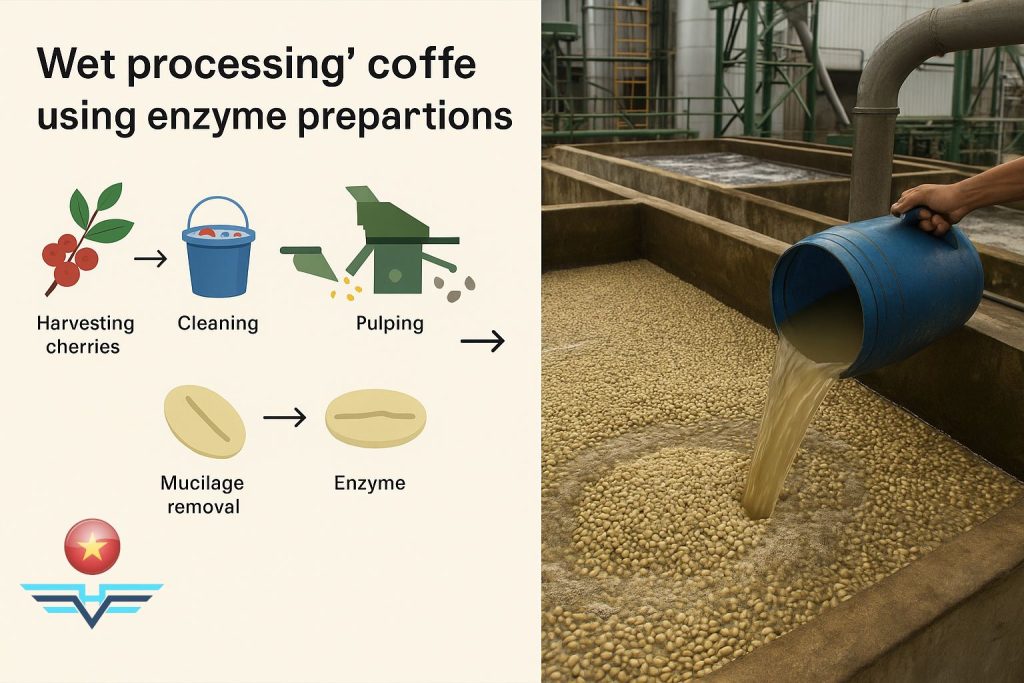
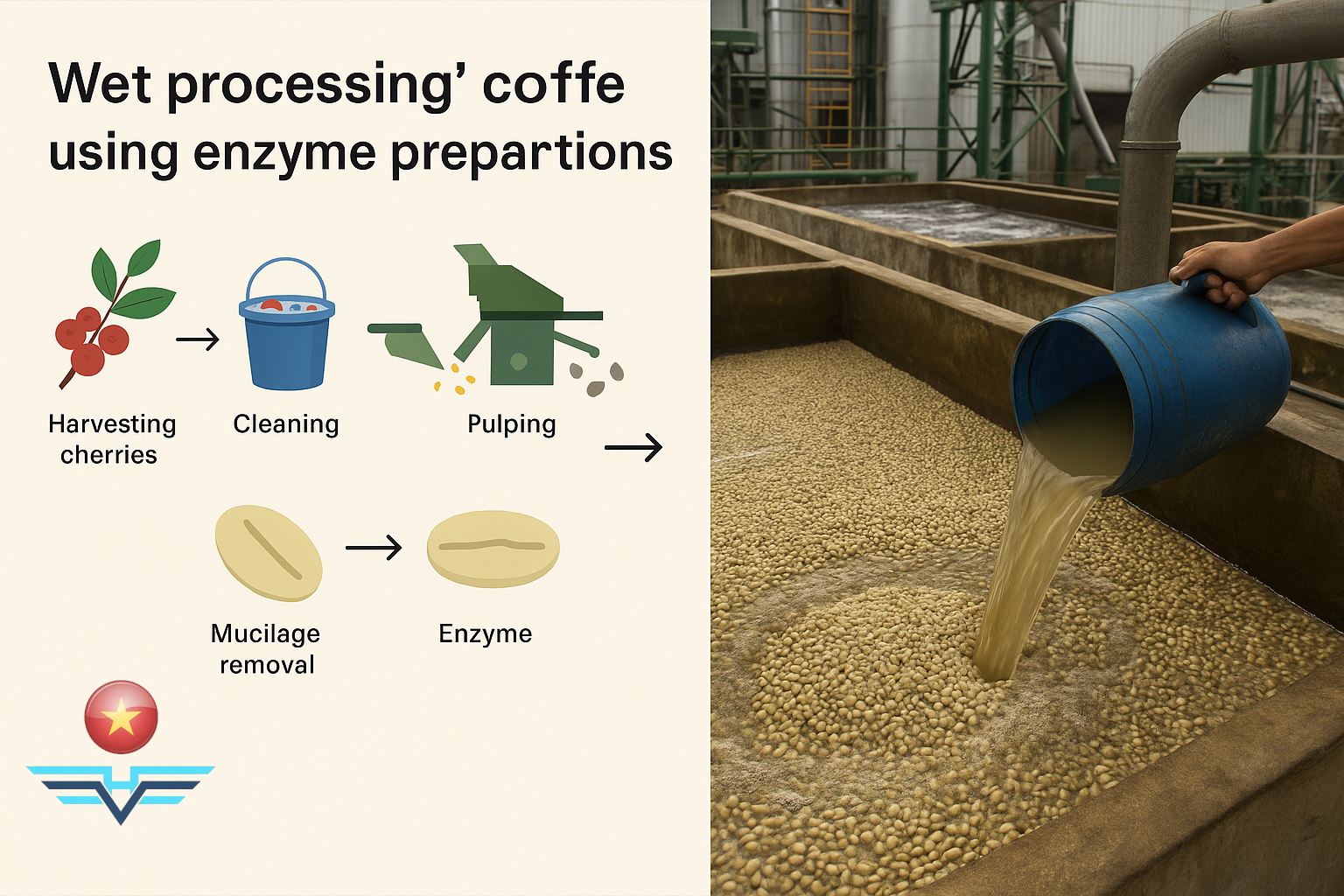
To improve the efficiency of wet coffee processing technology, while ensuring food safety, reducing costs, and limiting environmental pollution, the Tay Nguyen Institute of Agricultural and Forestry Science and Technology (IAFST) recommends that coffee farmers and coffee-processing businesses in the Central Highlands adopt the use of enzyme preparations.
The Wet Processing Method
Table of Contents
The wet processing of coffee typically involves five stages:
-
Harvesting cherries,
-
Cleaning,
-
Sorting,
-
Pulping (removing the outer fruit skin to obtain the parchment coffee, which at this stage is still covered with mucilage), and
-
Mucilage removal (eliminating the sticky mucilage layer surrounding the parchment).
After these steps, the coffee parchment is dried to produce green coffee beans.
Removing the mucilage layer is a critical step in coffee processing to prevent the beans from developing mold.
Traditionally, coffee farmers and businesses have used two methods to remove the mucilage:
-
Natural fermentation, and
-
Mechanical demucilaging.
However, both methods are costly and often result in faster deterioration of coffee bean quality.
Benefits of Enzyme Preparations
Research by the Tay Nguyen IAFST shows that using enzyme preparations in coffee processing ensures food safety and yields much higher economic efficiency compared to the traditional methods of natural fermentation and mechanical demucilaging.
Process:
-
After pulping, the parchment coffee is placed into fermentation tanks, and water is added to fully submerge the beans.
-
Enzyme preparations are thoroughly mixed into the tank.
-
The beans are then left to ferment for at least two hours, after which they only need a simple rinse before drying.
The amount of enzyme depends on the required processing time and the quantity of coffee:
-
For 2 hours of fermentation (allowing the parchment to be dried the same day), use 120–150 grams of enzyme per ton of wet parchment coffee.
-
For 10–12 hours of fermentation (overnight), use only 50–60 grams per ton of wet parchment coffee (Robusta).
Key Advantages
Practical applications show that using enzyme preparations:
-
Reduces mucilage breakdown time (after 2 hours, 90–95% of the mucilage is decomposed, whereas natural fermentation shows almost no decomposition),
-
Decreases the need for clean water,
-
Lowers electricity and labor costs,
-
Improves bean quality, and
-
Leaves no chemical residues in the final product.
Understanding Enzymes
According to the institute, enzymes are not chemicals but biological catalysts, naturally present in living cells. They are proteins that catalyze specific chemical reactions extremely quickly.
Today, food-grade enzyme preparations are mostly extracted from microorganisms.
Coffee Production in the Central Highlands
The Central Highlands region currently has over 551,670 hectares of coffee.
Each harvest season, millions of tons of fresh coffee cherries are wet-processed to produce over 1.2 million tons of high-quality green coffee beans, ensuring strong performance for export markets.